A Destruction Test Knife WIP

I've heard of various ways folks have gone about preparing a blade for this test.

  • Full blade quench & temper then
    drawing back the spine with OA torch, or...
    drawing back the spine with heat-sink tongs​
    .
  • Partial quench of blade edge & full blade temper
    .
  • Full quench of clay backed blade & full temper
    .
  • Various combinations of the above
 
Very interesting results and sad to see the knife smashed.

This is very interesting.

pa140117.jpg


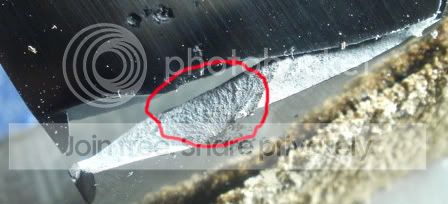
The grain looks quite large in this area but not either side of it and it seems to have a radial pattern from the scale pitting. I wonder what happened there.

That was my question. There seems to be some sort of defect there, but what the cause is may be hard to determine. I am very curious about the hardness changes along that area
 
I spoke to Blue on the phone after he posted the video. (I couldn't resist listening to him snif and wimper.) One of the things we discussed was the possibility of a forging defect. Perhaps getting a few last swings in out of forging range? Also the fact that the pitting happens to occur at the widest cross-section. The fracturing radiates out from those pits. This is my dummed down explanation but... When steel is pushed to its limit of elasticity it desparately wants to rip apart and seeks the weakest point to separate. The surface pitting acted like the perforation on a roll of toilet paper..... hmmmm.... let me rephrase that..... the scores on an x-acto blade. The knife snapped exactly where it was made to. Be thankful you didn't put a sawback on that baby, Blue!

Rick
 
I've heard of various ways folks have gone about preparing a blade for this test.

  • Full blade quench & temper then
    drawing back the spine with heat-sink tongs​

What are heat-sink tongs? I just did a forum search, and there are a couple of mentions, but no picture/description. Heavy steel plates welded to the ends of tongs that you heat-up and use to draw the spine?

I'm morbidly curious -- has anyone passed the Journeyman test with a clay-backed quench? The hamon is under immense tension, and I would imagine it wouldn't like an off-axis bending moment...
 
What are heat-sink tongs? I just did a forum search, and there are a couple of mentions, but no picture/description. Heavy steel plates welded to the ends of tongs that you heat-up and use to draw the spine?
I heard about it from Nick Wheeler. Here's a link to a thread discussing it, http://www.bladeforums.com/forums/showthread.php/750544-Temper-tongs.

I'm morbidly curious -- has anyone passed the Journeyman test with a clay-backed quench? The hamon is under immense tension, and I would imagine it wouldn't like an off-axis bending moment...
I don't know if anyone has done the performance test with a clay backed heat-treated blade. I read Kevin Cashen's suggestions about it in a thread or two though.
Here's an interesting thread discussing knives for the bend test.

Oh, and here's one from Kevin's site on heat treating 1084 steel.
 
And the next generation takes shape. :):)

Here are four new blades - the bottom two are hardened 1095(the bottom one is sanded to 1000). The larger one is just-heat treated 1084, and is the replacement for the destruction test knife. The just forged blade is of an old harrow rake from our farm.

I go to CBU tomorrow to have the smashed blade tested. I'll post the results here later.

 
I'll be the first to admit I'm clueless about forging... but you almost certainly knew that already.

Still, it occurs to me to wonder why you would introduce variables such as the composition of the steel (e.g. the harrow rake blade) into an already challenging assignment.

On the first test you saw uneven grain patterns at the point of failure. Did you definitively determine (in your conversation with Rick or otherwise) what caused the failure? What steps are being taken to either verify that determination or prevent the problems in the next test? Does the harrow rake fit into the equation somehow? :)

- Greg
 
Greg - Thanks for your comments.
Still, it occurs to me to wonder why you would introduce variables such as the composition of the steel (e.g. the harrow rake blade) into an already challenging assignment.
The simple answer is: Because I have some and I want to see how it fares. I have about 60 of these harrow rakes and I'd like to be able to use them. I have a piece of one at Cape Breton University Metallurgy Lab right now being analyzed to determine the steel type so I can more properly heat treat. At this point I'm still learning about the entire process, including forging a blade to shape. This blade is really just an exploration and I don't intend on making a "real" knife with it. I just want to practice and learn.

Did you definitively determine (in your conversation with Rick or otherwise) what caused the failure?

Not definitively...... yet. The consensus from Rick et al seems to be micro-cracks originating from forge marks left on the blade surface, coupled with less than perfect heat treat. Hopefully tomorrow's CBU Lab visit will tell me more.
 
Back
Top