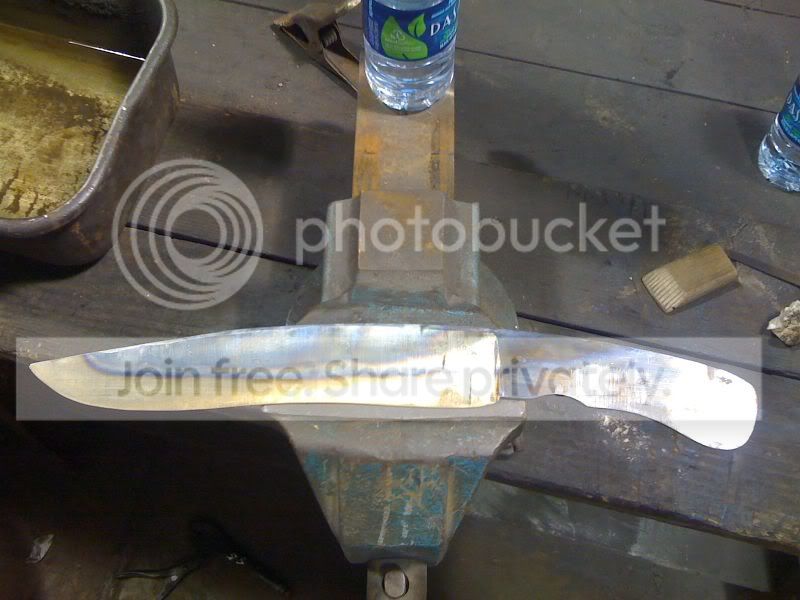
A Destruction Test Knife WIP

A rather blank stare I imagine. I had a feeling it would fail this part of the test..... just when was the question I had.
I was pretty confident in all other parts of the test.

I can tell you, there's technique involved with this test. Its a test of the blade and the user. I can obviously use some practice cutting hanging rope... my aim sucks. I could likely benefit from some chopping practice as well!!

My wife wonders if anything would have been different had I clamped the blade a bit closer to center-blade in the vice. I don't think so, but......??

So, with apologies to J. Brouse, I guess I have turned the knife making world "upside down" with my new-fangled heat treat method!! :p
 
Last edited:
[video=youtube;BTh5A2wcmuI]http://www.youtube.com/watch?v=BTh5A2wcmuI[/video]

Way to wack that 2x4!..... still watching video and making sheathes... I will be a smart-ass later.


Rick
 
Some thoughts...
First, what was your normalizing process. I couldnt' find it in the post.

Second, in this picture of drawing back the spine, you got it to blue. That might not be hot enough for 1084 since 425 degrees will produce blue/purple on polished 1084. The best guess is that you didn't draw it back nearly enough
p9200039.jpg
 
jawilder - Pre-heat treat normalizing/stress relief was:
Heat slowly to 1500, soak for 2-3 min, remove from forge and cool to room temp.... x 2.

That might not be hot enough for 1084 since 425 degrees will produce blue/purple on polished 1084. The best guess is that you didn't draw it back nearly enough
You are now the second person to mention this.
 
I wonder what would happen to the blade, and where on it, if you clamped it again right above the break and gave it another flex/bend test? Would the results be consistent with the first break or different?
 
...picture of drawing back the spine, you got it to blue. That might not be hot enough for 1084 since 425 degrees will produce blue/purple on polished 1084. The best guess is that you didn't draw it back nearly enough.

Interestingly though, the edge, which was not drawn back, did not break. What does that show? The spine got harder? The edge was softer? Or more likely, the value of thin edge geometry? I still wonder what would happen, and where, if the remainder of the blade was flexed/bent again?
 
Last edited:
Phil - I'm considering doing just that.

The edge came through just fine. I don't have a microscope but my magnifying visor gives me a pretty good look and I can see no fine chipping or deformation. This morning it sliced paper just fine. So, at least the edge did its intended job.

The break occurred right at the edge of the vice jaws. The jaws are hardwood with eased edges. I wondered if that may have been a stress point. But, I've watched videos of guys clamping their blades directly into steel jaws and bend away. So I'm not convinced.

I'm pretty confident with the integrity around the copper tag, guard/spacer and tang though. That felt pretty solid. We'll see if that changes should I do another bend.
 
Last edited:
I would also flex the remainder out of curiousity, maybe from the widest part of the blade to evenly distribute the stress. Although I am not sure if this is against ABS rules, I don't know if they care where you clamp it. Also, the dimples left from forging could theoretically form a weak point for fractures to occur. Tai mentioned this in one of his videos, though he was specifically talking about the edge of the blade (and scraping the defects further from the edge), but it probably still applies.
 
Last edited:
It was nice to see this project take shape from start to finish. I'm sorry your knife failed the last part of the test, I cringed and felt pretty bad for you when it happened. I hope for your next attempt things go better. Keep up the good work.
 
I just watched the video.

For the love of (place Deity here) sand the blade edge dull before doing a bend test !!!!!!!!!

Besides this, It is clear that the blade failed at the vise jaw, and that the break is from the spine. You normally clamp 1" of the blade in the vise, BTW.

I think the spine was overly hard for this type of test, but was right on for a real knife. Remember that the ABS test isn't for a knife that will be used. For an ABS test, draw the spine to soft pearlite.
The fact that the edge is better than the spine at bending may be the thinness, or that it is a consistant martensitic structure.
 
Quoted from the ABS website.


4. BENDING: THE PURPOSE OF THIS TEST IS TO SHOW THAT THE APPLICANT IS ABLE TO HEAT
TREAT A KNIFE WITH A SOFT BACK AND A HARD EDGE.

The bending of the blade is the final test. Safety gear should be worn. At the discretion of the
applicant or the Master Smith, the edge may be dulled prior to bending. The Master Smith
will mark a line across the width of the blade approximately three (3) inches from the tip of
the blade. The blade will then be inserted into a vise, tip first, such that the blade is placed
into the vise up to the mark on the blade. If the vise jaws are rough, smooth metal inserts
may be located on each side of the clamped portion of the blade to protect the blade,
when bending the test knife. The blade shall be bent by force applied to the handle. A
leverage device, such as a pipe may be used as long as it does not pose a safety risk. The
use of such a device is at the sole risk of the applicant and at the discretion of the
supervising Master Smith. The applicant will then bend the blade ninety (90) degrees. The
supervising Master Smith will signal the applicant when the ninety (90) degree angle has
been reached. The blade is allowed to crack at the edge on bending but not beyond
approximately one third (1/3rd) the width of the blade leaving two thirds (2/3rds) of the blade
intact. However, if any part of the blade chips or any part of the blade or tang breaks off,
the applicant fails. Because of the many variables in the size, geometry, and temper line of
the blade, the Master Smith using his/her judgment, shall determine if the extent or location
of the fracture line is acceptable. The decision of the Master Smith is final.​


Note the clamping at aprx 3" from the tip. That is probably for the standard maximum length performance test blade of 10".
 
Last edited:
I

For the love of (place Deity here) sand the blade edge dull before doing a bend test !!!!!!!!!

Yeahhhhh, I thought of that....... about the very moment it broke.

I think I will break it again(sanded dull first). My vice is to small for this so it will have to wait till I get to Glen's shop again, or possibly at the CBU Metallurgy Lab. I'm getting the blade hardness tested there as well, something I'm particularly interested to see the results of.
 
Overall, I am happy with the performance of the knife. It performed the tasks a knife should be able to perform. The big question I am left with is: Why did it crack on the spine and not on the edge... isn't that the reverse from what is expected?

In my ABS class at Old Washington, 3 of 9 blades failed the bend test, and they all fractured at the spine, just like yours.
Yours broke almost immediately -- maybe 30° bend?

We did triple spine tempers (in water). If you overheat a spot on the spine to get red (a hot spot), that'll leave a hard spot. I also did a 375°F temper for 2 hours before the spine temper (5160).
You really can't over-temper it in water, but it's important that the water level only come up about 1/4", because the water is a tremendous heat sink, and your spine temper will approach ~ half that distance.

By the way, I mentioned earlier: you can save yourself a lot of cuts on the 2x4 if you chop the corners, and keep rotating it.
 
Lazlo - Thanks for the advice.

One issue with the 2x4 chop - I have a week left hand and arm( a nerve thing). Its hard to hold things tight. This was the best alternative set-up in my mind.
 
One issue with the 2x4 chop - I have a week left hand and arm( a nerve thing). Its hard to hold things tight.

Ah, there's a new ABS rule: you can ask a stand-in to do the chopping for you. This was added because of an ABS Journeyman who had a badly fractured right hand.

So I'm going to pay Donovan to do my test for me :D
 
Phil,
Thanks, I don't know why I was remembering 1" as the clamp point. A you pointed out, on a shorter blade it would have to be moved toward the tip.

I would have the blade tested right next to the break area and from edge to spine at 1/4" intervals. That should tell you a lot.
 
I have a question that might be good here. When you draw the spine back, what color are you shooting for? I have heard it is deep blue/purple, but as I mentioned, the 425 temper on a polished 1084 blade gets to that color. So, what color should you be looking for on 1084 if it is already polished?

From my experience, a polished blade will turn different colors than a non polished, as forged/HT'd blade. On a recent knife, my polished area turned blue and the non polished area was still straw color after temper.
 
I have a question that might be good here. When you draw the spine back, what color are you shooting for? I have heard it is deep blue/purple

At the ABS school, we drew the spines of our journeyman test knives to steel blue, which for 5160 is apparently in the high 40/low 50 rockwell range. But I don't think you can really mess this part up: you start with a fully quenched blade, and when you play the torch across the spine, you start pushing rainbow (temper) colors down toward the edge. You basically want to push the rainbow colors down as far as possible. This is with the edge in 1/4" of water -- you'll hit a point where the rainbow colors stop moving (about 1/4 - 1/2" above the water line), and the blade looks like this (posted earlier):

journeymanknife2.jpg
 
As a side note, remember that alloy steels, like 5160, are more resistant to softening than carbon steels. They also oxidize differently when heated. Assuming the blue/425 F value given by jawilder is accurate (and I have no reason to believe it's not), then an alloy steel blade could be very different from what you think it is in terms of hardness if you just go by color. I can't remember if this test blade was carbon or alloy steel, so I'm saying this more as a general statement than specifically in regard to this test knife.

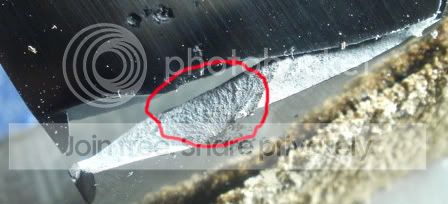
That fracture is exactly like I would expect, starting at the ridges of the harpoon tip. It looks like it started at some hammer/slag marks on the surface as well, though that doesnt necessarily mean anything unless you can see some slag or some other flaw hammered into the bottom of the mark. As long as the hard portion is thin enough, edges can be much harder than most people think. In a bend test, the location of maximum strain (stretch) will be at whatever location is furthest from the center line of the blade. The strain at the center line will be zero. The crack looks like it started at or near the ridge line of the harpoon tip, which would qualify it as the point furthest from the center line in the location of the fracture. You need a very ductile (soft) spine to get the crack to start near the edge and work toward the spine.
 
Very interesting results and sad to see the knife smashed.

This is very interesting.

pa140117.jpg


The grain looks quite large in this area but not either side of it and it seems to have a radial pattern from the scale pitting. I wonder what happened there.
 
Back
Top