
160 pieces of 1 inch! Good for you, Doug. It wouldn't seem so unless someone does the math, but 1 inch rope contains about 1.78 times the material as 3/4 inch rope. 1/2 inch rope doesn't contain 1/2 the material to be cut as does 1 inch rope, it contains about 1/5 the material... and so on. Unless someone has actually tried it, they have no idea how damned hard the rope is to cut EVEN with a sharp knife. That's why on that old video that I've stuck on YouTube I have friends helping cut the 500 pieces of 3/4. And in the old vid I'm using two hands on the blade just like I did when I tested Shiva's blade at my shop. During normal "minimum" testing for 100 cuts I only use one hand and have a cloth wrapped around the blade tang... but I'm used to the strain from having done it for years and years. It'll sure give the hand a workout!Hi Jimmy,
Did some rope cutting Friday.
I know you used 3/4" rope for the Shiva test but my buddy Mark had some 1" that I didn't think you'd mind me using
so I used that w/pine board underneath.
Sliced very, very well. 100 cuts and it didn't really need to be stropped but I did any way w/smooth side of a guitar strap strop (no compound).
Cut 60 more and hand got tired.
Will chop some doug fir 2 X 4 s in the next couple of days.
You emailed me back after I emailed you yesterday and told me to have fun with it and I am.
Hand's a little sore, probably because I haven't done this in a while but this is a blast.
Thanks again,
Doug

Glad you're having some fun with the thing. I don't really consider this blade design much of a "chopper" but it'll gnaw it's way through some lumber well enough. If you want to give the edge what I consider a real workout, lay into the knots in the wood. The grain in a knot is not only hard, it's multidirectional. One area of the edge might be pushed one direction by the grain while the area right next to it is pushed in the opposite direction. If a thin edge is not heat treated just right a chunk of it will be left in the knot pretty frequently.
My old buddy in the video, Hank Reinhardt, once came for a visit with a couple of blades made with what he had decided was the ultimate steel. He'd ground them out convex and the overall design was good, and he'd had them professionally heat treated. The blades did preform fairly well. They made about 70 cuts in the rope before they were completely dead (and that's excellent) and they were flexible enough to suit. They worked well in the bamboo and tree limbs didn't ripple the edges at all. BUT... hacking into the pine knots took chunks out of the edge the size of my pinky fingernail. Old Henri was demoralized. I'm sure that one of these days a steel is going to be formulated that will hold an edge better than straight high-carbon. I just haven't seen it yet.
Blah, blah, blah. I talk too much. Lay into those knots! Then run the edge down your thumbnail to check for nicks. Be sure to wipe any pine residue off the blade before checking since tiny particles of the knot sometimes stick to the blade and feel like nicks. I have a 10X jeweler's loupe I check with also... and then test on phone book paper.
And remember... if the blade chips I'll CLAIM YOU ABUSED IT!!!

Cut some sticks, whittle a bit, slice a tomato, dig a hole in the dirt. It'll still be a knife when you finish.
Old, Risk-Taking, Hopeful Jimmy


 There was a lot of fun that was had with that one, including scaring the crap out of one of what was then one of my teen daughter's "potential" boyfriends when I had it out chopping with it. Poor little fellow actually ended up coming back and became her boyfriend for quite a while. I gave him points for the guts to do so!
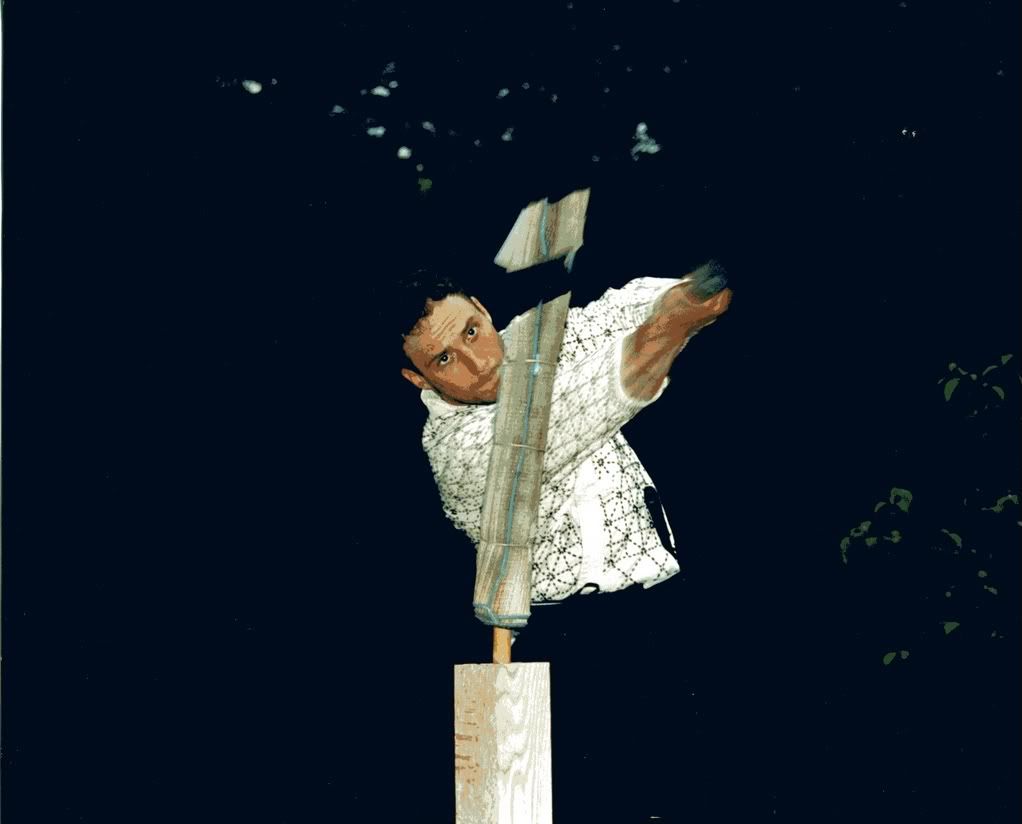

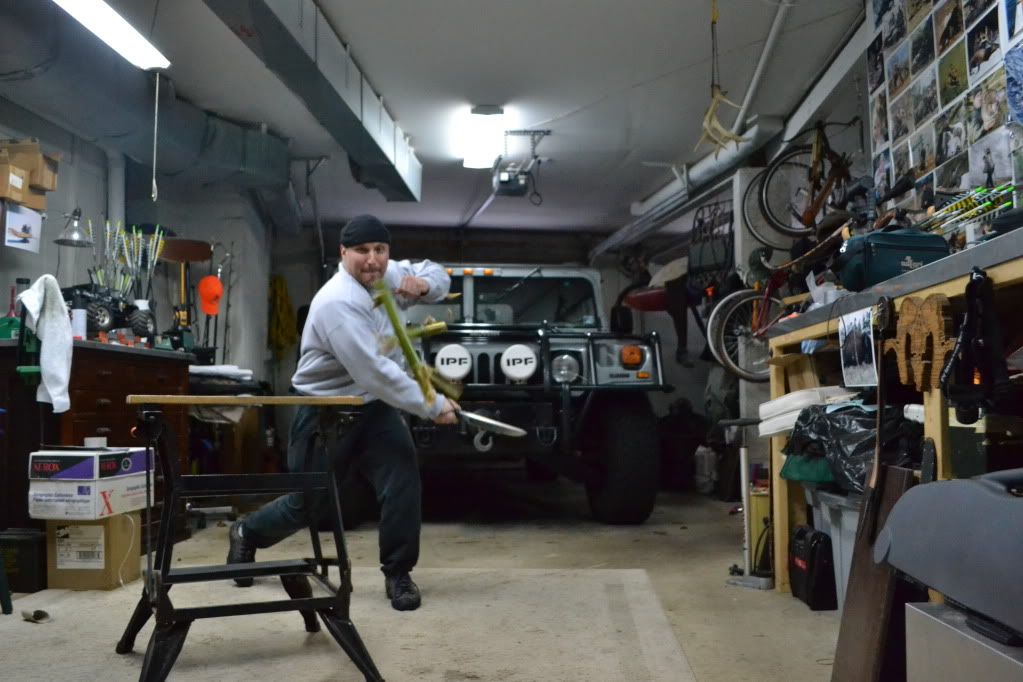


 Never got to meet him, but I hang around on the Hoodlums forum and sure miss seeing his posts.