
-
The BladeForums.com 2024 Traditional Knife is available! Price is $250 ea (shipped within CONUS).
Order here: https://www.bladeforums.com/help/2024-traditional/
You are using an out of date browser. It may not display this or other websites correctly.
You should upgrade or use an alternative browser.
You should upgrade or use an alternative browser.
All Knives Need Sheaths
- Thread starter Rick Marchand
- Start date


- Joined
- Feb 6, 2007
- Messages
- 1,298
okzj: Yes, I true up the edges on a belt (sharp one). Then I go to a duller, finer grit one to burnish (burn) the edges....because I don't have a proper burnisher yet and I can't use a fork to do that!

- Joined
- Jan 27, 2008
- Messages
- 2,010
I've been doing the same method as Rick and, with my sheaths, I often go through 4-6 layers of leather and wood(at times). I've noticed that the moment the needle actually hits the leather surface determines if it will wander. If the center of the needle is not directly over the center of the hole, the needle will bend slightly to position itself in the marked depression and therefore bore a new hole canted to the opposite side. If I'm off just a fraction to the right, the exit hole will be slightly off to the left of the intended target.
I just completed a wooden sheath consisting of two 1/4" layers of very hard bubinga, a full leather welt and two additional layers of leather that line the inside. My first 10 or 12 stitches were great and I think I became over confident. After a series of holes gone askew, two quite noticeably, I had learned my lesson. From that point on I took my sweet time and made sure the positioning was perfect before plunging through the layers. Not a problem from then on.
I just completed a wooden sheath consisting of two 1/4" layers of very hard bubinga, a full leather welt and two additional layers of leather that line the inside. My first 10 or 12 stitches were great and I think I became over confident. After a series of holes gone askew, two quite noticeably, I had learned my lesson. From that point on I took my sweet time and made sure the positioning was perfect before plunging through the layers. Not a problem from then on.
Last edited:

- Joined
- Apr 16, 2008
- Messages
- 814
thanks rick. I'm also one of those who hasnt tried making a sheath yet. And this helps out a lot.
Bennie
Ready to try my first. Thanks

- Joined
- Oct 26, 2006
- Messages
- 2,898
Keep it below 200F and you're safe..... best at 180F
Preheat the sheath and it'll go A LOT smoother.
My mix (in order of quantity):
Beeswax (organic, prefiltered with honey and pollen still present in small quantities)
linseed oil
pine pitch
teatree oil
The more oil you put in, the softer the leather will be. I use minimal oil for sheaths and increase the linseed for bags and pouches. For armour grade stuff, I use beeswax and paraffin 50/50 mix.
Rick
Rick, Where did you get the pine pitch? Just go out into the woods?
Thanks,
Mitch

- Joined
- Jan 6, 2005
- Messages
- 9,680
Rick, Where did you get the pine pitch? Just go out into the woods?
Thanks,
Mitch
You got it..... I'm a wudzy type guy. I collected it filtered it and ground it to a fine powder.
Rick
A few tips on using drill presses for this work.First, I use drill bits and sharpen the shanks then chuck them upside down and punch while the press is running.This allows me to size my holes to match various size needles whether I am stitching or lacing.I also made a table for my press using aluminum and UHMW which makes a nice slick sliding surface.I also use cut pieces of 1"x 4" with a notch to accommodate the belt loops.This allows the sheaths to sit much flatter.Be sure to run your press on the slowest speed.
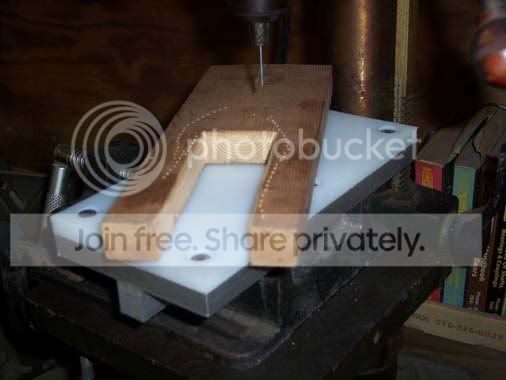
Like said above, I use multiple size bits for threads and laces,typically 1/16" for most threads, 3/32" and 1/8" for lacing 3/32" lace, and 1/8" and 5/32" for 1/8" lace.
This is one for a Rob Patton knife using both stitching and lacing
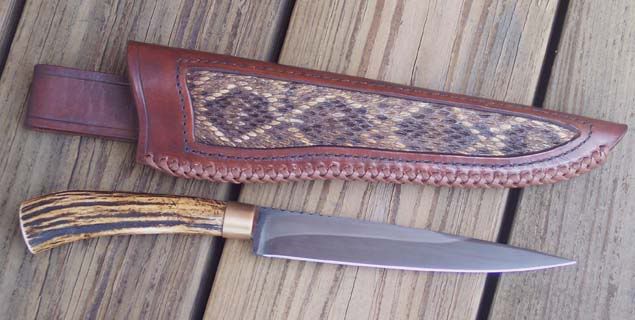
For those complaining about handstitching try something like this.
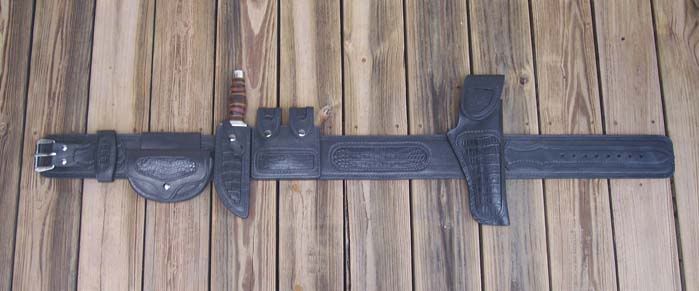
4" x 56" two layers of 10 oz, 10 seperate inlay's, holster and mag pouch sewn to belt.
For cleaning your leather prior to dyeing and assembly use Oxalic acid better known as Wood Bleach.It will take off most dirt and stains.
My biggest pet peeve is seeing sheaths with the insides not dyed and sealed.All leather surfaces should at least be sealed. Dave
http://dcknivesandleather.blademakers.com/
Like said above, I use multiple size bits for threads and laces,typically 1/16" for most threads, 3/32" and 1/8" for lacing 3/32" lace, and 1/8" and 5/32" for 1/8" lace.
This is one for a Rob Patton knife using both stitching and lacing
For those complaining about handstitching try something like this.
4" x 56" two layers of 10 oz, 10 seperate inlay's, holster and mag pouch sewn to belt.
For cleaning your leather prior to dyeing and assembly use Oxalic acid better known as Wood Bleach.It will take off most dirt and stains.
My biggest pet peeve is seeing sheaths with the insides not dyed and sealed.All leather surfaces should at least be sealed. Dave
http://dcknivesandleather.blademakers.com/
- Joined
- Jan 6, 2005
- Messages
- 9,680
Great set up and beautiful work! Thanks for sharing.
Rick
***Edit***
Dave, I was on your site and just had to post this one..... my favorite...
Kudu Dagger

Rick
***Edit***
Dave, I was on your site and just had to post this one..... my favorite...
Kudu Dagger
Last edited:
- Joined
- Oct 26, 2006
- Messages
- 2,898
A few tips on using drill presses for this work.First, I use drill bits and sharpen the shanks then chuck them upside down and punch while the press is running.This allows me to size my holes to match various size needles whether I am stitching or lacing.I also made a table for my press using aluminum and UHMW which makes a nice slick sliding surface.I also use cut pieces of 1"x 4" with a notch to accommodate the belt loops.This allows the sheaths to sit much flatter.Be sure to run your press on the slowest speed.
Like said above, I use multiple size bits for threads and laces,typically 1/16" for most threads, 3/32" and 1/8" for lacing 3/32" lace, and 1/8" and 5/32" for 1/8" lace.
This is one for a Rob Patton knife using both stitching and lacing
For those complaining about handstitching try something like this.
4" x 56" two layers of 10 oz, 10 seperate inlay's, holster and mag pouch sewn to belt.
For cleaning your leather prior to dyeing and assembly use Oxalic acid better known as Wood Bleach.It will take off most dirt and stains.
My biggest pet peeve is seeing sheaths with the insides not dyed and sealed.All leather surfaces should at least be sealed. Dave
http://dcknivesandleather.blademakers.com/
Great idea about cutting out a notch in a 1 x 4! :thumbup:
My stitching was coming out lousy because the work wasn't laying flat when drilling the holes.
-Thanks
- Joined
- Jun 29, 1999
- Messages
- 10,240
Beautiful work... thanks!

- Joined
- Mar 19, 2007
- Messages
- 7,443
Great points about making a jig for your stuff to sit in when drilling. I do this with my flatter pieces. I need to make some recessed jibs for my bushcrafter sheaths.
The lesson here kids - is that a multiple piece sheath is easier to get flat (and thus make on a drill press) than a one piece folded sheath.
TF
The lesson here kids - is that a multiple piece sheath is easier to get flat (and thus make on a drill press) than a one piece folded sheath.
TF

- Joined
- Dec 2, 1999
- Messages
- 9,910
I like this thread. Nice knives and sheaths too. Very informative. I use the same method on most of my sheaths but also have a Tippman sewing machine. I still go back to hand stitching on the higher end ones though because of better control.


- Joined
- Nov 23, 2008
- Messages
- 437
Just thought I'd mention here that I too was curious if would be ok to use the drill press like an arbor press to push the needle ( bottom of drill bit sharpened to a point) through without having the press running.
End result- Pushed half way through and got stuck. I had to pull so hard to get the sheath off my hands bounced off the table and back up to the needle piercing through my finger beside the nail.
It goes through fingers much easier than leather so keep it running, LOL
-Josh
End result- Pushed half way through and got stuck. I had to pull so hard to get the sheath off my hands bounced off the table and back up to the needle piercing through my finger beside the nail.
It goes through fingers much easier than leather so keep it running, LOL
-Josh
- Joined
- Feb 4, 2005
- Messages
- 834
Just thought I'd mention here that I too was curious if would be ok to use the drill press like an arbor press to push the needle ( bottom of drill bit sharpened to a point) through without having the press running.
End result- Pushed half way through and got stuck. I had to pull so hard to get the sheath off my hands bounced off the table and back up to the needle piercing through my finger beside the nail.
It goes through fingers much easier than leather so keep it running, LOL
-Josh
It would work if you made the cross section the same as a hand stitching awl... shallow diamond with spear point... long points 45deg from stitch line. It helps to have a foot over the leather so running the press handle up catches the leather on the foot instead of having to hold it down by hand. Also helps to bees wax the stitching thread when doing that.
Mike