
-
The BladeForums.com 2024 Traditional Knife is available! Price is $250 ea (shipped within CONUS).
Order here: https://www.bladeforums.com/help/2024-traditional/
You are using an out of date browser. It may not display this or other websites correctly.
You should upgrade or use an alternative browser.
You should upgrade or use an alternative browser.
ANOTHER %#!*@¢& Forge Attempt
- Thread starter DanF
- Start date
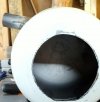
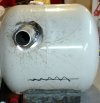
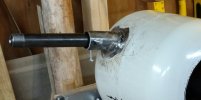

Stacy E. Apelt - Bladesmith
ilmarinen - MODERATOR
Moderator
Knifemaker / Craftsman / Service Provider
- Joined
- Aug 20, 2004
- Messages
- 38,467
Just put the TC in from the top at the center. It will be somewhat useful on a small forge like yours, because it will read the flame temp more than the chamber temp. When doing HT, pull the TC from the sheath and set it inside the muffle pipe without a sheath ( just the ceramic bead spacers that are on it.)
On a side note, I have just received my shipment of TC sheaths that I had made up for me overseas. They look great. I will be selling them in The Exchange soon. I decided that there needs to be a source for reliable and lower cost forge building supplies. Hopefully, I can get some good prices by bulk purchase on other items and offer an affordable parts kit to use when building a forge.
On a side note, I have just received my shipment of TC sheaths that I had made up for me overseas. They look great. I will be selling them in The Exchange soon. I decided that there needs to be a source for reliable and lower cost forge building supplies. Hopefully, I can get some good prices by bulk purchase on other items and offer an affordable parts kit to use when building a forge.
- Joined
- May 31, 2016
- Messages
- 485
That is awesome. The TCs themselves are so cheap and paying more than the TC for the sheath always feels wrong.Just put the TC in from the top at the center. It will be somewhat useful on a small forge like yours, because it will read the flame temp more than the chamber temp. When doing HT, pull the TC from the sheath and set it inside the muffle pipe without a sheath ( just the ceramic bead spacers that are on it.)
On a side note, I have just received my shipment of TC sheaths that I had made up for me overseas. They look great. I will be selling them in The Exchange soon. I decided that there needs to be a source for reliable and lower cost forge building supplies. Hopefully, I can get some good prices by bulk purchase on other items and offer an affordable parts kit to use when building a forge.

DanF
Knifemaker / Craftsman / Service Provider
- Joined
- Apr 17, 2017
- Messages
- 1,544
This being the case, I think I'll save me some aggravation and just set it inside the muffle pipe. Only time I need temp is for HT.Just put the TC in from the top at the center. It will be somewhat useful on a small forge like yours, because it will read the flame temp more than the chamber temp. When doing HT, pull the TC from the sheath and set it inside the muffle pipe without a sheath ( just the ceramic bead spacers that are on it.)
Stacy E. Apelt - Bladesmith
ilmarinen - MODERATOR
Moderator
Knifemaker / Craftsman / Service Provider
- Joined
- Aug 20, 2004
- Messages
- 38,467
That is a good idea. The TC in the sheath is good for larger forges and ones run by a PID.
DanF
Knifemaker / Craftsman / Service Provider
- Joined
- Apr 17, 2017
- Messages
- 1,544
That is a good idea. The TC in the sheath is good for larger forges and ones run by a PID.
Which this one will be eventually. Chamber dimensions ended up at 7" x11". Longest knife I make is 10". Borderline adequate.
Stacy E. Apelt - Bladesmith
ilmarinen - MODERATOR
Moderator
Knifemaker / Craftsman / Service Provider
- Joined
- Aug 20, 2004
- Messages
- 38,467
Forges are not shipping boxes. just because it fits doesn't mean it fits right. You can forge a 10" knife in an 11 inch chamber, but there will be problems … especially with HT. That is one reason most folks cut a smaller port in the back of the forge. This allows things to be pumped in and out or positioned to heat a certain area better.
With a back port, you can do a 24" knife in an 11" forge.
With a back port, you can do a 24" knife in an 11" forge.
DanF
Knifemaker / Craftsman / Service Provider
- Joined
- Apr 17, 2017
- Messages
- 1,544
Well, it has a back port in it, last bit of cutting I did today.
But, HT using the "pumping" action seems like a piss-poor way of heat treating, and this was built to ht smaller knives. I referenced 10" just as a size that fits the chamber.
I'm pretty much done with this thread now, you have fun with it
But, HT using the "pumping" action seems like a piss-poor way of heat treating, and this was built to ht smaller knives. I referenced 10" just as a size that fits the chamber.
I'm pretty much done with this thread now, you have fun with it
Stacy E. Apelt - Bladesmith
ilmarinen - MODERATOR
Moderator
Knifemaker / Craftsman / Service Provider
- Joined
- Aug 20, 2004
- Messages
- 38,467
I wouldn't call "Pumping the Steel" a piss-poor method. It is done by many/most skilled smiths, and has been the traditional way of getting evenly heated blades in Japan for 1000 years. I regularly do a 24"-30" sword in my 16" forge with perfect HT results. Even blades shorter than the forge are moved pretty much constantly in HT to avoid hot spots and to get an even edge heat.
When using coal to HT, I place several firebricks to make a tunnel and pump the blade ( any size) through the hot chamber created. This avoids burning the blade accidentally, and assures even heating.
When using coal to HT, I place several firebricks to make a tunnel and pump the blade ( any size) through the hot chamber created. This avoids burning the blade accidentally, and assures even heating.
DanF
Knifemaker / Craftsman / Service Provider
- Joined
- Apr 17, 2017
- Messages
- 1,544
"many/ most skilled Smith's"..., .
Well, I have to wonder about that. It being the case, why aren't many/most still using those methods (other than a few old-school die-hards who can't/won't change with the times)? Why are/have many/most built and using bigger and better designed ht forges than a coal forge?
Personally, I liked using coal. But times they are a-changing (and should change), to newer, better methods. If that's not the case, why not just keep on with "old ways"?
But this is a dead horse, beat the poor bastard if you want ( of course, only for the betterment of all knifemaking humankind), I'll see if I can sign up for "that" $5k class you mentioned and really learn some antiquated ideas.
Gotta go, I feel the urge to dig a hole in the back yard and throw some in coal in it.
Well, I have to wonder about that. It being the case, why aren't many/most still using those methods (other than a few old-school die-hards who can't/won't change with the times)? Why are/have many/most built and using bigger and better designed ht forges than a coal forge?
Personally, I liked using coal. But times they are a-changing (and should change), to newer, better methods. If that's not the case, why not just keep on with "old ways"?
But this is a dead horse, beat the poor bastard if you want ( of course, only for the betterment of all knifemaking humankind), I'll see if I can sign up for "that" $5k class you mentioned and really learn some antiquated ideas.
Gotta go, I feel the urge to dig a hole in the back yard and throw some in coal in it.

- Joined
- Jul 4, 2010
- Messages
- 866
 Wow
Wow
Stacy E. Apelt - Bladesmith
ilmarinen - MODERATOR
Moderator
Knifemaker / Craftsman / Service Provider
- Joined
- Aug 20, 2004
- Messages
- 38,467
Dan, I was not saying I prefer using coal, just that even when it is what is available, I pump a long blade. Few knifemakers have a forge or a HT oven long enough to do a 30" to 36" blade. That was my point.
Walter Sorrells, and most smiths in a Japanese video of sword forging and HT use the pumping method for long blades. I have seen it many times with other modern smiths.
Please don't go away ... just take a break and come back later. Let us know how the forge turns out.
As always, you can ask me questions by email if the forums are too open.
Walter Sorrells, and most smiths in a Japanese video of sword forging and HT use the pumping method for long blades. I have seen it many times with other modern smiths.
Please don't go away ... just take a break and come back later. Let us know how the forge turns out.
As always, you can ask me questions by email if the forums are too open.

- Joined
- Nov 29, 2000
- Messages
- 2,869
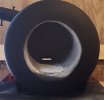
Danf that looks great! is it venturi fired or blower? This little guy is hot enough to weld... has two venturi burners I made myself. The forge body is half what a 5 gal. propane tank is. Guess it's the 2.5 gal? If your going to forge weld in it, you will find that flux is NOT your friend. I've taken to putting terracotta unglazed tile pieces in the bottom so they can be replace now and then. Flux eats a hole in them as well.


Last edited:
DanF
Knifemaker / Craftsman / Service Provider
- Joined
- Apr 17, 2017
- Messages
- 1,544
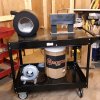
Everything is self-contained on one rolling cart now. One venturi and one blown burner on top inverted shelf, room for 2, 30 lb tanks and blower on bottom shelf.
A public thank you to Stacy E. Apelt for his invaluable help in getting this completed.
What started as a tongue-in-cheek joke between me and Stacy relating to a p-mail we had shared was misconstrued and then I failed to correct that issue. My personal apology Stacy, I said it before and will say it again, you have a hard, thankless job and jackasses like myself don't make it any easier.
Stacy E. Apelt - Bladesmith
ilmarinen - MODERATOR
Moderator
Knifemaker / Craftsman / Service Provider
- Joined
- Aug 20, 2004
- Messages
- 38,467
Glad it has all worked out Dan. I never get my feathers ruffled ( well, not much), and they smooth down pretty fast.
Make some knives and show us how the forge works.
Only critique is I still thing the rear port is too small. After using the forge a while, I bet you open it up to around 3" wide and 2" high.
Make some knives and show us how the forge works.
Only critique is I still thing the rear port is too small. After using the forge a while, I bet you open it up to around 3" wide and 2" high.
Last edited:
