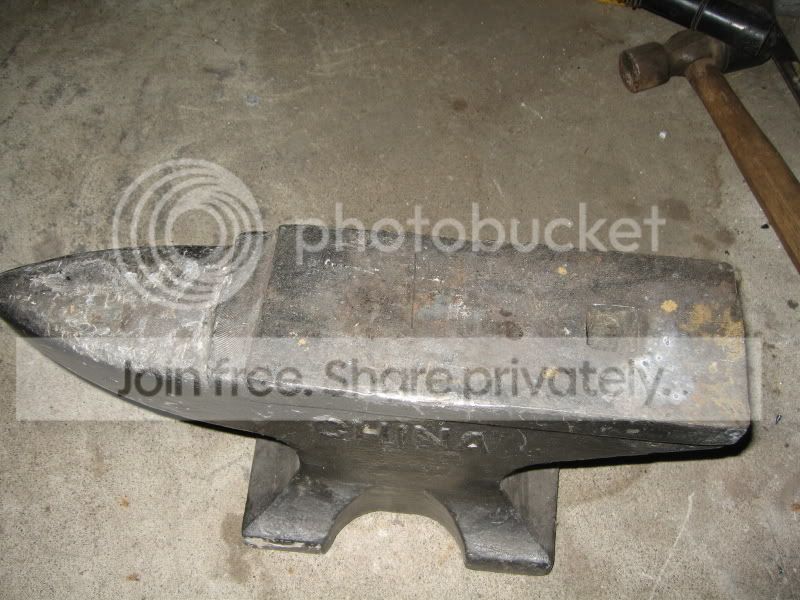
anvil idea?

Joined
Feb 16, 2006
Messages
1,962
hey guys.....i need an anvil and am having trouble finding one close enough to me that is cheap enough.....i see alot of people build stands out of wood to make their anvils heavier and to lift them up.....can i just build a big base out of wood and put a flat plate of steel on top of it?....if so, what kind of steel do i want to use to take the abuse of consant hammering?....is my idea possible.....thanks for any comments.....ryan


ohh i have also seen i think tim lively using a bucket with a big post sticking out of it.....is this a possibility?....again what kind of steel do people use?
 
I have one of those, I've used it twice and the edges are breaking off, really soft! It'll work though, but it feels like it'll break in half when you hit it. I'm using a piece of railroad track now and it works pretty well. A lot better than the China anvil except it's not flat. If you go to a rail yard usually the guys are happy to help you. If you watch Harbor Freight they have these on sale for $19.99.


002.jpg
 

At $1.87/lb. on the first one, that would be a good deal. Me, I'd have to be able to pick it up to consider it.

If you are any where near western Penn., search here for Bruce Godlesky and get in touch with him. He is an anvil magnet, near as I can tell, and he is likely to have one he would let go.

Mike
 
Last edited:
There are a lot of ways to get a good anvil without buying a standard one. I can't buy a decent anvil in Wyoming... they are either being used and not for sale or folks who want to use one as a yard ornament are willing to pay a lot more than I am.

Wayne Goddard's books have a number of alternative anvils. Look at Tai Goo's site. Look at Japanese forging sites. Look at Primal Fires for other workable ideas (HF anvils are not workable, really)... try Don Foggs site, look around at AnvilFire, the ARBANA site, SOFA and other state forging organizations.

I found what I think is a track-adjuster cylinder rod for a Cat D-8 or 9... a 2" x 10" flange with 5" industrial chrome rod. It's not tall enough and the top won't work so I got a piece of 4140 from a tool steel house (5" x 6" x 7 " is what they had but was looking for smaller) as a "drop" and I'm going to weld it onto the rod end (1/8" low to no hydrogen rod and a 300F to 400F preheat then reheat to keep the weld from cracking). I'll weld rebar to the flange, cut some glued particle board rounds to the ID of a 12" sono tube to adjust the height, weld plate to rebar and run it through holes drilled in particle board, drop the sono tube over the whole mess and pour. I calculate I'll end up with 367lbs. (sand is 110lb./cubic foot, concrete is 130-140lbs/cu.ft., steel is 0.283lb./cu.in (489lb./cu.ft.).

All I've done to the 4140 top piece is make a radius on one of the top-edge corners (3/4" and was wanting bigger but...)... that's the horn. Thought about a hardy hole (mill out square on vertical face opposite the "horn) and bolt/weld a 1" piece of plate over it) but let it go as half-assed (not enough metal behind the hole for good all around hardy hole use... got a junk anvil to use for hardy tools).

Anyhow, there are a lot of things that will make an anvil for a knife-maker. Howard Clark says a 4" square (or larger) of mild anchored to the earth (at the right height) is a fine anvil... it could have a piece of S5 or S7 or 4140 or 4340 or ??? gotten as a drop welded on top and flame hardened, if you don't want to believe Howard... his point is, a person hits the hot steel, not the anvil...

Mike

 
Last edited:
Stay away from cast iron anvils from China. There are several write-ups on the net about them and I even read a book written in 1901 in which the author warns about cheap anvils from China.

Look up the bearing bounce test and go try it for yourself.
 
I vaguely recall being told during my welding 101 class 4 years ago that one way to reface an anvil is to run lines of arc welding rods across the top, then machine it flat...

http://www.cvbg.org/tips/idxTips.htm

I beleive the top link for anvil repair gives instructions on how to do it... perhaps you could put a new/good face on the anvil you have and avoid buying an entirely new one? I have no idea about anything even remotely related to the topic, but maybe that vague memory will help... :confused:
 
What you're referring to is called hard facing.

It requires special welding wire or rods and all you do is lay a bead down on the entire working surface of the anvil and then grind it smooth.

Works pretty well if you're good with a welder. IIRC the welders required are a bit large, something like 300 amp for an arc welder and 250 for a mig.
 
What you're referring to is called hard facing.

It requires special welding wire or rods and all you do is lay a bead down on the entire working surface of the anvil and then grind it smooth.

Works pretty well if you're good with a welder. IIRC the welders required are a bit large, something like 300 amp for an arc welder and 250 for a mig.


I used to hard face water well drilling bits; you can get a 1/8" electrodes that will burn at 100 amps. Lincoln has a really nice selection of hard facing rods for various work environments... some of them can be heat treated.
 
Do you know if those Lincoln rods get to the needed hardness?? My understanding was you wouldn't need to heat treat after hard facing...
 
Yes, they are hard without heat treating but some do offer enhanced properties with HT.

I'll see if I can find the properties PDF that I used to use.

Not a PDF but this is the list. I used the wearshield ABR which is a general purpose hardfacing rod.

Actually, now that I think about it (it's been a few years since I had to deal with hardfacing) I think the heat treating was in case you had to machine some of the alloys you had to anneal it and do a really slow cool down.
 
Last edited:
The main problem with cheap anvils is they are made of cast iron (as apposed to cast steel). "Cast iron" has a huge amount of carbon in it. Way to much for the iron to absorb and it forms flakes in the casting (for lack of a better description) that absorb the shock of the blows instead of rebounding them. This also makes the corners brittle. This is also why many machine tools and motors are cast iron. Besides welding on a layer of hardfacing you can weld on a "cap" of tool steel.
 
Has anyone used or seen an NC Tool Anvil?

Their webiste claims them to be steel and hardened, but it doesn't give an actual hardness value.
 
I have a Sea Robin anvil, it's a Japanese style anvil. It's basically a 6" square of 4140 that has been hardened. It's great, so basically I'm saying if you can find a piece of steel 4-6" square or so it'd make a good to great anvil if you welded on a hardened plate or hardened it.
 
can u harden a big square like that with just a torch?.....ryan


edited-or i should say how hard should an anvil be....i have been reading alot and alot of people think it should be hard and alot of people say it doesnt matter....i'm not surprised....ryan
 
If I remember correctly from the neo-tribal guys a lot of them just build a big fire and chunk the chunk of steel in it maybe even overnight. Not sure what you'd quench in.... probably just hose it with something.

Edited to add:

If you can find a nice chunk of steel just weld or last resort bolt a hardened steel plate on the face.
 
Back
Top