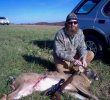
Anybody hunting? Let's see some pics

goldeneyeslayer,
I apologize profusely for my response to your first post, I misunderstood what you were asking.

I just got out of the woods, we have a front moving through today and the wind is horrible so I didn't do any good, I think I will go coon hunting tonight though. Chris


ABSOLUTELY no sweat Sir!! Just one of those catastrophic miscomunication deals....on both parts.:D Its all good.

I think I got most of the nastys out edited out of these.

Last weekend: One for me and one for my son. And one for vanity (if you squint, you can see a Becker BK7 on the pack.:D

mtb07.jpg


jnb07.jpg


huntpic008.jpg
 
Question for everyone here. How much meat would the average deer weigh in at in your parts of the woods? My boss just got his buck and weighed in @ 175lb on the hook. The fella he goes to said the largest he ever cut up weighed in at 222lb. From what I understand, that's meat, but I could be wrong.
 
Weight of live deer depends a great deal on the species and geography. The two shown above are mule deer and will generally weigh a great deal more than whitetail deer. Then there are blacktails and sitka...um...key deer and Saskatchewan deer (Northern Whitetails). Here in Southwest Tennessee (most of the mid-South I guess) our whitetails weigh between 110 and 230 live weight. My personal biggest buck yielded 180 lbs. of boneless meat. That is way above average though. Smaller, younger deer are more plentiful, more tender, and more often harvested. My normal yields are 65 tp 115 pounds of boneless meat.

Here is a link to one chart on whitetails comparing live weight, field dressed weight, and butchered weights. Other charts vary greatly. And as said, other species and locals are different.

http://www.alfredny.biz/sportsmen/Whitetail-yield-chart.htm

Codger
 
I popped a whitetail buck last weekend and got the first chance to use my new custom fixed blade from Joel Bolden. I forgot to photograph the knife with the deer but remembered to get my Browning in there....

blk%20mt.%2011-18-07d.jpg


JCB%20knife.jpg


I've been doing a lot of waterfowl and grouse hunting, too, but haven't taken any photos.

Good hunting,
desmobob
 
Wow- I have never heard of Saskatchewan deer before!! Is this a local term?


Lol! No, my best non-Canadian and non-biologist attempt to describe the larger bodied whitetails from that Northern region as different from the Virginia Whitetails encountered here in the Mid-South States. :o

Here is the list of Whitetail subspecied recognized:

Sub-Species:

Taxonomy is the classification of living things.I want go into the complex description of Taxonomy but I will discribe the Virginia Whitetail (Odocoileus Virginanus) , it's sub-species and where they range.

1. The Virginia whitetail, Odocoileus virginianus virginianus, is the prototype of all whitetail deer. Its range includes Virginia, West Virginia, Kentucky, Tennessee, North Carolina, South Carolina, Georgia, Alabama, and Mississippi. This is a moderately large deer with fairly heavy antlers. It is hunted in all of the states it inhabits, and each state has a good deer population. It has a widely diversified habitat, varying from coastal marshes, swamplands, and pinelands to the "balds" atop the Great Smokey Mountains.

2. The northern woodland whitetail,Odocoileus virginianus borealis, is the largest and generally the darkest in coloration. It also has the largest range, being found in Maryland, Delaware, New Jersey, Pennsylvania, Ohio, Indiana, Illinois, Minnesota, Wisconsin, Michigan, New York, Connecticut, Rhode Island, Massachusetts, New Hampshire, Vermont, Maine, and the Canadian provinces of New Brunswick, Nova Scotia, Quebec, Ontario, and a portion,of Manitoba. More whitetails of this subspecies are hunted than any other. Some 541,000 deer were legally taken from the region of the borealis subspecies in 1974. This area has also produced half a dozen of the top twenty record whitetail heads listed in the Boone and Crockett Club's official records book, North American Big Game. Including the long standing record harvested by Jim Jordan in Wisconsin.

3. The Dakota whitetail,Odocoileus virginianus docotensis, is another very large deer, about equaling the northern whitetail in weight . This subspecies has produced even more of the high-ranking trophy heads than the borealis race. The range covers North Dakota, South Dakota, and parts of Nebraska, Kansas, Wyoming, Montana, @ and the Canadian provinces of Manitoba, Saskatchewan, and Alberta. Dakota bucks have heavy, fairly widespread antlers. The winter coat is a little paler than that of borealis. This is a deer of the breaks. Its home is in the timbered coulees, gullies, draws, and river and stream bottoms that cut through the prairies.

4. The Northwest whitetail, Odocoileus virginianus ochrourus, is also a large deer. It inhabits parts of Montana, Idaho, Washington, Oregon, California, Nevada, Utah, and the Canadian provinces of British Columbia and Alberta. The biggest whitetail I ever saw was in Glacier National Park. It could have been either this subspecies or a Dakota. The two races intergrade in that area. This subspecies has very widespread antlers and a winter coat of relatively pale cinnamon-brown.

5. The range of the Columbian whitetail,Odocoileus virginianus leucurus, has been so greatly reduced that most of these deer are now found only on th 'e Federal Columbian White-tailed Deer Refuge, on the Columbian River near Cathiamet, Washington. The subspecies formerly ranged along the Pacific coast in Washington and Oregon, spreading eastward to intergrade with the Northwest whitetail. The Columbian whitetail is not hunted as it is now on the endangered-animal list.

6. The Coues, or Arizona whitetail, Odocoileus virginianus couesi, is a small variety. At one time it was thought to be a distinct species but more recent research has relegated it to the status of subspecies. It has larger ears and tail in relation to its body size than most whitetails, This deer is found in the dry, desert regions of southeastern California, southern Arizona, southwestern New Mexico, and on down into Old Mexico. The Coues is apparently isolated from areas where it could intergrade with the Texas whitetail but in the southern part of its range it probably intergrades with several Mexican subspecies. Even in Arizona the Coues whitetails are more or less isolated in the mountainous areas that rise above the desert, such as the Chiricahua and Huachuca Mountains. Arizona estimates it has about 25,000 Coues deer but does not give any harvest figures. New Mexico has a hunting season for this deer but gives neither a population estimate nor the hunter's take. The Coues deer has its own classification in the Boone and Crockett Club, dating back to when it was considered a distinct species. From the hunter's point of view, the separate classification remains legitimate since the little Coues deer has a light "rack," or antlers. A trophy that is outstanding by Coues standards could hardly compete with a trophy northern or Dakota whitetail.

7. The Texas whitetail, Odocoileus virginianus texanus, is found in western Texas, Oklahoma, Kansas, southeastern Colorado, eastern New Mexico, and the northern portion of Old Mexico. Everything about Texas is big, even its population of whitetail deer. Texas has four whitetail subspecies, of which the most abundant is the Texas whitetail. Its body is much smaller than that of the more northerly deer but it is the largest of the southern forms. The antlers are slender but widespread and there are several record heads among the top twenty-five.

8. The Carmen Mountains whitetail, Odocoileus virginianus corminis, is a small deer found in the Big Bend region of Texas. Its range is limited to the Carmen Mountains on both sides of the Rio Grande. Not many of these deer are hunted because most of their range falls within the boundaries of Big Bend National Park, where hunting is prohibited. Here is a good example of isolation. A buffer strip of semi-desert, inhabited by mule deer, separates this subspecies from the Texas whitetail and prevents intergrading.

9.The range of the Avery Island whitetail,Odocoileus virginianus mcilhennyi, stretches along the Gulf Coast in Texas and Louisiana. This is the deer of the Texas Big Thicket Country. It is a large one with a dark, brownish winter coat, and it intergrades with the whitetail subspecies found to the west, north and east.

10. The Kansas whitetail,Odocoileus virginianus macrourus, is the fourth subspecies occurring in Texas. Found in eastern Texas, Oklahoma, Kansas, Nebraska, Iowa, Missouri, Arkansas, and Louisiana, it is a large deer with heavy main antler beams and short tines. Several deer of this type are listed among the top 25 heads.

11. The Bull's Island whitetail,Odocoileus virginianus tourinsulae, is an isolated and very limited race of whitetail deer, found only on Bull's Island, South Carolina.

12. The Hunting Island whitetail,Odocoileus virginianus venotorius, is another of South Carolina's minor variations, found only on Hunting Island.

13. The Hilton Head Island whitetail,Odocoileus virginianus hiltonensis, is still another South Carolinian variation, limited to Hilton Head Island.

14. The Blackbeard Island whitetail,Odocoileus virginianus nigribarbis, is found only on the Georgian Islands of Blackbeard and Sapelo' All of those last four subspecies are medium-sized deer with fairly small antlers that are heavily ridged or wrinkled at the base. The islands they inhabit are far enough out in the ocean to prevent intergrading with mainland subspecies or with one another. I believe that hunting is currently allowed on all of these islands.

15. The Florida whitetail,Odocoileus virginianus seminolus, is a good-sized deer with a good rack. Some have antlers as impressive as the borealis though the spread is not as wide. The race is the deer of the Everglades.

16. The Florida coastal whitetail,Odocoileus virginianus osceola, is found in the Florida panhandle, southern Alabama, and Mississippi. It is not as large as the Florida or the Virginia whitetail but it intergrades with both.

17. The Florida Key deer, Odocoileus virginianus clovium, is the smallest of our native deer. No hunting is allowed for this subspecies, which is on the endangered-animal list. By 1949, the Key deer population had plummeted to an all-time low of thirty individuals. This reduction was brought about mainly by habitat destruction, fires, hurricanes, automobile kills, and hunting. The Key Deer National Wildlife Refuge was established in 1953. With the protection thus provided, the deer population has crept back up to about three hundred. Today the automobile is the number-one killer, as the highway linking the Florida Keys passes through the center of the range.


http://www.kerrlake.com/deer/white.htm
 
Chris, Guyon, anyone else to whom this applies,

I think you've all misconstrued what I actually asked. Read it, again. I was just curious what Chris's reasons were; that's all. No persecution. No trolling. I am not anti-hunting. I also understand that there are ecological imbalances, non-native species, crop destruction, and various other reasons why some animals must be destroyed; and I do not object.

I just asked a simple question out of curiosity, and some of you seem to feel like I'm some anti-hunting troll harassing you. I'm not and I haven't.

I got the answer, and moved on. Those of you who are defensive about my question should do the same.
 
Chris, Guyon, goldeyeslayer, Doc,

I think you've all misconstrued what I actually asked. Read it, again. I was just curious what Chris's reasons were; that's all. No persecution. No trolling. I am not anti-hunting. I also understand that there are ecological imbalances, non-native species, crop destruction, and various other reasons why some animals must be destroyed; and I do not object.

I just asked a simple question out of curiosity, and some of you seem to feel like I'm some anti-hunting troll harassing you. I'm not and I haven't.

I got the answer, and moved on. Those of you who are defensive about my question should do the same.

Hey Mr. Evolute,
I think you made a mistake here. I don't remember commenting on anything you said. If I did, please point it out, because I don't remember saying it, in fact, I went back over the posts in this thread and I still didn't see it. Now, mind you, at this point, I've had a few rye and cokes, so that could be a problem, but please, if I did critique anything you said, please point it out because I try to make it a policy not to criticize anybody. Not always successful, but I try my best. :)

Doc
 
I got a pretty good buck that I was very happy with. Those are some nice bucks that members have here.:)
 
Doc,

You are right. I made a mistake, naming you. I apologize for that, and I'll now edit your name from my post above.

Sorry.
 
What is ment by the term "trolling". Ithought they were refering to fishing, earlier in this thread.
 
A shortage of time and lack of luck brought me up empty this year.

This is the only pic I have of the little fork horn Blacktail buck I shot last year.
jerky3

jerky2
 
Mountain Goat and Sitka Blacktail from southeast Alaska. Everytime I eat some of the meat it brings back great memories of one of my favorite hunts.
jasonpictures074.jpg
[/IMG]
jason06buck-1.jpg
[/IMG]
 
Austin Shooter,
The rifle is an HS Precision light wieght pro hunter in .300 WSM. Love the long reach and light wieght.
 
After missing four deer so far this year, finally connected Sat.
Scott
 

Attachments

  • IM000114.JPG
    IM000114.JPG
    70.3 KB · Views: 34
A very nice meat deer Scott! Congratulations! That is really the size deer I prefer. Two of the four on my gambrel so far this year have been bigger, but the smaller ones will provide better quality meat for jerky and venison steak, onion and gravy. But I don't see a knife in the picture!

Codger :thumbup:
 
Back
Top