AZ Knifemakers - Ever have stabilized scales move?

I have seen more movement with wood that was only recently stabilized, as mentioned, it does seem that the resin takes several weeks, maybe more than a month, to fully cure. Recently treated wood, stuff done within the last few weeks, often still smells of the resin, but it seems that it can still move a little for a while after the smell goes.

Can't remember who it was on here that said to treat stabilized wood like untreated wood, ie for best results let it sit in block form before cutting, then cut, rest a bit more, keep it warm and dry and while gluing and working, then add a sealing coat of oil when done. Does seem like a waste of stabilizing, but it does mitigate many of the risks.

Hope you work out a fix for your handle!
 
I don't use stabilized woods. I tried some a long time ago, but didn't like it. It seemed plasticy, brittle and chipped a lot when I tried to carve it, but it's been 20 years or so and maybe the stuff is better now. I've never had any serious problems with un-stabilized, air dried and well seasoned woods here. The only exception is very hard woods coming in from somewhere else. If they come in from a wetter climate they almost always warp and crack. If they've been here a while and have had time to adjust to the climate and reach equilibrium, they hold up great, even when sent into wetter climates. I do make a habit of sealing the wood before it goes out. I have experimented with natural stabilization by immersing the wood in wood rosin (heated to a liquid state) for 15 minutes or so, just for the hey of it. Once the wood heats up it draws the rosin in, fills the pours, vents off any moisture and seals it up real well… not necessary though.
 
Last edited:
Hi, I'm new to knife making and the forum, currently working on my first knife, a knork for my dad wo had a stroke several years ago and wants to be able to cut food with one hand. I've never used stabilized wood but I have a lot of experience with natural wood.

With natural wood that's been dried the phenomenon where the wood is dry on the surface and wetter in the center is called case hardened. It can require considerable time for case hardened wood to reach a consistent moisture content throughout, usually up to a year per inch of thickness. And even then when the relative humidity changes the wood will still "move" or warp.

All varieties of wood are different in terms of stability, some naturally more stable than others. It would be a good idea to choose a species of wood that is naturally more stable than others before being "stabilized" and use that species for your knife. Also wood that is stable in a particular environment needs to stay within that environment, in other words if the knife was made in the dessert needs to stay in the dessert.

I hope some of this will help. I love the forum and I've learned lots already. Keep up the good work!
 
Good points,… but going from a dryer climate to a wetter climate, isn’t as much of a problem as going from wetter to dryer. With wooden instruments, made from some of the most stable woods there are like mahogany, it’s still advisable to use a humidifier when going from a wetter climate to a dryer one. Cracking and warping usually happen when the wood is drying out unless there are a lot of unusual internal stresses in the wood (usually from poor construction methods),… then it could happen the other way around.
 
Last edited:
Totally agree. You mentioned Redwood...very poor candidate for stabilizing. Sometimes it works, and sometimes it does not.

If a stabilizer does one way/formula for all woods then Redwood does not do as well as some of the others. I found that out when I was doing my own stabilizing. When I decided to start sending wood out for stabilizing instead, I talked to WSSI and K&G since it was general opinion that they are the best in the industry. K&G told me they have 2 different formulas used specifically for redwood so I decided to try them. In my opinion the results from K&G have been excellent.

It seems we all agree that stabilizing does not make the wood bulletproof, just less prone to the problems that can happen with untreated woods.

Should makers in areas like Arizona just not use natural materials (wood, ivory, bone) and just stick with the synthetic materials? Or are there special precautions and care needed? I should probably search my sales records for other customers in Arizona who have been purchasing stabilized woods and find out what they are doing differently.

I want to provide the best possible stabilized woods that I can. That is the main reason I use K&G, but if they can not possibly survive certain climates it only makes sense that I not sell to people in those areas.
 
If a stabilizer does one way/formula for all woods then Redwood does not do as well as some of the others. I found that out when I was doing my own stabilizing. When I decided to start sending wood out for stabilizing instead, I talked to WSSI and K&G since it was general opinion that they are the best in the industry. K&G told me they have 2 different formulas used specifically for redwood so I decided to try them. In my opinion the results from K&G have been excellent.

It seems we all agree that stabilizing does not make the wood bulletproof, just less prone to the problems that can happen with untreated woods.

Should makers in areas like Arizona just not use natural materials (wood, ivory, bone) and just stick with the synthetic materials? Or are there special precautions and care needed? I should probably search my sales records for other customers in Arizona who have been purchasing stabilized woods and find out what they are doing differently.

I want to provide the best possible stabilized woods that I can. That is the main reason I use K&G, but if they can not possibly survive certain climates it only makes sense that I not sell to people in those areas.

Hey mark,
I went ahead and took the scales back down to dead flat. At this point i have sanded almost 1/8" off since starting the warp issue.:eek: I set them on edge like you said and they have sat for 24 hours with no changes yet.... I am just going to keep an eye on them for a few days and report back. Like someone mentioned before how long ago did you get these back from k & g? Also FWIW we have gone from super dry 2 days ago to thunderstorms and higher humidity for the next 2 days.
 
I live in a very dry climate area.
I have used lots and lots of stabilized wood, including wood I stabilize myself with resinol 90C, with excellent results.
I think there are two things that need to be done to prevent warping.
First, don't have thin pieces stabilized. 1/4", 3/8" thick scales are too thin. If you want scales, stabilize them as a block, then later cut the block in half.
Second, after stabilizing, I keep the wood in my shop for a year or more before I use it.
Following these two rules, I have never had any stabilized wood warp.
 
The wood I send to K&G for stabilizing is done in block form. There have been a few times with thinner stuff that was going to be cut into folder scales afterward. If I remember correctly the redwood talked about here was a block that was stabilized by K&G about 4 or 5 weeks prior then cut into scales when purchased.

The reason I am so befuddled is I don't have the problem of stabilized wood moving for me here. I cut scales as thin as 1/8" and move them around from my heated office (usually at least 70f) into the storage area (often below freezing).

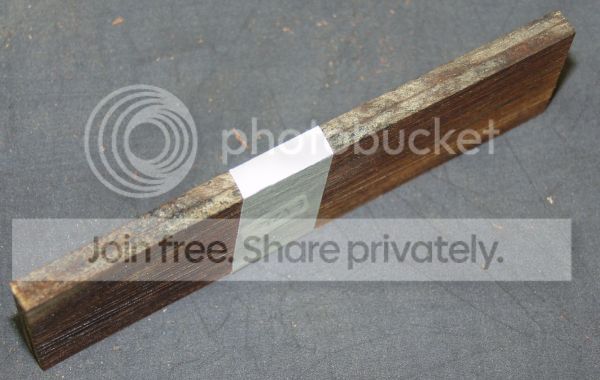
This is how I store them. Just 1 strip of masking tape to keep things from getting mixed up. These scales are 6 inches long and 1/8" thick.

g014.jpg


I am not trying to argue the point. Just trying to figure out what is going on. That is why when I was called by scotsmanspride I sent a full refund while we were talking on the phone. He was very friendly, never even asked for a refund and agreed to try a few things to see if the stabilized wood could work for him in his climate. I figured the help he was giving by trying a couple things was worth way more than the $25 refund for the wood. It is sounding like allowing the wood to settle is alleviating the issue of movement.

I live in a very dry climate area.
I have used lots and lots of stabilized wood, including wood I stabilize myself with resinol 90C, with excellent results.
I think there are two things that need to be done to prevent warping.
First, don't have thin pieces stabilized. 1/4", 3/8" thick scales are too thin. If you want scales, stabilize them as a block, then later cut the block in half.
Second, after stabilizing, I keep the wood in my shop for a year or more before I use it.
Following these two rules, I have never had any stabilized wood warp.

Tom,
If I remember correctly you were a big help to me a few years ago when I was first starting to do my own stabilizing.
Thank You. I still remember and appreciate the help. I went from doing my own stabilizing to having it done by K&G because they were able to do such a good job stabilizing of the wood and I ended up spending less money than when I was doing it myself.
 
Last edited:
I use a lot of wood and have all of it stabilized. One main reason is for the no mess finish on the wood and stabilizing for sure preserves and protects the wood.

I have found that I have to use at least hidden pins to insure against movement, since I don't like pins to show on the wood. I think a presentation piece of wood looks better without pins, my personal opinion that is shared by most of my clients.

Our weather here in Iowa presents every type of weather and well insures all natural handle material needs more than epoxies to secure handles.
 
Should makers in areas like Arizona just not use natural materials (wood, ivory, bone) and just stick with the synthetic materials? Or are there special precautions and care needed?

The problem isn’t with Arizona or natural materials.

The problem is with people.

Sadly, we seem to be living in a dishwasher safe/instant gratification synthetic society…
 
I can grind the back of just about any handle scale material and it will warp. Even a piece of steel...

One must learn how to make something flat. It's part of the game.
 
I have a chef knife I made with stabilized curly maple. I use this knife on a regular basis and it has slightly warped at the ricasso area (Maybe .006 or so). It did suprise me however like most have said stabilized wood is not immune from movement. I even had a micarta handle shrink a little around the tang once I still am puzzled over that one.
 
I have a chef knife I made with stabilized curly maple. I use this knife on a regular basis and it has slightly warped at the ricasso area (Maybe .006 or so). It did suprise me however like most have said stabilized wood is not immune from movement. I even had a micarta handle shrink a little around the tang once I still am puzzled over that one.

Yes, micarta will shrink. :)
 
Going off on a tangent here.
One of my customers called me and said that with natural, untreated woods he puts it into a double thick paper grocery bag and lets it sit closed for a couple weeks to allow a slow transition to the climate.
 
I've got linen based micarta knives that the scales have moved on, as was said nothing is bombproof.
Ken.
 
How about the stuff know as Dymondwood? The little I've used it so far it hasn't been a problem for me. But it is made of laminated wood so may show less changes because of that.

- LonePine
Alias Paul Meske, Wisconsin
 
How about the stuff know as Dymondwood? The little I've used it so far it hasn't been a problem for me. But it is made of laminated wood so may show less changes because of that.

- LonePine
Alias Paul Meske, Wisconsin

That stuff is closer to micarta than stabilized wood and very stable.
But I've seen it shrink and warp also.
 
Back
Top
