AZ Knifemakers - Ever have stabilized scales move?

Going off on a tangent here.
One of my customers called me and said that with natural, untreated woods he puts it into a double thick paper grocery bag and lets it sit closed for a couple weeks to allow a slow transition to the climate.

Mark,
Thats a common method used by turners. Some wrap in newspaper then paper bags, some boil in water, some store in box of dry saw dust, some wax, some anchor seal, some use pentacryl, and the list goes on and on.

"Some turn around 4 times on the 3rd Sunday of the 6th month at high noon with the shadow of the sun just cresting the wheat in farmer Johnson's field......:p"

OK so I made that last one up, but here is something that I do to try and help keep things dry while storing my blocks in my shop (both air dried or kiln dired natural and stabilized). First off, I keep all my blocks in their own lableled plastic storage boxes (has a lid but is not completely air tight)

The second thing I do is to pour some of that crystalline powder they use to dry flowers out with, from the craft store into a coffee filter and twist into a quarter sized ball, and tie it off with a twisty tie. The powder turns pink as it absorbs moisture, and then you set it in the sun and it will dry out and you can reuse it. Anyways, I make up a few of these and throw a couple in each box, just to try and keep the moisture levels more consistent. As always YMMV.....:p
 
Ug. This sucks. Ive got the most beautiful wood in my hand, i cant rub it, buff it, shine it, grind it and i have to leave it dry. Yeah im talking wooden knife scales.:p This has been a very informative post so far. I am by no means an instant gratification type person as this blank has been here for almost 8 months. Maybe ill just cord wrap it til then.....crap! Even that shrinks!
 
Sounds like you haven't done much knife making work.

Once those scales are glued and pinned on the knife, they should not warp.
Get them as flat as you can and use Locktite 324.
 
I am still new. This is knife number 4 for a handle. Done one stock removal. Lots of firesteel handles and lots of leatherwork.
 
Having used K&G for many years and living in AZ there are a few Quirks.
K&G sends there stuff straight out of the Stabilizer in the name of quick service, which they do well.
It smells of Resin and if you can smell resin it is not finished curing...

Average Humidity here is from 5% to 12% where Oregon is not.
If I were to venture a guess what reads dry in Oregon is just the surface... bet the core matches Oregon average humidity.

Fully dried blocks which have been stabilized Crack and move quite a bit
I let them sit for a month or more in my 110 Deg 5% humidity shop to climatize or untill they no longer smell. Where it is Cold and Wet takes even longer.

Also if you heat up the scales at all (Especially thin ones) they will warp even when cured, stabilized and dried... Ask me how I know this

You can speed the process a bit by drilling a hole in the center of the block after it is stabilized. This allows for quicker out-gasing
 
I am not to sure how to respond to the post from Hankins. This is not meant as an argument or disagreement. Just my opinion based on my experience and procedures.

1st in defense of K&G.
When wood blocks are stabilized after the wood is fully impregnated with the stabilizing solution it is heat cured. A process which turns the liquid into a solid. After they have completed their stabilizing procedure, they mail the blocks back. That is what I would expect them to do. There is a chemical smell that remains for a while. Similar to what you would find with a new car or newly purchased plastic goods.

2nd the way moisture content is determined.
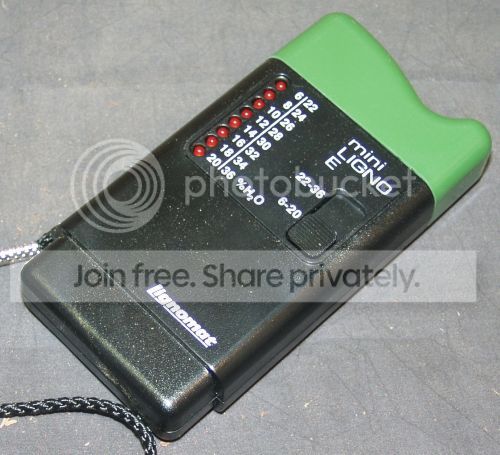
This photo is the moisture gauge I use. It is a professional grade moisture meter.
m001.jpg

The way it works is electrode pins (7/16") penetrate into the wood and determine the moisture content inside the piece of wood. Readings are taken at the edge, face and end grain of the piece.

I do agree that it is a good idea to let any handle material have time to settle and adjust to your climate. I also agree that most materials natural or man made will move with excess heat. Not to sure about drilling a hole into the block for degassing. I will leave that up to you guys.
 
Do you need to treat stabilized wood handles with anything (like linseed oil) to prevent them from shrinking/expanding/warping or are they supposed to be pretty much "maintenance free"?
 
Do you need to treat stabilized wood handles with anything (like linseed oil) to prevent them from shrinking/expanding/warping or are they supposed to be pretty much "maintenance free"?

From what i have gathered, when sanding even though stabilized the woods outside cells are still"open" so a soft finish is recommended. But thats just my understanding. Maybe some of the other guys know better since im just starting.
 
Back
Top