
-
The BladeForums.com 2024 Traditional Knife is available! Price is $250 ea (shipped within CONUS).
Order here: https://www.bladeforums.com/help/2024-traditional/
You are using an out of date browser. It may not display this or other websites correctly.
You should upgrade or use an alternative browser.
You should upgrade or use an alternative browser.
Bark River edge angle and can I sharpen it on the Lansky guided system?
- Thread starter AR850
- Start date
- Joined
- Apr 13, 2014
- Messages
- 522
Blacken the edge with a Sharpie marker. Start with the lowest angle and the finest stone. Increase the angle until you are removing all the marker with one pass. That is the existing angle. Be alert that if the knife is new from the factory the two sides could possibly have different angles.
Once you know the factory angle(s) you may want to step back to a coarser grit stone. If the factory angles are different you can keep them that way or change them to be identical. Some knives are designed to have one flat side and one beveled side. Others come close but not equal - I got a knife that was 20 on one side and 17 on the other. I assumed that was a mistake and fixed it.
Once you know the factory angle(s) you may want to step back to a coarser grit stone. If the factory angles are different you can keep them that way or change them to be identical. Some knives are designed to have one flat side and one beveled side. Others come close but not equal - I got a knife that was 20 on one side and 17 on the other. I assumed that was a mistake and fixed it.
You probably could sharpen the BR on a Lansky but if the edge is convex, it will convert the edge to flat. The blade itself looks like Full Flat Grind. That ought to clamp easily. Just remember that the angle get shallower the farther from the clamp. You probably knew that though. Enjoy your knife.
- Joined
- Mar 16, 2012
- Messages
- 939
I believe that the Woodland Special, like all Barkies, have a full convex edge.
You can reprofile on the Lansky to any degree you'd like but it is going to take some effort and time.
You may want to try using/sharpening the convex before attempting this. I have the Barkie Drop Point Hunter and find it very easy to maintain the convex edge using wet/dry sandpaper on a piece of drawer liner material...a firmer rubber like material than a mouse pad...and a strop.
You can reprofile on the Lansky to any degree you'd like but it is going to take some effort and time.
You may want to try using/sharpening the convex before attempting this. I have the Barkie Drop Point Hunter and find it very easy to maintain the convex edge using wet/dry sandpaper on a piece of drawer liner material...a firmer rubber like material than a mouse pad...and a strop.
Thanks for all the input i'm no good at free handing so I guess I will re-profile it when it gets dull however it will take some effort as it is D2.I may send it off to have it professionally re-profiled to flat so I can sharpen it if need be anyone have any recommendations on who to send it to?

- Joined
- Aug 2, 2014
- Messages
- 867
http://www.bladeforums.com/forums/s...harpening-Regrind-Cerakote-Service-(pic-heavy!!)
^ Razor-Edge-Knives does just that & more ^
^ Razor-Edge-Knives does just that & more ^
- Joined
- Mar 16, 2012
- Messages
- 939
You aren't really freehanding when touching up a convex edge. It is far easier and worth the effort. Search Youtube for convex edge sharpening for lots of help.

- Joined
- Apr 7, 2014
- Messages
- 866
Bark River knives are convexed. If you sharpen it on your Lansky, it will reprofile it to a v-edge. If that's what you prefer then that's fine, but I would wait to do so until you've played around with the convex edge a bit to see if you like it or not. Once you apply a v-edge, it's rather difficult to reconvex it.
In the meantime, I'll second the mousepad and wet/dry sandpaper suggestions. You should be fine with something like a 400/8000/1200 grit progression unless there's serious chipping. But seeing as how it's new, you should be fine.
In the meantime, I'll second the mousepad and wet/dry sandpaper suggestions. You should be fine with something like a 400/8000/1200 grit progression unless there's serious chipping. But seeing as how it's new, you should be fine.
- Joined
- Apr 7, 2014
- Messages
- 866
Thanks everyone I will for sure try the convex out first ; however, say I would rather have a standard v edge would the overall blade profile look different like it has had a lot of metal removed?
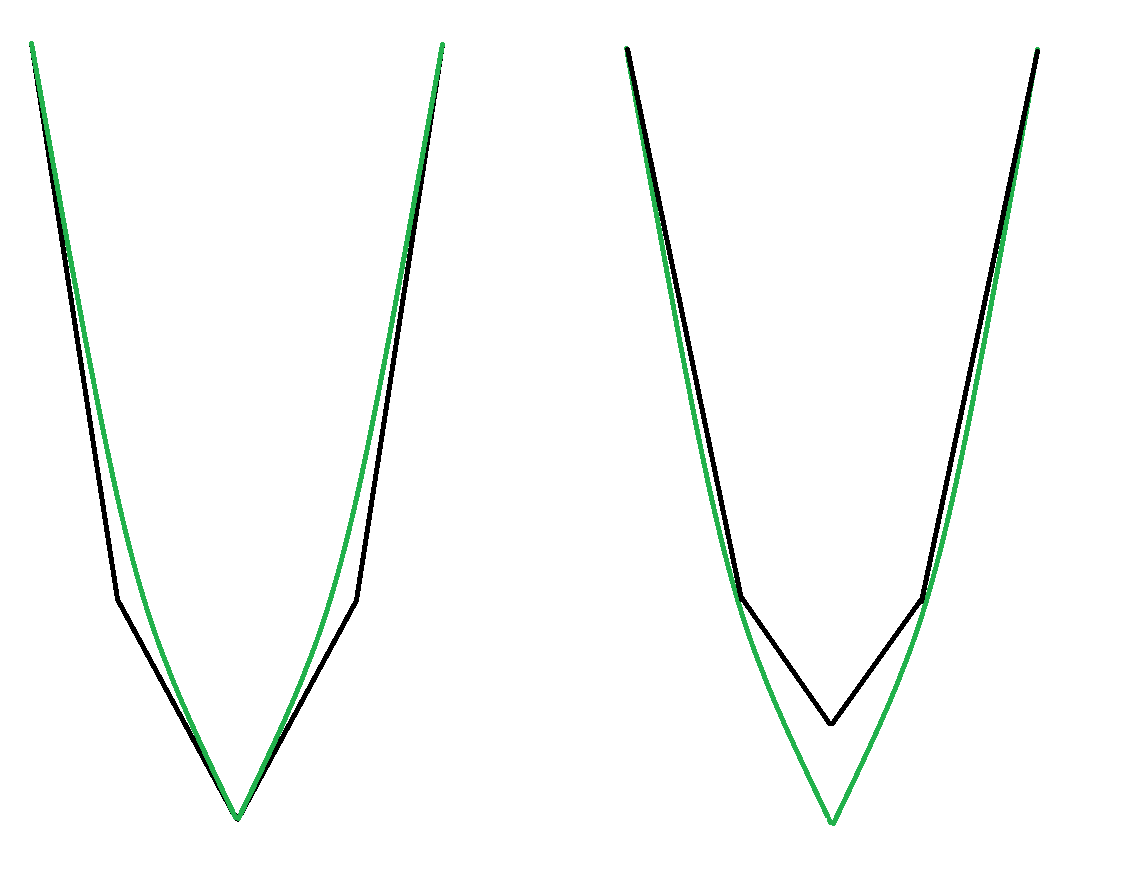
On the left, you see how a convex edge (depending on how it's ground, of course), in green, compares to a v-edge, in black. On the right, you see how grinding a v-edge into a convex edge will recede back into the material. The exact dimensions will of course depend on your particular knife, but hopefully this will help you visualize it.

- Joined
- Jun 4, 2010
- Messages
- 6,642
Additionally, the sides (what will be the primary grind if you V bevel it) will be convexed going into the cutting bevel. It doesn't look terrible but does look a little awkward. As mentioned above I'd use it as is, maybe get a cheap knife to practice on, but I'd keep it as a convex at least long enough to get a feel for it.
I initially made my Bark River a V bevel and changed it back. Lost a little steel, but that was the knife that made me appreciate the convex. Not all of my cutlery is convexed, but some are. It isn't difficult to maintain them, I just use the same stones I use on my regular grind tools.
I initially made my Bark River a V bevel and changed it back. Lost a little steel, but that was the knife that made me appreciate the convex. Not all of my cutlery is convexed, but some are. It isn't difficult to maintain them, I just use the same stones I use on my regular grind tools.
- Joined
- Mar 16, 2012
- Messages
- 939
Well said and well diagrammed...
On the left, you see how a convex edge (depending on how it's ground, of course), in green, compares to a v-edge, in black. On the right, you see how grinding a v-edge into a convex edge will recede back into the material. The exact dimensions will of course depend on your particular knife, but hopefully this will help you visualize it.
While those graphics are interesting, they are also misleading. Those are two possible comparisons between a convexed edge and a V edge, but there are an infinite number of convex edge profiles and an infinite number of V edge profiles -- and an infinite number of ways to convert one to another. We don't know what kind of convex edge your Bark River has. It could be extremely obtuse or it could be virtually identical to a V edge.
You can mess around with sandpaper and mousepads and see how it works. You can also used a guided system and get a precise V edge of your choosing.
When you don't define the boundaries of an edge, you can make a convex edge outperform a V edge or vice versa.
But when you do define the boundaries of the edge (edge shoulders and apex in the exact same places for both types of edges), the V edge will be more acute and slice better. The convex edge will be more durable. But those differences can be huge or almost non-existent, depending on the arcs you choose for the convex edge.
If you don't keep things constant in the comparison, either a V edge or a convex edge can be a better slicer or more durable. The problem with a convex edge is that you don't know what you have. With a V edge, you can dial it in precisely (15 dps or 20 dps or 12 dps with a 15 dps microlevel, etc.)
Your Lansky will easily convert whatever convex edge you have into a V edge of your choosing. But it's also not too difficult to maintain whatever convex edge your knife comes with -- you just won't know what kind of edge your dealing with.
A convex edge is formed by the meeting of two arcs. A V edge is an angle. They don't directly compare.

- Joined
- Sep 28, 2014
- Messages
- 693
If you want a cheaper knife to practice your convex sharpening, you could get an Opinel. Seems a shame to me to V grind a Barkie. It's like putting a secondary bevel on a Scandi. Sure you can do it, but why? Good luck!

LEGION 12
Gold Member
- Joined
- Jan 8, 2009
- Messages
- 63,677
I think I am going to go ahead and buy the sharpening system for Knives Ship Free it has sand paper,strop,paste,and come in a s3 otterbox that serves as a platform for the strop and the sand paper.In addition it is only $40
I have one and it works great for a convex edge.
- Joined
- Apr 7, 2014
- Messages
- 866
While those graphics are interesting, they are also misleading. Those are two possible comparisons between a convexed edge and a V edge, but there are an infinite number of convex edge profiles and an infinite number of V edge profiles -- and an infinite number of ways to convert one to another. We don't know what kind of convex edge your Bark River has. It could be extremely obtuse or it could be virtually identical to a V edge.
They're not at all misleading, seeing as how I clearly stated multiple times that it all depends on how it's ground and that this was just to help them visualize:
On the left, you see how a convex edge (depending on how it's ground, of course), in green, compares to a v-edge, in black. On the right, you see how grinding a v-edge into a convex edge will recede back into the material. The exact dimensions will of course depend on your particular knife, but hopefully this will help you visualize it.
- Joined
- Jun 4, 2010
- Messages
- 6,642
They're not at all misleading, seeing as how I clearly stated multiple times that it all depends on how it's ground and that this was just to help them visualize:
The diagram made sense to me. Bottom line - all other things being equal (spine thickness, width of blade face, terminal apex inclusive angle) the convex will always have less resistance - less material behind the edge. Only a full flat grind (or hollow grind) from shoulder to apex, all other things being equal, can have a more acute terminal edge angle. Any V bevel that has a primary and secondary grind can be made more streamlined by convexing it - smoothing the shoulders out. Only by eliminating the grind transition (FFG) can one eliminate this factor.
I'm not claiming it makes a measurable difference in performance in every case, in general I only sweat it with my heavier choppers that have to bite as deep as possible. On many cutting chores it makes very little difference and can actually result in less lateral stability if ground too thin. On thicker stock, it makes a big difference.