blade quenching fact or fiction

Status
Not open for further replies.
What's that mean Rick?

It's the same metallurgy, just different logic and reasoning behind the two. There is only one type of metallurgy,... "human metallurgy". I agree that the most important thing is to understand both types of quenches and logic, and then apply whatever reasoning you like to it.

However,... I think a full quench will make a better pry bar. :)

That is why I put "metallurgically sound" in quotes.... because it has a different meaning for different applications. If you wanted the stunning look of a highly active temper line, then a method that promoted varied structures(post quench) would be the most "metallurgically sound" choice for you. If you wanted a tough blade but also needed to maximize strength for a given thickness, the "metallurgically sound" route would be to impart a homogeneous martensitic structure with customized tempering.

lol.... Don't be such a pry-baby, brother!

Rick:D:thumbup:
 
That is why I put "metallurgically sound" in quotes.... because it has a different meaning for different applications. If you wanted the stunning look of a highly active temper line, then a method that promoted varied structures(post quench) would be the most "metallurgically sound" choice for you. If you wanted a tough blade but also needed to maximize strength for a given thickness, the "metallurgically sound" route would be to impart a homogeneous martensitic structure with customized tempering.

lol.... Don't be such a pry-baby, brother!

Rick:D:thumbup:

... O.K., but stop trying to be so "mental-lurgically sound".

Be a "CAWK"!
(Crazy And Whacky Knifemaker) :)
 
Last edited:
Bottom line is, you can subscribe to the virtues of one method or the other, or you can undertake the journey to find out for yourself, as Ed Fowler said. Unfortunately, making and breaking 2 blades won't provide the full answer, so the quest for truth is a rather long one, and obviously dosen't turn out the same for everyone.
 
You hit upon one of the main divides in knifemaking between:
1-Those who believe in using known scientific knowledge and controls to make the best knife possible.
2-Those who use traditional methods and experience to do what they judge to be the best, based on their training, experience, & perhaps testing

The point that I consider to be the biggest downside in edge quenching vs. fully quenched blades & so far hasn't been mentioned is temperature control.


In another thread about quench oils, Tai champions Canola oil for 1095.
He likes it because it minimized cracking, but for optimal performance, 1095 needs exceptional temperature control and a very fast quench.
I believe in this case, the use of the slower oil is used to compensate for imprecise temperature control.


All the edge quenching I’ve seen is torch heated and temperatures are eyeballed.
Perhaps the smith with 30 years of testing and experience can hit his temperatures very well, but especially for a new maker, it will leave a wide variation of temperature, steel structure, and therefore performance.


With all the technology available to control temp, PID controlled forges, salt pots, kilns.
I can’t see why a person wouldn’t use it; especially if you already own it.


There seems to be huge weight placed on a knife’s ability to bend rather than break.
It’s a knife vs. prybar issue.
As mentioned before, full quench and differential temper also makes sense to me.
Fully hardened blades are stronger than ones that are left so soft that they bend.
Some people put lots of marketing effort behind bendy.
 
Either way you slice it,... certain conditions have to be met to achieve the desired results. (Exactly what the desired results are is up to you). In other words, temps., and timings must be right on or you will not achieve the desired results. The flip side of the coin is that, if you achieve the desired results,... the temps., and timings etc., must have been right on.
 
Edge quench or not to edge quench.

How about listing the "desired results" wanted and then itemizing how the edge quench method does not meet the criteria?
 
Edge quench or not to edge quench.

How about listing the "desired results" wanted and then itemizing how the edge quench method does not meet the criteria?

Instead, let's list the desired qualities and find the HT process that best addresses each.... majority rules.
 
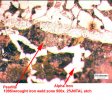
mixed pearlite microsructure is a composite structure consisting predominantly of tiny flat brittle carbide plates in a ductile iron matrix. It is somewhat abrasion resistant but has little relative strength. Pearlite structure will skate a file and squeak a drillbit but will deform somewhat readily and not spring back from a bend

wroughtIron-1095_weldzone_500x.jpg

1095-w-decarb_500x.jpg

These are not the best images to show the microstructure of an edge quenched spine because I would like to have sections all the way through from spine to edge, but I do not have access to a microscope anymore so these will have to do. Pearlite will fracture not only along grain boundaries, but will also show fracture propagation as the brittle carbide plates break, and at the boundaries between the carbides and the iron matrix.

On the other hand tempered martensite has a consistent structure, with the strength that accompanies that, will spring back from bending, and will not deform excessively if some idiot decides to demonstrate their wilderness skills by batoning with an iron bar

-Page
 
A knife is a total package, to try to examine one aspect without considering all the variables from the selection of the steel to the development of the final edge geometry is preposterous. There are many metallurgists who readily discuss from the firm traditions of the science depending upon the safety net of the foundations of tradition, I consider them nothing put parasites feeding off of what is known.

To quote myself " Some hang onto the traditional science of steels like a drunk hangs onto a lamppost for support, rather than using the illumination provided to explore where none have been before."
 
Calling a piece of steel a knife does not magically transform it into a mystical object in which material properties and physics are no longer applicable. Calling people names will not change those facts.

-Page
 
Status
Not open for further replies.
Back
Top