
-
The BladeForums.com 2024 Traditional Knife is available! Price is $250 ea (shipped within CONUS).
Order here: https://www.bladeforums.com/help/2024-traditional/
You are using an out of date browser. It may not display this or other websites correctly.
You should upgrade or use an alternative browser.
You should upgrade or use an alternative browser.
BOSS Street vs. Bravo 1... it's on!
- Thread starter Moloko Plus
- Start date

Ankerson
Knife and Computer Geek
- Joined
- Nov 2, 2002
- Messages
- 21,094
That ought to be interesting he does'nt cut knives any slack!
Yeah I can't wait to see that one.
 :thumbup:
- Joined
- Jun 18, 2008
- Messages
- 1,802
You're comparing edge geometry and blade geometry - not the same thing. A fully convexed zero edge, if kept shallow enough, can be every bit as good of a cutting geometry as a full flat.
The first thing I would have done with my BOSS Street, if I had kept it, would have been to put a nice convex edge on it.
Actually, it should be even better as there are no transitions to get stuck in the material you are cutting. A full flat grind still will have a comparatively abrupt transition from the edge to the secondary grind.
- Joined
- Jun 4, 2002
- Messages
- 332
A2 VS INFI, INFI WINS. By a huge margin.
Bravo1 has a convex edge which is strong but is not as good cutting geometry as a full flat (Boss Street). So while if both knives where made of the same steel the Bravo1 would be tougher but actually the Boss Street not only has better cutting geometry the steel makes it tougher than the Bravo1 EVEN though the Bravo1 has a tougher grind.
Furthermore, that little thumb ramp thing on the Bravo1 looks uncomfortable. And the Bravo1 is not coated, so its more susceptible to rust than the Boss Street which is coated. And even if you removed the coating from the Boss, INFI is STILL more rust resistant.
Moloko, I am looking forward to your review!!
I have the Bravo 1 in CPM154 so the rust-resistance is not an issue, but even so, I have several other Bark Rivers in A2 and never had a problem. The blades are very sharp and I've never had a BRKT that wasn't a mad slicer. Most times they just need a little strop if anything after a days work. My Bravo 2, which is now relegated to kitchen duty, has not been touched-up in a few months of food prep, including cutting frozen ribs apart and carving a couple turkeys and some chickens.
My Busse collection is growing ever larger and its my favorite brand but I still think I have room for two brands in my collection of fixed blades. For light work and even EDC I think a BRKT is a fine choice, along with some Busses. For emergency, major chopping, or SHTF duty, I would pick a Busse. BRKT A2s are very tough but I think the advantage goes to INFI, however, the A2 is easy to sharpen and stays sharp for a long time. Many of my recent Busse's were very sharp when I got them but I think the sharpness and convex grind advantage may be with BRKT, although it is getting very close and any knife can be reprofiled and resharpened to pop hairs.

- Joined
- Apr 4, 2009
- Messages
- 1,347
So when is this test? I have a few Busses and just ordered a BRKT Bravo 1 SS. I think price alone may put the BRKT ahead of the game if all other things are equal. Guess we'll see....
Ankerson
Knife and Computer Geek
- Joined
- Nov 2, 2002
- Messages
- 21,094
So when is this test? I have a few Busses and just ordered a BRKT Bravo 1 SS. I think price alone may put the BRKT ahead of the game if all other things are equal. Guess we'll see....
He said he will try and do it this weekend.


LMT66
Gold Member
- Joined
- Jun 18, 2008
- Messages
- 11,317
I think some of the posts here are a good indication of folks wanting thinner INFI to adapt to Bushcraft and hiking/camp tasks.
Lot's a folks peeking in from time to time hoping to see ThINFI. Revenue potential could be huge if Busse can accomodate. Delete the choils and thin past EDC models and sales might be Huge.
BOSS St without a choil and thinner would be sweet! Might put a stop the the huge sales of the Bravo-1 which is apparently BRK's biggest seller ever.
Lot's a folks peeking in from time to time hoping to see ThINFI. Revenue potential could be huge if Busse can accomodate. Delete the choils and thin past EDC models and sales might be Huge.
BOSS St without a choil and thinner would be sweet! Might put a stop the the huge sales of the Bravo-1 which is apparently BRK's biggest seller ever.
Ankerson
Knife and Computer Geek
- Joined
- Nov 2, 2002
- Messages
- 21,094
I think some of the posts here are a good indication of folks wanting thinner INFI to adapt to Bushcraft and hiking/camp tasks.
Lot's a folks peeking in from time to time hoping to see ThINFI. Revenue potential could be huge if Busse can accomodate. Delete the choils and thin past EDC models and sales might be Huge.
BOSS St without a choil and thinner would be sweet! Might put a stop the the huge sales of the Bravo-1 which is apparently BRK's biggest seller ever.
The Bravo 1 is .215" thick and the Boss Street is .220" thick, hardly enough to tell the difference in thickness.


Skrapmetal
Gold Member
- Joined
- Jul 13, 2009
- Messages
- 2,020
Honestly, I think a SAR4 would be a better apples to apples comparison to the Bravo 1.
The Bravo 1 is .215" thick and the Boss Street is .220" thick, hardly enough to tell the difference in thickness.
but the Bravo isn't really a Bushcraft knife. As stated earlier they are both "do all" knives. I think he was stating that people would love a knife suited/designed for Bushcraft and made from thin INFI.

tundratrader
BANNED
- Joined
- Jan 10, 2009
- Messages
- 1,312
I am for sure looking for thin. I finally bought a big knife the BWM. I have only held a couple of Busses and they have all been to big for the stuff I do. I have the S5LE and love that it is just about perfect. I was glad they finally made a skinny mistress. I am excited to get it. I think most busse people really like the sharpened pry bar stuff though. I think no matter what knife they make people buy them but it might draw a few more people in if they made skinfi!
LMT66
Gold Member
- Joined
- Jun 18, 2008
- Messages
- 11,317
but the Bravo isn't really a Bushcraft knife. As stated earlier they are both "do all" knives. I think he was stating that people would love a knife suited/designed for Bushcraft and made from thin INFI.
"Bushwacker" Mistress is a fine example and a name that has probably attracted more folks to consider a Busse for non-combat uses. Thin and a better fit in the great outdoors.
Ankerson........ After spending a great deal of time in Wildreness and Bushcraft type forums, I see the majority of Bravo-1 buyers are buying their knives for Bushcraft, hunting/trapping/game processing and general camping and hiking use. Yet to see one reviewed as a combat/tactical knife which it was made to be.
Both the BOSS ST and Bravo-1 are close in size and shape but both are pretty thick blades for the uses most buy them for, which is non-combat/tactical related.
I suspect the coming review won't include hacking thru recovery cables, chopping thru clay/mud walls, prying opening car doors but will include cutting wood, slicing meat or veggies or notching and feather sticks.
The BOSS ST arrival has caught the attention of outdoorsman and some posts have eluded to this being a knife they would buy for use outdoors but dislike the thickness. Slight differences in thickness in similarly shaped blades have noticable results when used for non-combat purposes.
It's a traditional overall shape for outdoors use and is kind of similar in design to the old Busse Tanker A and Euro-4, which many outdoorsman liked but were also a bit too thick for tasks most often done with a knife this size. The BOSS ST is a little too thick also but it has caught the attention of those wanting thin INFI woods knives.
BOSS ST - Skookum - Cultellus. (Cultellus is a great thin woods knife)


Last edited:
LMT66
Gold Member
- Joined
- Jun 18, 2008
- Messages
- 11,317
I am for sure looking for thin. I finally bought a big knife the BWM. I have only held a couple of Busses and they have all been to big for the stuff I do. I have the S5LE and love that it is just about perfect. I was glad they finally made a skinny mistress. I am excited to get it. I think most busse people really like the sharpened pry bar stuff though. I think no matter what knife they make people buy them but it might draw a few more people in if they made skinfi!
Well said!

- Joined
- Dec 31, 2005
- Messages
- 2,984
Well, since the OP is a "tad" slow on this review....I think on a "self help" contribution basis we are getting on fine....for my part I agree with a lot of what PorcyMtn66 says and I like his photo contrast of the Boss, the Skookum and the Culti as well because it fit's nicely in with what I would like to say....
My own experiences with Scandi Bushcrafters and I have a lot of them....is that the Scandi Edge grind that you see on the Skookum is at too steep an angle for a "lie it flat on the stone and sharpen by using the scandi grind as a guide" and if such a "zero edge" was applied to sharpen the knife....then like as not the edge would "roll"...
I have a number of Scandi knives which I have sharpened in this manner....


They are all from 3 or 4 mm thick stock and they all have a depth of scandi grind which is 8 to 9 mm....doing trigonometry maths this means that the edge on a zero grind is around the 25 degree inclusive mark.
This is way too thin for 01 steel or any other steel hardened to around 58-59 Rc... the edge simply rolls and if hardened higher it like as not would probably chip.
The best edge retention for these blades is by giving them a micro bevel and from my experience my best/most long lasting edges come from using the Sharpmaker on the 40 degree inclusive angle for the ceramic rods.
Spyderco tested a lot of angles before putting the Sharpmaker out on sale and found 40 degree inclusive to be the ideal for most steels and I have to say from my experience trying all sorts of angles I cannot contradict them.
However if you are looking at Scandi grinds for Bushcraft use on the basis that field sharpening is the reason for choosing them as the consistancy of using the grind for a zero edge makes field sharpening "easy"....and now find out that to make the knife perform well you need to sharpen using a micro bevel...the whole reason for choosing a Scandi design has to come into question
And for those who want to say my knife works perfect on a Scandi zero edge...well check out the Ray Mears DVD on sharpening a Woodlore....I think it is available on U tube...Ray does a zero grind and then strops his edge for 50 strokes which will certainly convex the edge somewhat...and then he runs it along the window of a Landrover at an angle which is not a zero edge but more like the 40 degree inclusive you would get from a Sharpmaker....so if Ray is putting a micro bevel on his knife and he designed the Woodlore and probably has more user hours clocked up than most of us...it is unlikely that what I have said is wrong...
So moving forward in my thinking....if you are going to micro bevel a scandi you may as well avail yourself of a knife design which works better than a scandi bevel for general field use on things like preping carcasses or meat/vegetables or cutting rope where the wedge shaped grind is a disadvantage...
Looking at the Boss Street and Culti you have really good examples of alternative choices...personally for the size of blade I feel the thickness of the Boss Street is a bit more than you need as the handle then becomes a fair bit heavier than the blade....but if you tapered the spine that would give the knife a lot more of a lighter/neutral feel to it....and a good convex Infi edge is very hard to beat for Bushcrafting IMO...so long as it is a thinned out edge and not one taken from the factory grind.
A Culti is a really nice choice for a knife that is ready to go from Busse for bushcraft work...but you can alter some other good candidates if you want a slightly bigger knife for camp chores...
I did a stripping and thinning and a high convex grind on this SJTAC and it works brilliantly for bushcraft...it is my sharpest Busse and possibly my sharpest knife....
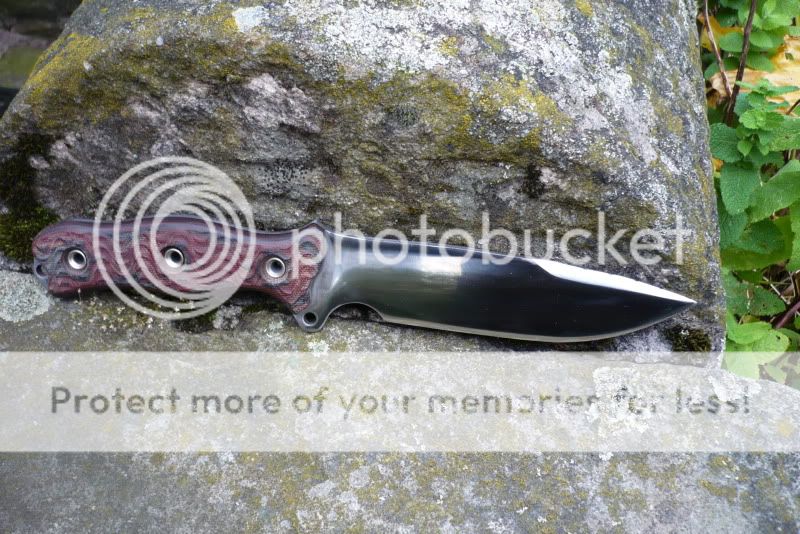
I gave the edge a bit of extra height by the handle for more delicate tasks and having convexed it ... it is still very strong and does not "roll" when working on hard wood...for strength near the tip I gradually tapered the edge so that it is still plenty sharp but strong enough for chopping and batoning or rawling holes using the tip...this knife works as well as any and probably for a lot longer than the scandi bushcrafters with zero edges and even those which have a proper micro bevel...
My S5LE being smaller and lighter is another candidate for a great bushcraft knife....
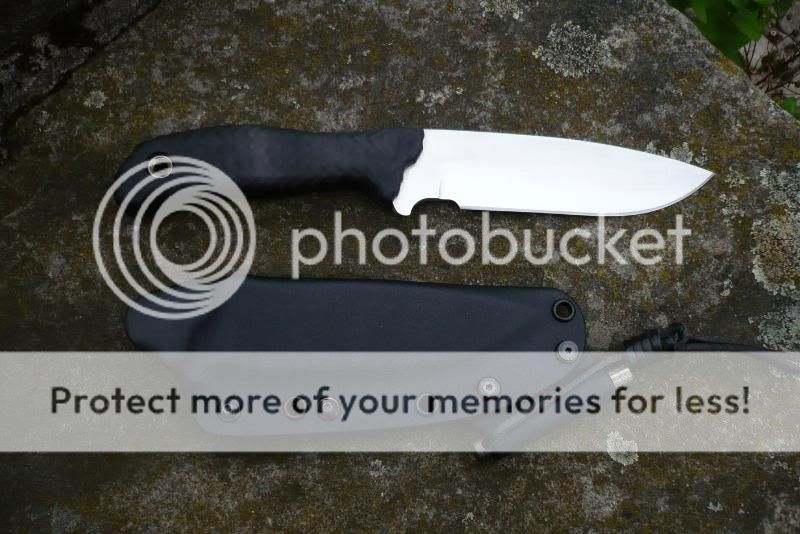
Not quite the edge work of the SJTAC but a good convex edge and it works like a charm....and I am sure the Boss Street could work just as well with the same time and effort put in to making the edge the right one for the tasks...:thumbup:
As to the Bravo 1 being a good bushcraft knife...it is...and it comes with a great convex edge razor sharp out of the box...get one without the thumb ramp and you have an instant winner from opening the box...so I think it would easily win compared to a factory edge Boss Street.... a closer call on a factory choice would be the S5LE IMO...they came razor sharp and even as bog standard factory blade they are better than the Bravo 1 IMO...I had a standard Bravo 1 and tweaked it by removing the ramp and then put a slightly dropped point on it and a custom sheath like Bear Gryllis...and was offered "premium money" for it by a Dutch Marine I met on a course.... so off it went to a new home....
My own experiences with Scandi Bushcrafters and I have a lot of them....is that the Scandi Edge grind that you see on the Skookum is at too steep an angle for a "lie it flat on the stone and sharpen by using the scandi grind as a guide" and if such a "zero edge" was applied to sharpen the knife....then like as not the edge would "roll"...
I have a number of Scandi knives which I have sharpened in this manner....
They are all from 3 or 4 mm thick stock and they all have a depth of scandi grind which is 8 to 9 mm....doing trigonometry maths this means that the edge on a zero grind is around the 25 degree inclusive mark.
This is way too thin for 01 steel or any other steel hardened to around 58-59 Rc... the edge simply rolls and if hardened higher it like as not would probably chip.
The best edge retention for these blades is by giving them a micro bevel and from my experience my best/most long lasting edges come from using the Sharpmaker on the 40 degree inclusive angle for the ceramic rods.
Spyderco tested a lot of angles before putting the Sharpmaker out on sale and found 40 degree inclusive to be the ideal for most steels and I have to say from my experience trying all sorts of angles I cannot contradict them.
However if you are looking at Scandi grinds for Bushcraft use on the basis that field sharpening is the reason for choosing them as the consistancy of using the grind for a zero edge makes field sharpening "easy"....and now find out that to make the knife perform well you need to sharpen using a micro bevel...the whole reason for choosing a Scandi design has to come into question
And for those who want to say my knife works perfect on a Scandi zero edge...well check out the Ray Mears DVD on sharpening a Woodlore....I think it is available on U tube...Ray does a zero grind and then strops his edge for 50 strokes which will certainly convex the edge somewhat...and then he runs it along the window of a Landrover at an angle which is not a zero edge but more like the 40 degree inclusive you would get from a Sharpmaker....so if Ray is putting a micro bevel on his knife and he designed the Woodlore and probably has more user hours clocked up than most of us...it is unlikely that what I have said is wrong...
So moving forward in my thinking....if you are going to micro bevel a scandi you may as well avail yourself of a knife design which works better than a scandi bevel for general field use on things like preping carcasses or meat/vegetables or cutting rope where the wedge shaped grind is a disadvantage...
Looking at the Boss Street and Culti you have really good examples of alternative choices...personally for the size of blade I feel the thickness of the Boss Street is a bit more than you need as the handle then becomes a fair bit heavier than the blade....but if you tapered the spine that would give the knife a lot more of a lighter/neutral feel to it....and a good convex Infi edge is very hard to beat for Bushcrafting IMO...so long as it is a thinned out edge and not one taken from the factory grind.
A Culti is a really nice choice for a knife that is ready to go from Busse for bushcraft work...but you can alter some other good candidates if you want a slightly bigger knife for camp chores...
I did a stripping and thinning and a high convex grind on this SJTAC and it works brilliantly for bushcraft...it is my sharpest Busse and possibly my sharpest knife....
I gave the edge a bit of extra height by the handle for more delicate tasks and having convexed it ... it is still very strong and does not "roll" when working on hard wood...for strength near the tip I gradually tapered the edge so that it is still plenty sharp but strong enough for chopping and batoning or rawling holes using the tip...this knife works as well as any and probably for a lot longer than the scandi bushcrafters with zero edges and even those which have a proper micro bevel...
My S5LE being smaller and lighter is another candidate for a great bushcraft knife....
Not quite the edge work of the SJTAC but a good convex edge and it works like a charm....and I am sure the Boss Street could work just as well with the same time and effort put in to making the edge the right one for the tasks...:thumbup:
As to the Bravo 1 being a good bushcraft knife...it is...and it comes with a great convex edge razor sharp out of the box...get one without the thumb ramp and you have an instant winner from opening the box...so I think it would easily win compared to a factory edge Boss Street.... a closer call on a factory choice would be the S5LE IMO...they came razor sharp and even as bog standard factory blade they are better than the Bravo 1 IMO...I had a standard Bravo 1 and tweaked it by removing the ramp and then put a slightly dropped point on it and a custom sheath like Bear Gryllis...and was offered "premium money" for it by a Dutch Marine I met on a course.... so off it went to a new home....
Last edited:
Ankerson
Knife and Computer Geek
- Joined
- Nov 2, 2002
- Messages
- 21,094
Ankerson........ After spending a great deal of time in Wildreness and Bushcraft type forums, I see the majority of Bravo-1 buyers are buying their knives for Bushcraft, hunting/trapping/game processing and general camping and hiking use. Yet to see one reviewed as a combat/tactical knife which it was made to be.
Both the BOSS ST and Bravo-1 are close in size and shape but both are pretty thick blades for the uses most buy them for, which is non-combat/tactical related.
I suspect the coming review won't include hacking thru recovery cables, chopping thru clay/mud walls, prying opening car doors but will include cutting wood, slicing meat or veggies or notching and feather sticks.
The BOSS ST arrival has caught the attention of outdoorsman and some posts have eluded to this being a knife they would buy for use outdoors but dislike the thickness. Slight differences in thickness in similarly shaped blades have noticable results when used for non-combat purposes.
It's a traditional overall shape for outdoors use and is kind of similar in design to the old Busse Tanker A and Euro-4, which many outdoorsman liked but were also a bit too thick for tasks most often done with a knife this size. The BOSS ST is a little too thick also but it has caught the attention of those wanting thin INFI woods knives.
The edge can be thinned out pretty quickly if one wants to do it, I plan on putting a 30 Degree edge on mine as soon as I get it.

- Joined
- May 31, 2005
- Messages
- 6,860
I'm confused. I always thought that "bushcraft" meant a certain type of blade. Now that I look at "bushcraft" knives and some bushcraft knife sites, I see there is a lot of variation.
F'rinstance, I was under reasonable impression that there was no guard or hint of guard in a bushcraft knife. I see lots of knives with so. Are Busse and Bravo-1 more distinct? Yep.
Also - there is the whole "no choil" thing. I don't get that at all. One would think a good bushcrafter would WANT some sort of smallish choil - just to be able to sharpen right up to the area most used for delicate push work. ????
Aside - saw one guy that was reviewing a knife use that same difficult-to-sharpen area to scrape his fire-rod. EEEK! Making triggers and such isn't in his game-plan I guess.
Finally, there is much debate on thickness. Is 1/4" too thick? Probably. But a wickit-thin Mora? Seems too thin to me for bushcraft. I wouldn't want to be splitting too much wood with something that thin, I think.
But I'm a certified armchair commando.
F'rinstance, I was under reasonable impression that there was no guard or hint of guard in a bushcraft knife. I see lots of knives with so. Are Busse and Bravo-1 more distinct? Yep.
Also - there is the whole "no choil" thing. I don't get that at all. One would think a good bushcrafter would WANT some sort of smallish choil - just to be able to sharpen right up to the area most used for delicate push work. ????
Aside - saw one guy that was reviewing a knife use that same difficult-to-sharpen area to scrape his fire-rod. EEEK! Making triggers and such isn't in his game-plan I guess.
Finally, there is much debate on thickness. Is 1/4" too thick? Probably. But a wickit-thin Mora? Seems too thin to me for bushcraft. I wouldn't want to be splitting too much wood with something that thin, I think.
But I'm a certified armchair commando.


- Joined
- Mar 14, 2009
- Messages
- 3,646
Also - there is the whole "no choil" thing. I don't get that at all. One would think a good bushcrafter would WANT some sort of smallish choil - just to be able to sharpen right up to the area most used for delicate push work. ????
....
Finally, there is much debate on thickness. Is 1/4" too thick? Probably. But a wickit-thin Mora? Seems too thin to me for bushcraft. I wouldn't want to be splitting too much wood with something that thin, I think.
A choil snags on stuff. If you're skillful enough hand sharpening, you can get that sharp edge dang close to the plunge line, and make it work just fine. With a tiny choil, you have to move the material you're cutting out away from your hand by the width of the choil to use the sharp edge anyway, so it's not like you are gaining any cutting edge. You can get the sharp part just as close with no choil, and often closer. And with no choil, you don't have to worry about that stupid *#$(@&ing choil snagging on everything when you cut it, especially soft, fibrous materials
As far as thickness, mora's are actually quite good for bushcraft. A bushcraft knife is NOT THE SAME THING as an all-around survival knife. It would be typically be paired with an axe or larger knife, which would handle chopping and splitting tasks, leaving the bushcrafter for the detail tasks where cutting is more important.
That said, you can baton with a mora quite easily, and as long as you don't try to force it through a knot and aren't pounding the hell out of it like you would a Busse, there is almost no worry that it would break.

- Joined
- Jan 28, 2006
- Messages
- 7,035
I often wonder why when someone brings up wanting a thin INFI blade for bushcraft, the BAD never comes up?
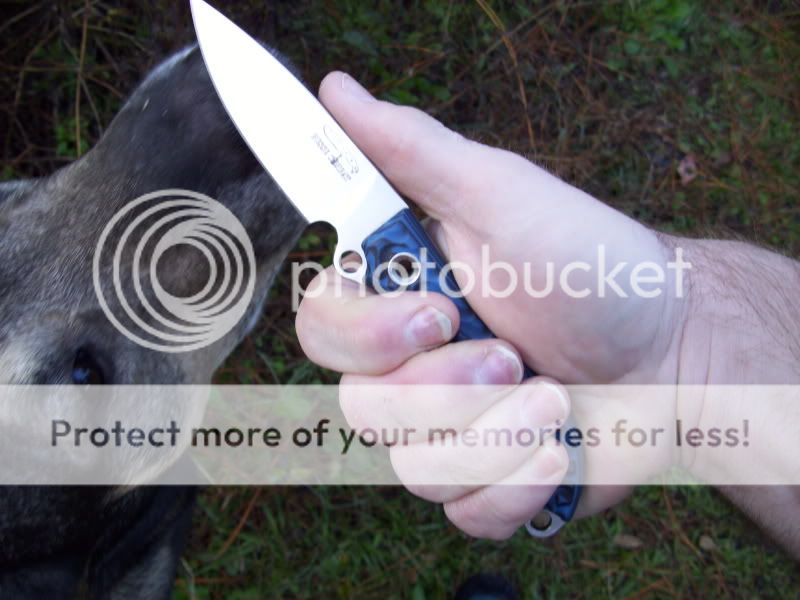
How is that not a great bushcraft blade? It's 1/8" thick at the scales, tapers all the way to the point, and is flat ground. I knocked the bevel to cheek edge off, and stropped the bevel and the thing cuts like a laser. Some Busse folks may think it too delicate because Jerry said the point won't hold up to prying. When in fact, I think he was referring to the kind of prying you guys do when you cut up an old washing machine or something. It holds up fine to drill divots for bow drills and prying out chunks of wood from notches and whatnot.
I know some will say that the blade is too short. Yet, when I mention how great the BRKT Aurora is as a bushcraft knife -- the blade profile and handle are very close to the BOSS Street, and the overall size is also very close -- people complain that the blade is too long. The Aurora is .150" thick, but if the BOSS Street is a flat grind, which it seems to be, it'll still slice well.
No offense, but I think some folks just want to complain (speaking more of comments on other forums and boards than here). If Jerry made it thinner with a satin finish, no doubt they'd just fall back on the "But it's too expensive!" complaint.
Re: scandi edges.
I'm a bit of a heretic here, but I'm not in love with a scandi grind overall. First, most people don't seem to realize that in Scandinavia, the "scandi grind" does come with a microbevel. Second, I think most US makers make the grind too obtuse. Look at how far up the cheek the scandi grinds above go, and then look at these:
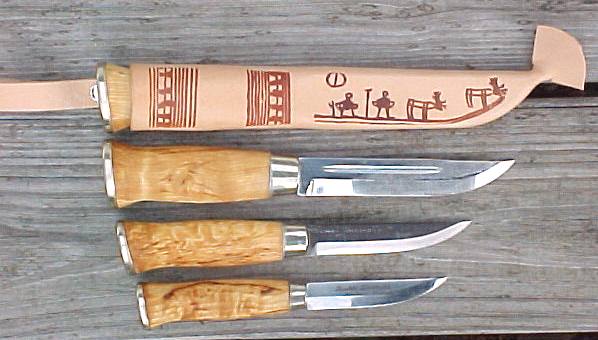
Instead of a quarter of the way up the blade, they go 1/3 to almost 1/2 way up the side.
I also find the "scandi grind" to be superior in one thing and one thing only, and that's shaving thin slices of wood, like making a fuzz stick, which seems to be the biggest test to most people on what makes a bushcraft blade.
Stand by, more heresy:
I think this is primarily due to the insistence upon pushing the blade straight through the wood. I tend to angle the blade and use a push slice to cut the wood, often with my off-hand thumb on the spine, giving me much more control and, to me, it's easier to do that way.
So, IMO the best bushcraft profile is the best slicing profile, which, to me, is a full flat grind with a convex final bevel.
How is that not a great bushcraft blade? It's 1/8" thick at the scales, tapers all the way to the point, and is flat ground. I knocked the bevel to cheek edge off, and stropped the bevel and the thing cuts like a laser. Some Busse folks may think it too delicate because Jerry said the point won't hold up to prying. When in fact, I think he was referring to the kind of prying you guys do when you cut up an old washing machine or something. It holds up fine to drill divots for bow drills and prying out chunks of wood from notches and whatnot.
I know some will say that the blade is too short. Yet, when I mention how great the BRKT Aurora is as a bushcraft knife -- the blade profile and handle are very close to the BOSS Street, and the overall size is also very close -- people complain that the blade is too long. The Aurora is .150" thick, but if the BOSS Street is a flat grind, which it seems to be, it'll still slice well.
No offense, but I think some folks just want to complain (speaking more of comments on other forums and boards than here). If Jerry made it thinner with a satin finish, no doubt they'd just fall back on the "But it's too expensive!" complaint.
Re: scandi edges.
I'm a bit of a heretic here, but I'm not in love with a scandi grind overall. First, most people don't seem to realize that in Scandinavia, the "scandi grind" does come with a microbevel. Second, I think most US makers make the grind too obtuse. Look at how far up the cheek the scandi grinds above go, and then look at these:
Instead of a quarter of the way up the blade, they go 1/3 to almost 1/2 way up the side.
I also find the "scandi grind" to be superior in one thing and one thing only, and that's shaving thin slices of wood, like making a fuzz stick, which seems to be the biggest test to most people on what makes a bushcraft blade.
Stand by, more heresy:
I think this is primarily due to the insistence upon pushing the blade straight through the wood. I tend to angle the blade and use a push slice to cut the wood, often with my off-hand thumb on the spine, giving me much more control and, to me, it's easier to do that way.
So, IMO the best bushcraft profile is the best slicing profile, which, to me, is a full flat grind with a convex final bevel.