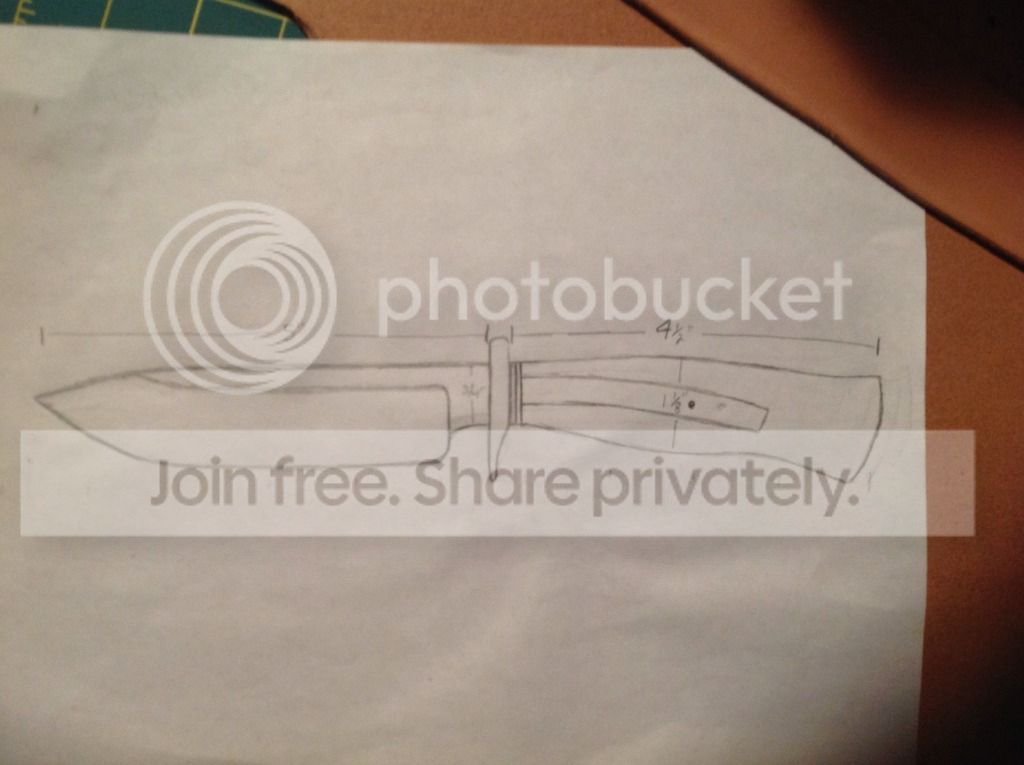
Matt R,
Keep a couple of things in mind. Nobody is trying to change your design so don't feel you need to redesign for us. We are just trying to help you optimize YOUR design. If our suggestions inspire you to make changes of your own intent, that's cool. The other thing is that your drawing is kind of like the blueprint for the project. So draw it as accurately as you can. That doesn't mean you have to use computers or spec out measurements to the thousandth of an inch. It means make sure curves and angles are smooth, straight, aligned or whatever the way they need to be. Let's look at your new drawing. Your angles are off a bit. Let's use the point at the top left corner of the guard (from this view) as our zero point or home base from which we make our visual assessments. I use this point as my reference point because this is where we usually find a right angle. The guard should be straight up and down here and the spine of the blade should be extending out at 90˚ from the guard. The spine may curve as it travels towards the tip and the guard may curl depending on design. But at this corner we usually have a good right angle reference.
So, if we examine your sketch it appears that the spine droops, the plunge line leans forward and the bottom of the ricasso curves downward. I think we can fix most of those problems just by turning the paper a few degrees to the right, hahaha. Then we only have the guard to fix. The point is to pick a zero point like the spine/guard junction as your foundation then make sure everything else is drawn/built in proper relation to that point. I understand that this is just a sketch but as you start working out the details you want in the finished piece, try to make sure the drawing is accurate. In this drawing it looks like the front of the handle is a little taller than .75". Unless you have very small hands I think 1"-1.125" is a comfortable width. I would widen the whole handle accordingly. If you decide to widen the handle, don't forget to widen the ricasso to match. Your line across the top of the knife looks good. Nice swell at the butt. The tang could still use another quarter inch in length. But if you make the handle wider you can also widen the tang. More steel = more strength. Also, the thinner the tang is, the closer to a square it will get in cross section. the closer to square it is, the more chance of the handle rotating on the tang under twisting loads. You will have the epoxy in there and it looks like you'll be pinning the handle. In theory however, the taller the tang in relation to the width, the less likely it is that the handle will break it's bond and twist. While we are talking about handles, take a look at your hand. Close your fist and look at how your curled fingers fall in your palm. The pinky (on my fat paws) is 3/4" away from the edge of my hand. This means that the top part of the handle may benefit from being a little longer than the bottom to accommodate the heel of the palm. That is why, if you take a look at the drawing I posted earlier, you will see the butt is angled at approximately 45˚. This is a personal preference issue but worth considering.
I think the blade deserves a closer look. What do you want here? Do you want a continuous curve from the heel all the way to the tip? Do you want a straight section before it begins to curve up to the tip? It seems that the edge, starting at the heel, drops down then straightens out then heads back up towards the tip in a pretty straight line. This is important. Even small changes in the line of the blade can make a big difference visually. It can mean the difference between something kinda wonky and something streamlined and refined. It sets the attitude of the knife. Changes in the line of the blade, particularly the edge, can also have a big impact on its performance. So it's usually a good idea to ask yourself "what is this knife going to be asked to do"? I am not an expert on all styles of knives but obviously some shapes work better for certain task than others. Make this part of your design decisions. The forward 1/3 of the edge looks a bit straight to me but if you erase the inside stretch of the line where it is drawn thickly I think it will give you the feeling of just enough curve there. If you intend for the rest of the edge to be straight then bring it straight back to the heel.
Overall I think your design is good. Tighten up the drawing a bit before you transfer the pattern to your steel. Keep us posted with your progress.