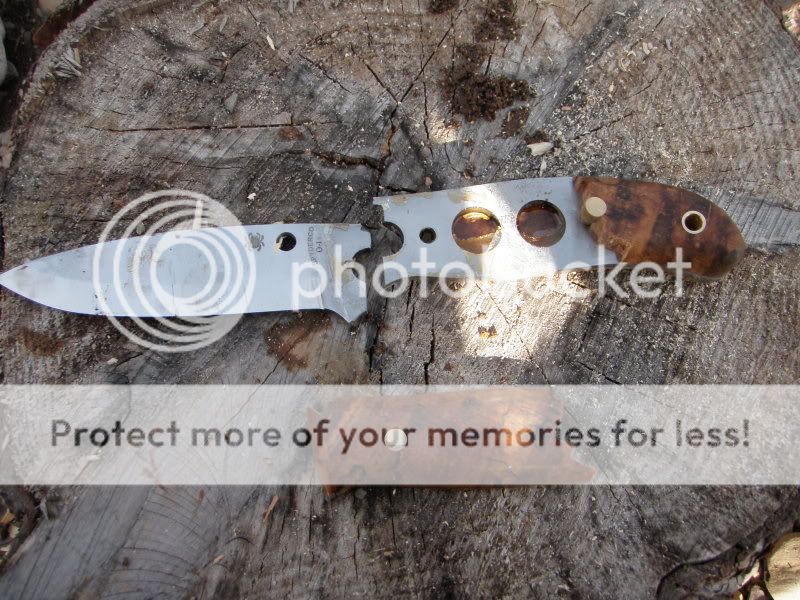
Breaking skelotonized knife while batoning

P3171255.jpg
 
I'm with Nathan. If I make a bush-craft knife.( Only made a few). Batoning is an accepted use of that knife. The knife should be up to the task. I could accept the handle to be damaged. But wood against the blade? The knife should win. I would gladly refund my customer the full price of the knife, and give a deserved apology ( guess I'm headed to knife hell with Nathan)
 
You guys are right...a good knife should be able to take the punishment. Thats why makers do destructive tests on knives anyways isn't it? I just like bigger knives so rather than batoning with the aid of a stick, I can just take one good swing and be done with it.:D
 
I think its stupid to drill holes in the tang to lighten it or give it better balance. If people are too feeble to carry the very small amount of extra weight of an undrilled tang, they should not be out in the wilderness in the first place.
 
I think its stupid to drill holes in the tang to lighten it or give it better balance. If people are too feeble to carry the very small amount of extra weight of an undrilled tang, they should not be out in the wilderness in the first place.


I believe that is only a valid argument if those holes lead to a reduction in the reliability of the knife, which I do not believe is always the case. Take a look at the article that Mete posted, it raises some interesting points.

There is no doubt that drilling a large hole in a stressed area will reduce the strength of any beam. However, depending upon the size and placement of the hole, it is possible to have a hole that does not contribute to a failure. For example, a small hole through the neutral plane of a displacement will be greatly overshadowed by the forces at the point of impact causing the displacement.

An exaggerated example : a glass window pane with a hole in the center of it, struck on the edge by a hammer. The impact from the hammer is either strong enough to start a crack and break the window or it isn't, the hole in the center of the window doesn't significantly affect the outcome.

I'm not saying this is the case in this particular knife, but I don't think you can just broadly say it is "stupid" to skeletonize a tang. If the benefits are not offset by a reduction in performance if would be a pretty good idea.

It is quite possible that knife would have failed even without a hole. I don't know.


edit to add:

The break going through the center of the hole certainly suggest it affected the break, but the interrupted fracture starting at the spine suggests that blade was going to break anyway. The hole may have simply affected the direction of a crack propagation.
 
Last edited:
It does'nt look like the holes were chamfered either...:confused: Is'nt that standard practice ? As a general rule I would'nt treat a knife like that unles it was a cord wrapped full tang,maybe synthetic scales. I have made some camp choppers that I would warranty that kind of treatment...in fact I encourage it!!


Eta: see ya in knife hell...
 
I use a knife and a hammer to split the rib cage on deer all the time. I just don't use a thin skinner for that. But I do use an actual hammer, not a nice soft piece of wood. I guess I'm going to knife hell...

Actually you can go right along the side of the sternum with a blade and cut the rib away from the sternum with minimal effort. No need to bring a hammer hunting unless you're feeding them out of your hand :p
 
No need to bring a hammer hunting unless you're feeding them out of your hand :p

Heh heh.. sweet holy Jesus, that's sick. :thumbup:

I don't actually bring a hammer down in the woods. I drag the deer to the trail, then haul it back up to the farm, hoist it up with a tractor etc. There I have a couple knives, saw, hammer, string, etc. I don't bring even a knife with me down into the woods anymore, I certainly wouldn't lug a hammer down there. About the only thing I take with me anymore is my bean field rifle, and I've even taken the sling off of it.

That would be funny as hell though. A hunter sitting there with a freakin hammer, feeding deer out of his hand and bonking them in the head. I think I'd pee my pants if I ever saw something like that.
 
Assuming all else is equal... quality steel, properly HT'ed, chamfered holes, avoiding stress-risers etc etc... how much material can you remove from a tang before you seriously compromise its strength? 10%? 25%? Do a tapered tang and a skeletonized one having the same profile and overall mass, have the same strength? What about a narrow tang with the same mass etc? I realize there's an awful lot of variables involved, just curious as to your general opinions/experience.

I suppose the only way to get a somewhat clear picture is to build 3 or more knives from the same bar and find out which one breaks first.
 
I am reminded of the Simpsons episode where Mr. Burns picks out cows for his steak, each one killed by a pneumatic hammer. "Oh that was a lively one"
 
There are many books out that discuss stress raisers. Any hole, any scratch can be a stress raiser, even the direction the blade was last buffed influences strength.

Just ask the maker how he personally tests his knives and what his guarantee is and you will know the limits of the knife. Then the decision is yours to make.
 
I wouldn't baton with one of those Spyderco's more out of concern for the handles than the blade/tang although both are obviously a legitimate concern as evident in that picture.

I wouldn't take a knife into the woods if I wasn't comfortable battoning with it but that's just me. I baton in the back yard pretty regularly to split firewood for my copper fire basin but none of the knives I use have skeletonized tangs except the Izula which I've used before but is really to small unless it's smaller wood.
 
Skeletonizing or tapering of tangs is for light weight and balance -not for strength, and not for something as important as a survival/ bushcraft knife.

For extreme hard use, a full tang is the only way to go.

I also noticed that the holes were laser/ waterjet cut with ragged edges ... not the best choice either as there are multiple stress risers. The holes if they absolutely needed to be there should be drilled and chamfered.

For light use, the knife is fine -as evidenced by the maple burl scales. Micarta or G10 are better choices for a bushcraft knife.

For hard use (which includes batoning), it could have been designed and made better.

Plus, I wouldn't call batoning longitudinally (along the grain) hard use -it's actually quite easy on a knife, turning it 90 degrees and batoning across the grain is more stressful.

Just my 2 cents. :thumbup:
 
I forgot to mention: should a maker tell you his blades are not meant for batoning and doing so will void the guarante, be sure and thank him for being honest with you.
 
Learned quite a bit from this thread. So should any knife designed for common camping/field chores not be skeletonized?

If so..then think I made a large mistake with the camp knife I'm working on. The knife in question is ~7 5/16" OAL with a ~3 9/16 tang about 1" in widest area and 1/8" thick; not sure how many holes I drilled to reduce weight..but most of them are more towards the center.
 
Actually you can go right along the side of the sternum with a blade and cut the rib away from the sternum with minimal effort. No need to bring a hammer hunting unless you're feeding them out of your hand :p

Does that work on hogs as well? That was the only time I batonned anything was on a 300+ pound wild hog. Yeah I should of bought and axe or a saw but didnt expect to run into a big hog.
 
[sarcasm]
Sounds like a new fashion... Some years ago it seemed that everybody had to cut nails with their knife which, if successful, demonstrates that hardened steel can cut mild steel... (oh, the wonder!) and if unsuccessful demonstrates that knives aren't made to cut nails (astonishing!). :jerkit:

Now there's batoning... that comes from "baton", french for "stick, club" and means "hitting with a stick".
I've looked up how "hitting with a knife" is written, and that's "knifing". I'm amazed beyond saying.

Bottom line: unskilled people getting disappointing results usually blame the tool. :rolleyes:
[/sarcasm]

Sorry... it's been a long day... and is a sad sight that of a nice knife destroyed in such a foolish way. :foot:
 
I think its stupid to drill holes in the tang to lighten it or give it better balance. If people are too feeble to carry the very small amount of extra weight of an undrilled tang, they should not be out in the wilderness in the first place.

:thumbup:
 
It's not about weight. It's about balance.
However there is such a thing as distal taper...
 
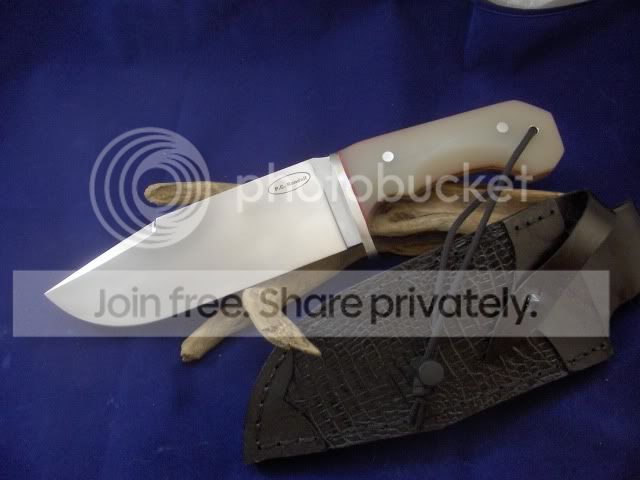
Baton this, I entered this into the Camp Knife Challage and I believe it was the only knife to complete the baton task, with alot of beating. Is this a job for a knife, only if designed for it, that is what I did with this one. The knives I have seen that are broken were designed to be used a normal camp knives and only in very extream situations should the be beaten to death. THis one will take a beating but as the reviewer stated not a good choice to peel potatoes.

campchallange001.jpg
 
Back
Top
