Burrs - SEM imaging - thoughts & theories

REK Knives

Moderator
Knifemaker / Craftsman / Service Provider
Joined
Apr 3, 2011
Messages
5,934
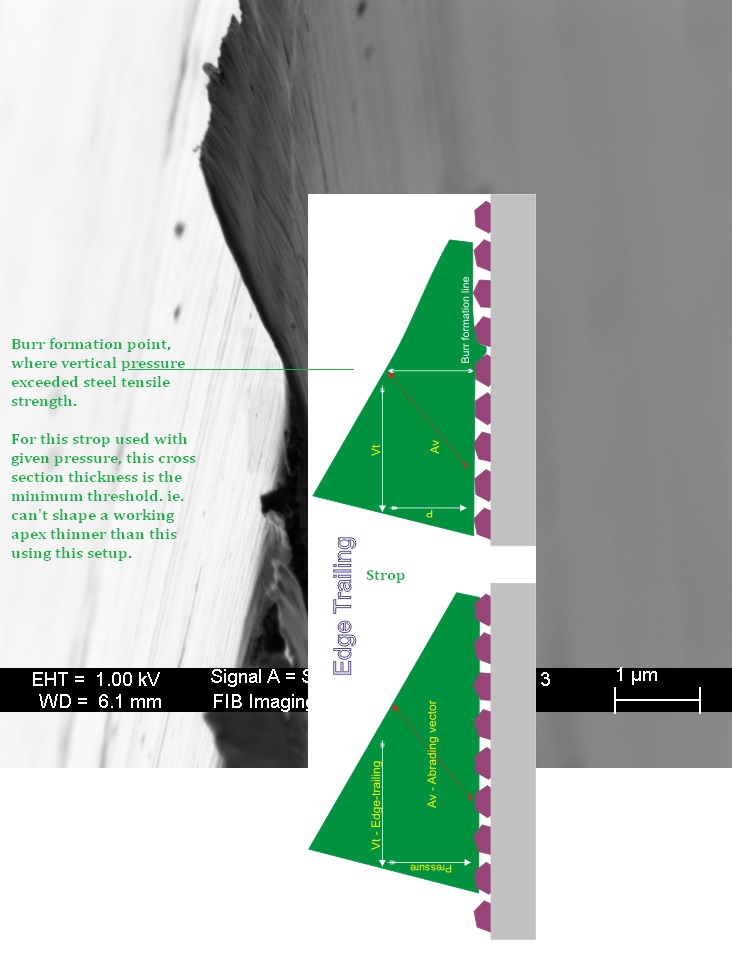
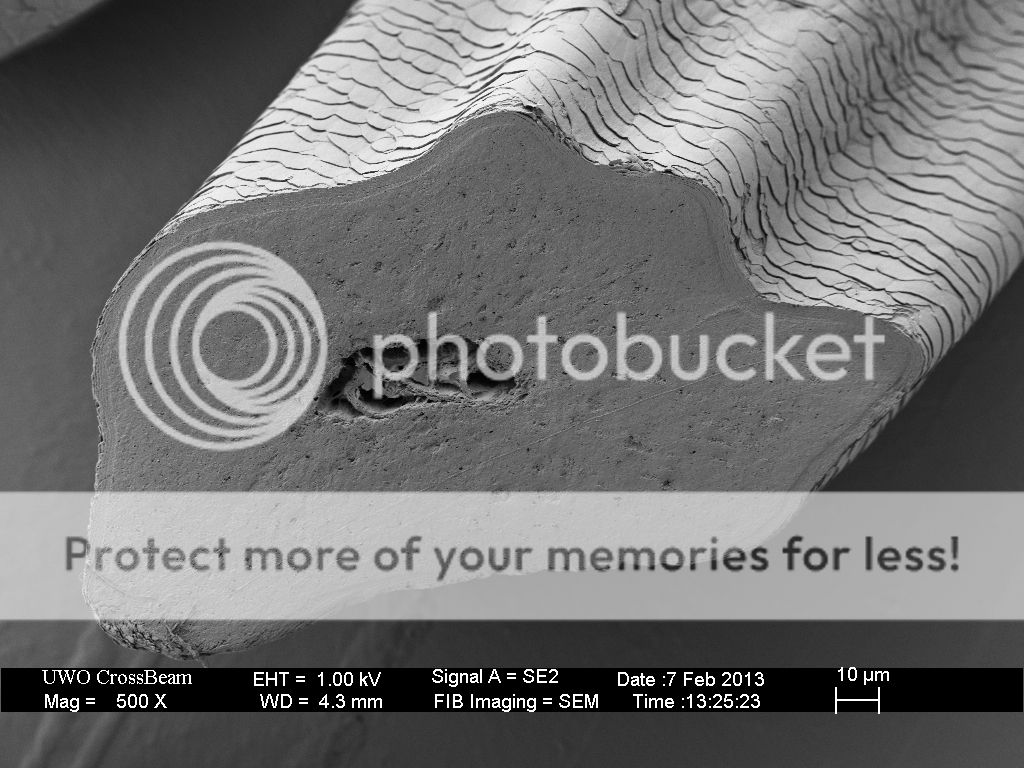
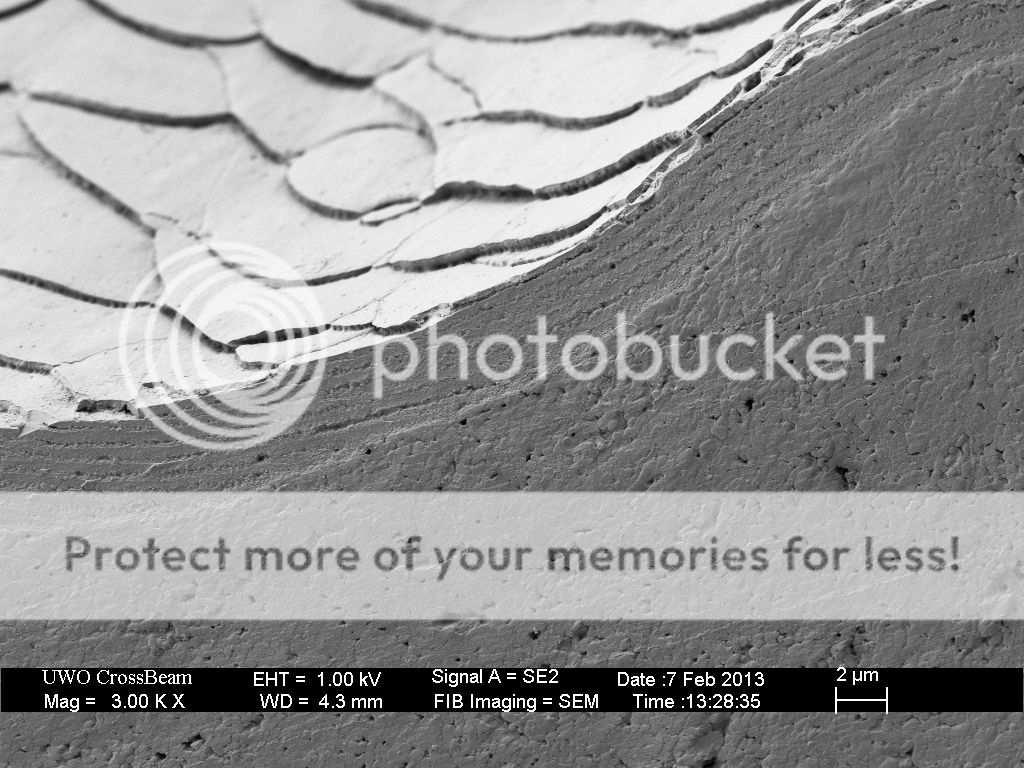
I am following Todd's blog here and figured I would post it up for others information... the SEM images are some of the best I have seen. In this article he is looking at multiple aspects and questions to both raising a burr and minimizing/eliminating it.

One of the interesting things that I found was that the edge does indeed become thinner at the very apex the further up in grit you go. This has been theorized but I had not seen it proven until now.

burr_08.jpg
 
Awesome pictures and info, thanks for sharing! Very interesting!

I remember a recent discussion about producing a burr on very fine diamond compound on linen. Sure enough, it happens, even on 0.25 microns. This seems to be true at least for carbon steels. I wonder how those SEM pictures would look like on steels with abrasive resistant carbides and diamond compound?!

On page "What is a burr? - page 2", after the first picture, it says:
"The addition of sub-micron abrasive to the strop will greatly accelerate this process; however, if done “incorrectly” can produce a very undesirable burr"
I wonder what they mean with "incorrectly" though. Too much pressure? Not alternating?

But they also say, if patient enough and no compound, the bare leather or linen will turn the 150-200 nm edge into a "thinner" apex, more comfortable for shaving. Hmm, I would understand leather with some natural silicates abrading carbon steel but linen? What about denim? Any "natural" abrasives in those materials? Or is this all just burnishing?

I guess I need a SEM at home to really understand what I am doing ...

Looking forward to the other folks comments.
 
Last edited:
There are two major types of burr as I see it. One is the bits of steel that form at the apex because the abrasive cannot cleanly remove every last bit of steel as it trails off into space (trailing), or as the abrasive enters into the steel (leading). A percentage is shoved out of position, either because the angle of the cutting mineral wasn't optimum or the steel deformed out of the way ahead of the mineral's passage (per the second type of burr below but on a much smaller scale). This is left behind per pass and over the course of a few passes it builds up to an appreciable level - heavily dependent on the manner in which the abrasive is presented etc.

The second type of burr is the curling that is formed when the amount of force applied is greater than the steel's ability to resist. There will be tailings at the edge per the first type of burr, and along the curving surface as it veers away from the abrasive surface. The curvature issue is mostly a product of force and what the steel can support - this can be eliminated by using an abrasive that cuts the steel more efficiently at lower force, using a steel that has more lateral strength, or increasing the edge angle.

The burring by abrasive contact has more components to it and has been covered to some extent in earlier posts. Factors that reduce this tendency - less applied force, greater friability of the abrasive, looser attachment of the abrasive to the underlying surface (mobility), conformability of the underlying surface, higher contact speed, with some steels a higher Rockwell value.

The mineral is basically a shaped ploughshare driving through the steel. The steel builds up and is cut free, builds up and cut free - abrasives work with a scratching mechanism for the most part (though CBN can actually shave curls off if the abrasive orientation is just right). Continuing with the analogy, the ploghshares to either side and behind all grind off the wake-like buildup of the abrasives to either side and any left in its path. You generally won't see burrs on a flat surface but will see grind troughs that terminate in mid stride if using a scrubbing pass or stopping cold in the middle of the stone - occasionally there will be a bit of debris still attached but not often.


If the ploughshare has mobility, can fold back on itself, sacrifice part of its physical structure (friability) or otherwise deflect when it encounters too much resistance etc, burring will be reduced. This is why lapping operations produce the frosted surface, and also reduced burring - likewise slurries, softer waterstones etc all tend to produce less burring - all other factors being equal. Speed reduces the burr formation because the ability of the steel to hang on as the minerals scratch away at it is partially a form of tensile strength per an elongation test - higher speeds result in less elongation before failure. At hand sharpening speeds I do not believe this is a factor.

I still have reservations about the conclusion reached in the earlier blog regarding coarser edges and inability to create high points that are as thin across as with finer abrasives (albeit over a smaller total percentage of the edge). The absence of burrs or burr precursors on the sample edges leave me curious about how they were prepared specifically. I have some optical images taken at 400 and 1000x of edges finished at medium grit value (800) and the high points appear to be quite acute - low sub-micron. Granted they are not with the clarity of a SEM at the same magnification, but even accounting for some lack of focal clarity they edges look mighty thin.

 
There are two major types of burr as I see it. One is the bits of steel that form at the apex because the abrasive cannot cleanly remove every last bit of steel as it trails off into space (trailing), or as the abrasive enters into the steel (leading). A percentage is shoved out of position, either because the angle of the cutting mineral wasn't optimum or the steel deformed out of the way ahead of the mineral's passage (per the second type of burr below but on a much smaller scale). This is left behind per pass and over the course of a few passes it builds up to an appreciable level - heavily dependent on the manner in which the abrasive is presented etc.

The second type of burr is the curling that is formed when the amount of force applied is greater than the steel's ability to resist. There will be tailings at the edge per the first type of burr, and along the curving surface as it veers away from the abrasive surface. The curvature issue is mostly a product of force and what the steel can support - this can be eliminated by using an abrasive that cuts the steel more efficiently at lower force, using a steel that has more lateral strength, or increasing the edge angle.

The burring by abrasive contact has more components to it and has been covered to some extent in earlier posts. Factors that reduce this tendency - less applied force, greater friability of the abrasive, looser attachment of the abrasive to the underlying surface (mobility), conformability of the underlying surface, higher contact speed, with some steels a higher Rockwell value.

The mineral is basically a shaped ploughshare driving through the steel. The steel builds up and is cut free, builds up and cut free - abrasives work with a scratching mechanism for the most part (though CBN can actually shave curls off if the abrasive orientation is just right). Continuing with the analogy, the ploghshares to either side and behind all grind off the wake-like buildup of the abrasives to either side and any left in its path. You generally won't see burrs on a flat surface but will see grind troughs that terminate in mid stride if using a scrubbing pass or stopping cold in the middle of the stone - occasionally there will be a bit of debris still attached but not often.


If the ploughshare has mobility, can fold back on itself, sacrifice part of its physical structure (friability) or otherwise deflect when it encounters too much resistance etc, burring will be reduced. This is why lapping operations produce the frosted surface, and also reduced burring - likewise slurries, softer waterstones etc all tend to produce less burring - all other factors being equal. Speed reduces the burr formation because the ability of the steel to hang on as the minerals scratch away at it is partially a form of tensile strength per an elongation test - higher speeds result in less elongation before failure. At hand sharpening speeds I do not believe this is a factor.

I still have reservations about the conclusion reached in the earlier blog regarding coarser edges and inability to create high points that are as thin across as with finer abrasives (albeit over a smaller total percentage of the edge). The absence of burrs or burr precursors on the sample edges leave me curious about how they were prepared specifically. I have some optical images taken at 400 and 1000x of edges finished at medium grit value (800) and the high points appear to be quite acute - low sub-micron. Granted they are not with the clarity of a SEM at the same magnification, but even accounting for some lack of focal clarity they edges look mighty thin.

Thanks for chiming in HH! I am having some difficulty following the terms you are using w/ out visual reference... also could you define what you mean by ploughshare?

As far as the apex lateral width minimizing with higher grits, if I am not mistaken Dr. Verhoeven also found the same thing under high magnification. Now both of these could be flawed and a larger overall look at the edge may be needed to try and find the high points you mentioned as well.
 
Does anyone know how far steel can be pushed up the edge bevel to create a burr? Do wider edge bevels produce larger burrs because more steel is being moved?

It looks to me as though the steel is being smeared up and over the apex. With coarser abrasives, more pressure, longer strokes, more strokes before alternating, and a wider edge bevel, the greater the burr.
 
Thanks for chiming in HH! I am having some difficulty following the terms you are using w/ out visual reference... also could you define what you mean by ploughshare?

As far as the apex lateral width minimizing with higher grits, if I am not mistaken Dr. Verhoeven also found the same thing under high magnification. Now both of these could be flawed and a larger overall look at the edge may be needed to try and find the high points you mentioned as well.


By ploughshare I mean the head of plow, like one being pulled by an ox. We don't normally think of it like that, but the abrasive is really a primitive plowhead. Picture if you lashed a sharp rock to a beam and added handles, and used it to plough furrows for planting. Only in this case it is a very sharp, tough rock, and you're driving it across steel with immense (for the scale) pressure being applied. Is not much different than dragging a nail across aluminum. It only gets difficult to imagine when you have to account for the entire field of abrasives moving in a unit - how does the cause and effect, easily seen when there is a single abrasive point dragging across a metal surface, change as you switch to a whole field of abrasives.

Next is what happens as you change the exit/entrance angle and vary not only the amount of support the dud metal has when the abrasive passes by, but the angle of the intersecting planes - in effect limiting the depth the abrasive is allowed to engage at the intersection as it cuts free. For example what happens to burr formation at the exit/entrance corner if you grind one plane of a 120* angle as opposed to the corner of a 30* angle? What happens to burr formation at the exit/entrance as you grind a 1/32" diameter rod opposed to a 3" diameter rod? Now imagine what happens as your furrow ends on an overhang and your plow passes off that point in space and/or catches it head on the return.

As long as the steel hasn't deflected into a curved burr (#2) it is just some tailings, they can be removed pretty easy. The attachment point is small and weak though. If the attachment point also encorporates some curl, removing the burr gets progressively difficult. The burr itself can readily flip if the applied force is greater that its ability to resist - that abrasive will remove some of it, but it will deflect out of the way and do so with increasing ease per number of flips and the abrasive will have less and less effect - so very important to use enough force that the abrasive can remove the burr but not enough to flip it, or at least that it can shrink its length/size before it flips each time, reducing the amount of leverage it has.

The burr is also a monent in time. On a clean edge with light pressure etc, one can make several passes on the same side before any appreciable amount of dud steel will form on the edge. If the burr is being ground down, you can get to a clean apex and have a bit of grace period before another will form - just have to increase the number of observation stops to catch it at the right moment during that bit of grace period.


In terms of lateral width, I believe a lot of it might come down to how the edge was prepared - waterstones tend to be pretty mild on burr formation at low to moderate grit value - to the point where one can get good results backhoning without raising another burr (easily) - try that on diamond or an India stone. I suspect a lot of this is due to the lapping action of many of them. Here are the pics I was talking about earlier, am not sure what to conclude as my edges were not done on a SEM, but I'd have to see a large sample of edges prep'd with different media and by different hands before I'm willing to accept as a blanket conclusion anything re abrasive size and terminal edge widths at the smallest point:


Images are at 0 and 45 degrees, 400x and 1000x. There are certainly regions that are more broad than others but also some of the high points look to be extremely narrow across.


800_42hc_400x_PP_Scaled_zps994593d4.jpg

800_42hc_400x_PP_45_Scaled_zps0a5104ab.jpg


800_42hc_1000x_PP_Scaled_zps01569b4c.jpg

800_42hc_1000x_PP_45_Scaled_zpsb3cb0620.jpg
 
Last edited:
Thanks for the explanations! But are those directly edge on? They look to be from the side, in which case you can't really measure width at all.
 
I still have reservations about the conclusion reached in the earlier blog regarding coarser edges and inability to create high points that are as thin across as with finer abrasives (albeit over a smaller total percentage of the edge)...

But isn't that the point, that a coarse grit produces thin high-points but also thicker low-points, i.e. not the desirable level of "keen" for shaving - a smaller and more uniform average apex-diameter? Verhoeven's experiments showed a reduction in this average as grit-level increased (particle-size decreased): http://www-archive.mse.iastate.edu/...te.edu/static/files/verhoeven/KnifeShExps.pdf

The coarse grit leaves thin high-points for penetration, but those points can gouge and are weak and the less thin valleys can snag and collect debris. Nobody wants to shave with a saw :eek:

But great explanation :thumbup:
 
Thanks for the explanations! But are those directly edge on? They look to be from the side, in which case you can't really measure width at all.

Those are pairs, side on and again at 45*. So not as good as edge on but still some info - I included the side view for reference as they are of the same approximate region on the edge.

Here's an edge on - the scale upper left is under 3.8u, so the edge at its thinnest spots is might narrow. Tough to say exactly as the light scatters some, but well under a micron anyway. We're starting to get away from the burr discussion...

edgeon_400x_scale_zps02eb277d.jpg
 
But isn't that the point, that a coarse grit produces thin high-points but also thicker low-points, i.e. not the desirable level of "keen" for shaving - a smaller and more uniform average apex-diameter? Verhoeven's experiments showed a reduction in this average as grit-level increased (particle-size decreased): http://www-archive.mse.iastate.edu/...te.edu/static/files/verhoeven/KnifeShExps.pdf

The coarse grit leaves thin high-points for penetration, but those points can gouge and are weak and the less thin valleys can snag and collect debris. Nobody wants to shave with a saw :eek:

But great explanation :thumbup:


I'm not taking issue with the average overall width, but rather the notion that the coarse abrasive is inherently incapable of creating edge widths at the narrow end of the spectrum (submicron) at all. Keep in mind, for draw cutting those points provide a lot of efficiency. Also, the region just behind them at the low points have sharp edges dropping down into the low spots and still quite narrow. This lends credence to the rougher edge (within limits) having greater longevity across a wide range of chores compared to a super uniform edge that is mostly reduced to pressure cutting (as a generalization).

For additional reference, that is 420HC done to 800 grit and stropped on paper. Part of an edge wear series I did -

http://www.bladeforums.com/forums/s...r-micrographs?highlight=edge+wear+micrographs

edge was dulled by draw cutting/shearing end grain red oak. Took 200 passes before it would stop shaving arm hair. Is surprising when you see how toothy the edge was, but then consider the scale.
 
Yeah I think it does bear more research there... good stuff to see what's actually happening at the edge all the same!
 
Yeah I think it does bear more research there... good stuff to see what's actually happening at the edge all the same!

It a lot of fun to play with the variables and actually (more or less) see what's happening as opposed to what we suppose might be. The images from Todd"s blog are fantastic, his ability to section off the ends for greater clarity is fantastic.

I have a dream of hooking a GoPro to my microscope, and mounting a stone to the stage - suspend the blade independently right in the viewing area and see real time what happens as the stone moves back/forth/laterally etc at over 200 frames per second. I don't believe the stage is robust enough for that, but am pretty sure I could rig the camera...

Martin
 
Martin/HH - you might even produce a clean edge sharpen a rubber knife. Just sharpen like a newb or avg sharpener using dull abrasive, burr up then take a few high mag pics.

OP **

I am rusty with sharpening and probably shaky on this ground. Hahaha won't stop me from 2centing ...

Or (misguided) steadfast on my hand-waving physics from 2 years earlier
vsGDzZj.jpg
 
Thanks for sharing bluntcut, that is good stuff... although I don't understand it all (didn't get that far in math lol). On a side note, here are some more pics Todd took of a human hair I thought were interesting... gives "new" insight into the HHT huh? lol

Feather_01_zps5b556134.jpg

Feather_03_zps6f50bbaa.jpg

Feather_04_zps908bbc2e.jpg
 
I'm still trying to get a working sense of what is happening to form that burr.

What makes sense to me to this point are the concepts of elasticity vs plasticity, coupled with the concepts of burnishing and spalling. Elasticity in metal is a deformation where energy is stored in the deformation and released (springs back) when the load is removed, like a spring or a blade that is flexed a few degrees. Make that load too heavy, and elasticity turns to plasticity, where there is permanent deformation when the load is removed (the blade doesn't fully spring back, but takes a set that cannot be recovered without the application of more force).

Then when we add the concept of burnishing, we can see what happens to the burr -- at least part of what happens. When the stone slides along the edge of the steel blade (burnishing), steel is actually pushed forward (plasticity). The burr forms as the stone passes over the apex and there is nowhere left for the metal being pushed to go, so it is pushed up as a burr. As you continue to sharpen on that side of the edge, more metal is pushed up and added to the top (stone side) of the burr, forcing the burr to curl away from the stone.

Spalling is caused by subsurface cracks that form when steel is forced to flow by the sharpening stone. This cracking causes the steel to flake off in tiny pieces, and so this becomes a second way that steel is removed in the formation of an edge.
 
I'm still trying to get a working sense of what is happening to form that burr.
Both of those burrs are simply the metal "left behind" from not abrading through the apex. The raised burr is a 3 micron thick layer of metal that "was" the right side surface of the bevel. The stropped burr "was" the center of the blade. In neither case has the metal moved from it's initial location, other than flipping back and forth.

I'm not taking issue with the average overall width, but rather the notion that the coarse abrasive is inherently incapable of creating edge widths at the narrow end of the spectrum (submicron) at all.
You are correct; here are two images from an straight razor after a DMT 325:

dmt325_01.jpg

dmt325_06.jpg
 
Thanks, Todd. Awesome stuff.

The metal in the burr looks solid (photo in post No. 1), with the exception of some spalled metal debris on the perimeter. That metal had to come from the blade edge, and I'm not seeing how it could get there in that form other than by plastic flow.

I'm also a little confused about the apex width issue that HeavyHands raised. In the first post, Josh says: "One of the interesting things that I found was that the edge does indeed become thinner at the very apex the further up in grit you go. This has been theorized but I had not seen it proven until now." Are you saying that the apex width is not a function of the honing grit?
 
Back
Top