Chop off TEST Cold Steel Vs. Busse PICTURES

Joined
Jul 9, 2005
Messages
475
Gentlemen

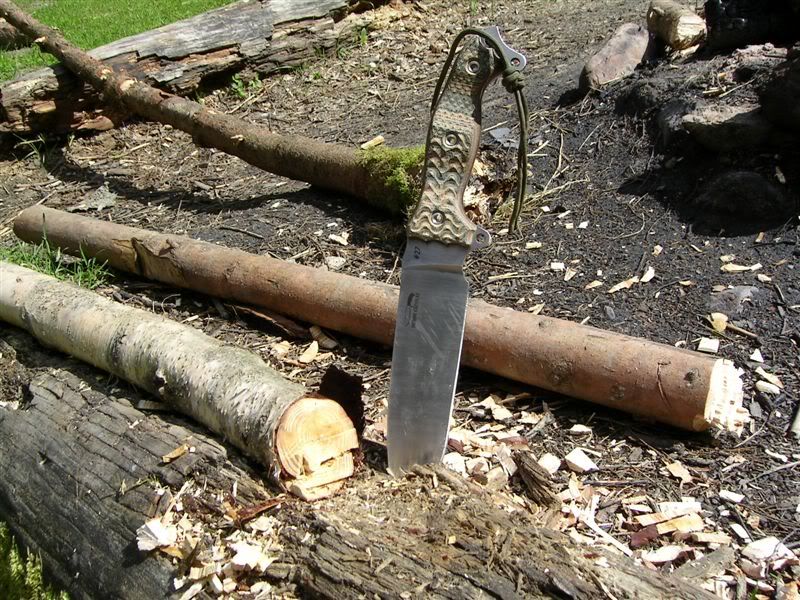
I decided to make a chop off test between the Cold Steel Trail Master (TM) and the Busse Heavy Ordinance Fusion Steel Hart limited edition (HOFSH LE)
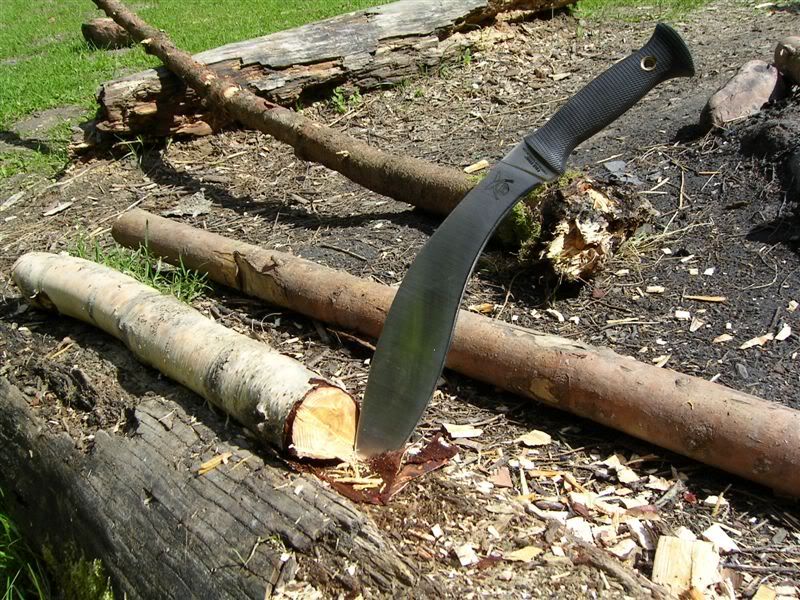
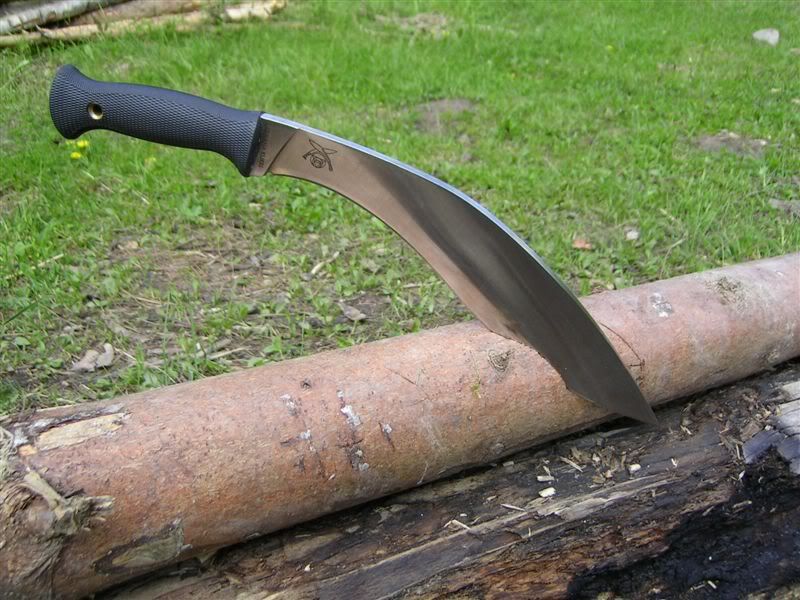
I also through in the Cold Steel Kukri as a wild card to see how this true chopping machine would do among ordinary knives.

The knife specs are:

Cold Steel TM old satin version 9.5" blade made from 5/16" carbon V, the knife is a factory second. (The grind is not perfect on the left side)

Busse HOFSH LE 8" blade made from 5/16" INFI steel

Cold Steel kukri 12" blade made from 5/16" Carbon V stock

This test is not made to make one knife look better then the other.
The TM is my old trusted knife and the HOFSH LE is a new knife that I have not experienced so much with.
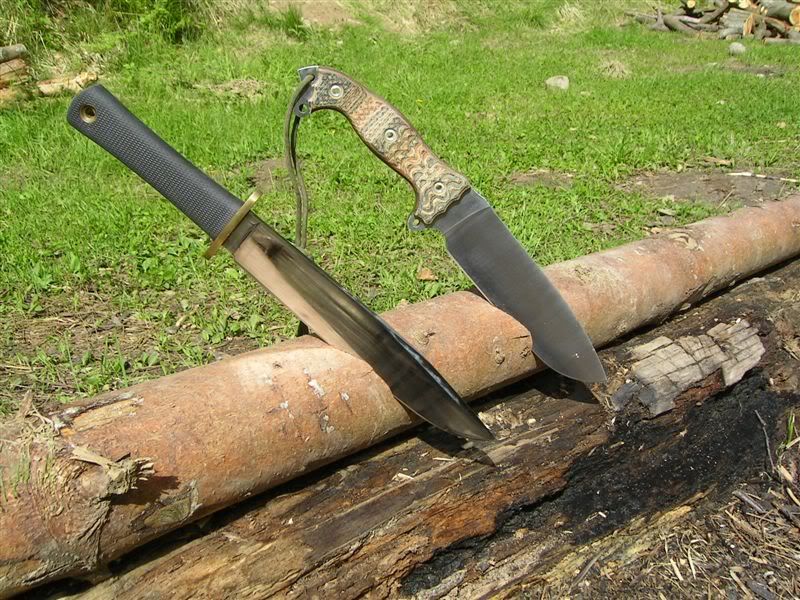
ChopOffTrailMasterandHOFSHLE1.jpg


ChopOffTrailMasterandHOFSHLE2.jpg


I started off chopping some dry pine logs. I did not try to chop with the fewest strokes but just worked normal like I would if I was setting up a camp.
These are the results:

After 50 strokes the TM made it this far into the log.
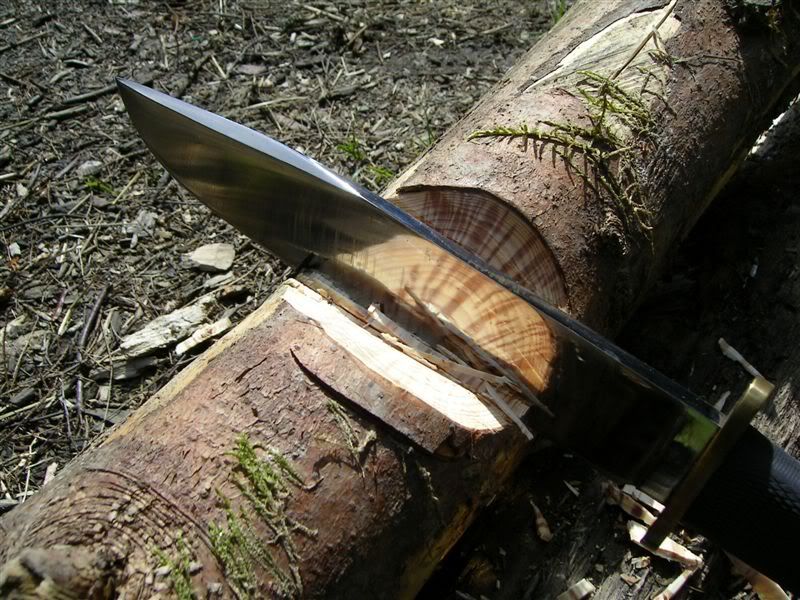
ChopOffTrailMasterandHOFSHLE3.jpg


The log was chopped in half after 149 strokes.
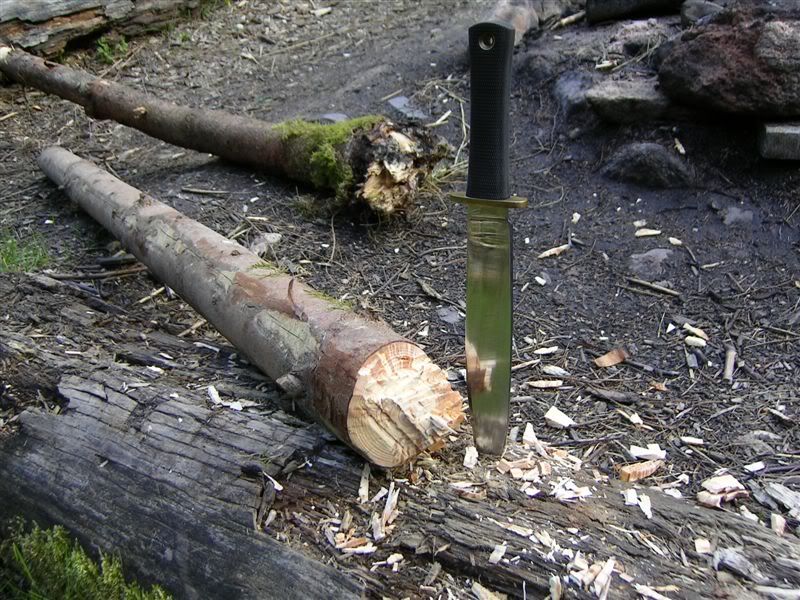
ChopOffTrailMasterandHOFSHLE4.jpg


The HOFSH LE made it this fare after 50 strokes.
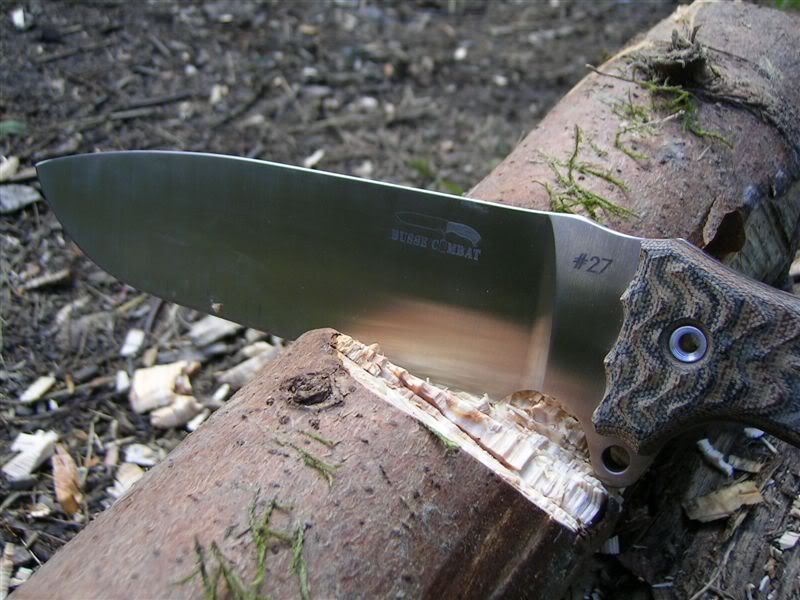
ChopOffTrailMasterandHOFSHLE5.jpg


The log was chopped in half after 127 strokes.
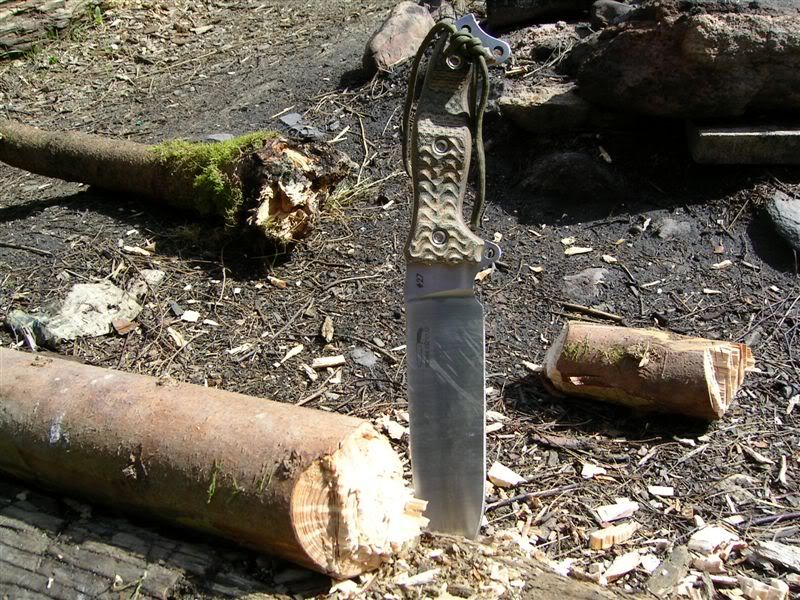
ChopOffTrailMasterandHOFSHLE6.jpg


I was exited to see if the Kukri would do much better, after all it is made for chopping and is larger.
This is what the log looked like after 50 strokes.
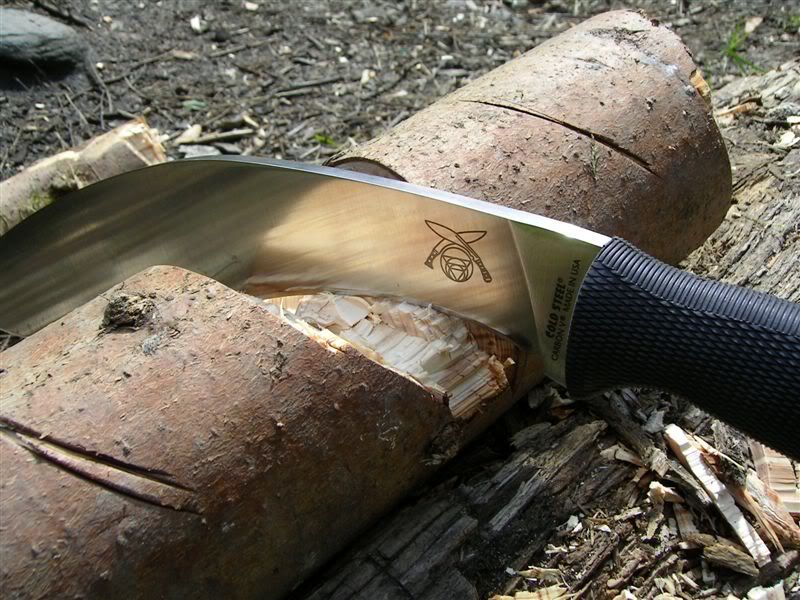
ChopOffTrailMasterandHOFSHLE7.jpg


The log was chopped in half after 97 strokes.
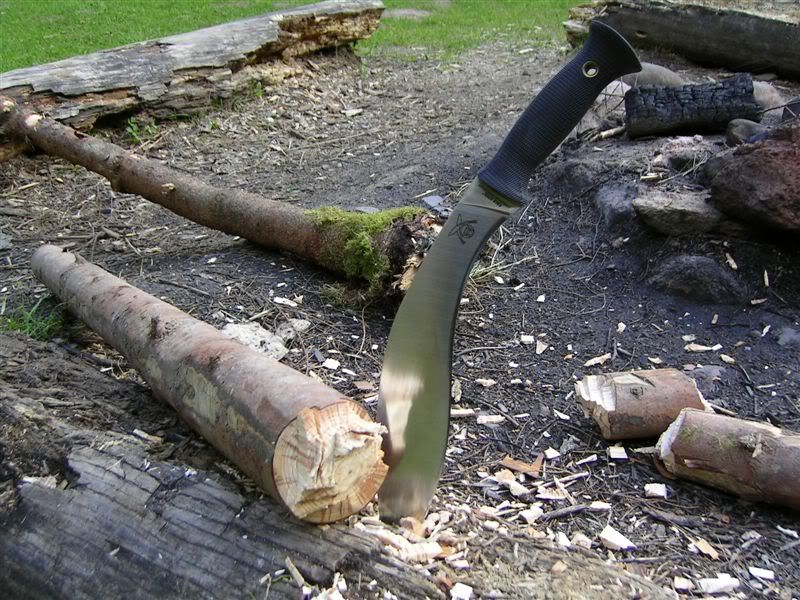
ChopOffTrailMasterandHOFSHLE8.jpg


All tree knives performed very well and the knives where still very sharp. Boy was I having fun
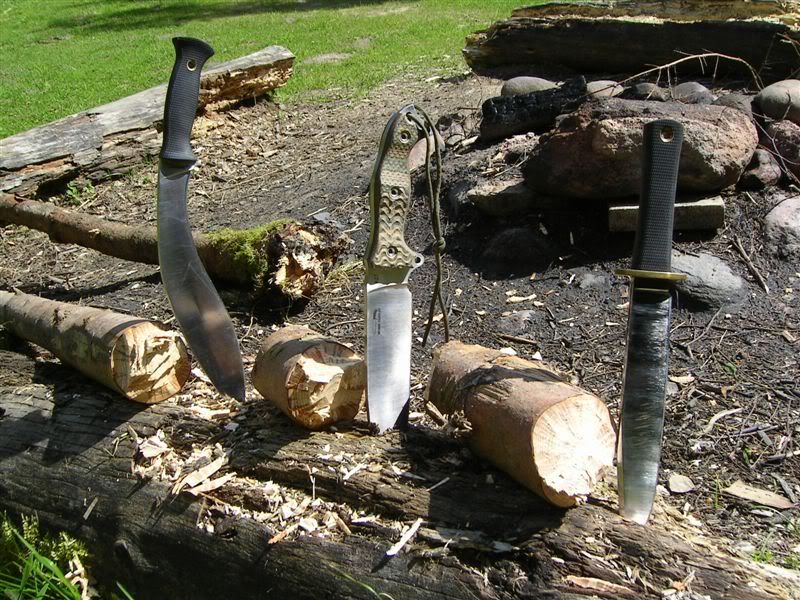
ChopOffTrailMasterandHOFSHLE9.jpg


Cheers,

André
 
I decided to chop some birch wood, also dry wood that was laying around the camp site where this test took place.

These are the results:

TM 25 strokes

HOFSH LE 32 strokes

Kukri 20 strokes

ChopOffTrailMasterandHOFSHLE10.jpg


ChopOffTrailMasterandHOFSHLE11.jpg


ChopOffTrailMasterandHOFSHLE12.jpg


I do not feel that the TM did better then the HOFSH LE and the explanation for the fewer strokes is that almost every stroke was perfect.

After chopping the birch wood I inspected the knives with my nail to feel if the knives had any chips or uneven development on the edge. The Busse knife had some very minor deformation/unevenness but is was very little. This might be due to the fact that the edge is a factory edge and a bit more rough then the polished edge on my Cold Steel knives. All tree knives where still sharp but non of them where able to shave hair on the part of the blade where the blade had worked the most.

These are the small deformation that the HOFSH LE obtained in the test. It is a little difficult to see - sorry.

ChopOffTrailMasterandHOFSHLE13.jpg


ChopOffTrailMasterandHOFSHLE14.jpg


All in all I was very pleased with my new Busse knife and the full tang construction sure makes this one hard to kill knife. However the Trail Master is not up for retirement just yet.

A good day in the forrest

Cheers,

André
 
Nice test and pics andré, thank !
The busse knife look smaller, may-be be also is he lighter?
That woudl explain also the stroke Number difference, probably.
 
Freddy

The knives weigh:

Trail Master 454 gr. :D
Busse 750 gr. :eek:
Kukri 630 gr. :D

The Busse is a monster

Cheers,

André
 
Interesting work, the Trailmaster certainly stood out from a performance/weight perspective. I would be interested if the deformation on the HOSH repeated after it was sharpened.

-Cliff
 
Interesting test, especially since all three test subjects are made from the same thickness stock; that lets us take one variable out of contention, and focus on what's left.

It looks to me like you've verified what I've read and heard elsewhere: that blade length has a very strong influence on chopping performance. What surprises me is how strong that influence is, compared to weight!

Bottom line seems to be: it's not so much the weight of the blade, but where the weight is. A longer blade, even if lighter, seems to out-chop a shorter, heavier blade in the Real World.

Thanks again for the story, and the excellent photos!
 
Interesting test and great photos, André. Thanks for the careful observations and measurements!
 
Hey André, it’s nice to see you using that Steel Heart! The Fusion Steel Heart is probably the best looking knife I know of, not to mention what a great performer that steel is. Alas, it is about 5 cm too long for my taste and needs; otherwise I’d be all over it. If they would make a knife that looked like that but was the size of a Natural Outlaw…

…well, then I would have to get it!
 
Gryffin said:
...that blade length has a very strong influence on chopping performance. What surprises me is how strong that influence is, compared to weight!

Power on a swing comes from the moment of inertia. In a knife like the HOFSH which is essentially a uniform rod, the moment of inertia around the middle is 1/12 ML^2, so yes length (L) has a much larger influence than mass (M). On knives like the Trailmaster which have much more of the mass in the blade, the fraction in the front increases (to a maximum of 1/3 in the limit the handle has no mass) so they can have a greater power on the swing even with a lower static balance in hand. Possum has discussed this in detail, it can also be effected with pommel weights significantly. It is important to note that in order to actually use this greater moment of inertia you have to be strong enough to actually swing it to maximum power. Not everyone for example will be more effective driving nails with a 28 oz hammer than a 16 oz even though the 28 oz hammer has the potential to be much more powerful. It would be nice if there was a uniform reference for this, such as noting chop depth in a pine 2x4 so users could gauge the level of impact energy of the chops.

-Cliff
 
Cliff Stamp said:
It is important to note that in order to actually use this greater moment of inertia you have to be strong enough to actually swing it to maximum power. Not everyone for example will be more effective driving nails with a 28 oz hammer than a 16 oz even though the 28 oz hammer has the potential to be much more powerful.
Oddly enough, though, André states that he didn't swing at full strength, just at a comfortable level of exertion:
500jefferyDK said:
I did not try to chop with the fewest strokes but just worked normal like I would if I was setting up a camp.
So apparently you don't need to swing like Barry Bonds (with or without steroids) to see at least some of the benefit of a longer, more tip-balanced blade.

Speaking of which, I like the way André approached this, keeping a constant, comfortable level of exertion rather than, say, equal impact force, or rate of swings per minute, or some other artificial measure. That's what a real user in the real world would do, and it's a good test of how effective these knives are in real use. Likewise, swinging at full strength for maximum effect on each swing isn't realistic either, outside of cutting competitions.
 
Just a fantastic test with unbeatable pictures. It's almost better than the COld Steel DVD's
 
Query for 500jefferyDK...

Did you notice any difference in level of comfort in your hands while chopping with any of the three blades (hot spots, blisters, all or none of the above)? Did you wear gloves or go bare-handed?

Interesting thread, thanks for the pics!

Editted to add: J85909266, your post wasn't there when I started to compose mine! :o ;) Great minds, aka Opeth fans, must think alike! \m/
 
What a nice test. I think you had one great day out in the forest. You make me jealous:cool:
 
Thanks for all the nice words:)
To answer the questions:
I used no gloves but if I had to work longer with the HOFSH I would need gloves the magnum Micarta handle is rough and the chekering without mercy.
The Trail Master will give hot spots if you hold the handle to lose or wrong. I did not get any blisters from any of ther knives.
The balance of the Trailmaster is amazing and the slim and uniform handle allows you to hold it in many ways. The HOFSH handle has two positions where you have a god grip and full grip feels best, holding the reat of the handle also works but not better IMO. The knife is so heavy that all you have to do is relax and let the knife work.
The easiest knife to work with was the Trail Master maybe because I know it by hart. I might do a second inning tomorrow :D

Cheers,

André
 
How was the balance on the kukri? Did you notice it biting deeper than the other 2 blades?

And once again your posts have brightened up my day:)
 
The kukri was the best in the test but for other chores it would be to big IMO.
Grip is super and you do not need to experiment with other ways to hold it.
The kukri some times cut to dep and the blade got stuck tree times:D I had to swing lighter. The weight is just where you need it for chopping.
Again the kukri was just a wild card and not a fair contender in the test. My axe would outperform them all:grumpy: :D

Cheers,

André
 
Deadhead Archer said:
Great minds, aka Opeth fans, must think alike! \m/
:thumbup: \m/:cool:\m/

500jefferyDK said:
Thanks for all the nice words:)
To answer the questions:
I used no gloves but if I had to work longer with the HOFSH I would need gloves the magnum Micarta handle is rough and the chekering without mercy.
Yeah, I figured you would say something like that. I have a Ratmastiff, and the micarta handles absolutely ravage my hands. I'm seriously considering trading it for a Battle Rat with the softer, more shock resistant, fully enclosed tang handle.
 
Gryffin said:
Oddly enough, though, André states that he didn't swing at full strength, just at a comfortable level of exertion

I would assume that would be why the heavier blade didn't have a significant advantage as it likely has a higher rotational inertial moment. You can tell it from the feel on the swing. If it is too low it feels like you want to jump ahead of it and if it is too high you feel like the blade is lagging behind.

So apparently you don't need to swing like Barry Bonds (with or without steroids) to see at least some of the benefit of a longer, more tip-balanced blade.

In general, heavy slab tang isn't an optimal design for dynamic cutting for many reasons regardless of the strength of the user. Possum has discussed this in detail on the forums, Chas has to great length on rec.knives and there are significant discussions of the general principles on Swordforums. Full slab tangs are more for strength and durability.

Speaking of which, I like the way André approached this, keeping a constant, comfortable level of exertion rather than, say, equal impact force, or rate of swings per minute, or some other artificial measure. That's what a real user in the real world would do, and it's a good test of how effective these knives are in real use. Likewise, swinging at full strength for maximum effect on each swing isn't realistic either, outside of cutting competitions.

It is easily possible that maximum effort for one person would be the comfort swing level for another and it is kind of hard to argue the same data is both real and artifical especially since you don't know what conclusions the individuals are trying to reach. Methods are determined by what you want to investigate. If you want to see the influence of geometry then you would cut with similar impact energies. To see which could cut rounds the fastest then you would go with maximum effort. If you wanted to see which one you could use all day long then you would cut at that pace. Swaim and Talmadge generated a massive amount of information on knife performance in highly "artifical" manners (constrained time, effort, blade length, etc.), and Johnston did similar with no constraints, both approaches have benefits which is why Johnston sent blades to both types of users, still does. Lots of makers do the same, Busse, Glesser, Fikes, Cashen, Kirk, etc. .

In many cases real people in real life situations do cut at near maximum effort or at least much more than you could all day. Chopping pine for example I swing light because it is soft and penetration isn't an issue but large black spruce requires much heavier swings or you will end up multiple notching and lot more time and effort. It is more efficient to chop at high levels and take breaks as necessary if the wood is large. On smaller wood you don't need to break because you have to switch to limbing, clear the brush, moving the wood, watching out for bigfoot, etc. in between felling and you also space out the wood, cut a hard one, then a few soft ones. There are also emergency/survival cases when you are building shelters and fires and such in a hurry and you use a lot more effort than a relaxed pace you could cut with for hours.

It would be interesting to compare dynamic cutting at different levels to see at where the blades match and how the performance pulls apart at different levels. This is kind of hard to do individually though as while it is pretty easy to do something at maximal effort consistently it is kind of hard to do at 65% (or whatever). This is why as I noted years ago it would be nice if there was a constant impact energy reference so the results could be compiled (in a loose way). In regards to production knives, the edge geometries are also very critical and variations in samples of the same blade are another reason why people can often have very different results.

-Cliff
 
Back
Top