Cold forging

No, but we figured you had found some effective anti-aneurism meds.:D But seriously, ladies and germs. I discovered that a thin piece of 416 can be bent cold with a hammer. However, i wouldn't recommend it as a regular activity unless you really like things like tennis elbow.:rolleyes:

Tennis elbow is not a good thing do everything you can to avoid it. I have been dealing with it for the last 2 years, and its at the point that I am slowly becoming right handed because just drinking a cup of coffee is too painful. On good days I can put on the elbow brace and wrap it with ice and manage to get some knife making time in. Most of the time it just hurts, a lot.

Only good thing about its physio, all attractive female therapist where I go. I get my MRI results tomorrow morning and find out if they can fix it surgically.
 
I just thought it would be an odd thing to do and wanted to know what everyone thought of it, trust me I wasnt expecting a detailed breakdown of why it would or wouldn't be better than hot forging.

It is an odd thing to do, particularly when he talks about heat treating afterwards. Any structural changes in the steel will at least be partially changed by heat treating, rendering them moot. You may as well forge and heat treat in the normal fashion.

~Alden
 
I just spent some more time looking at the site, and it is filled with little snips of valuable information that need to be sorted from other stuff, making it not much different than the majority of knifemaking information in print. So I still can’t be too hard on it and believe there has to be a middle ground between totally agreeing with the guy’s website and calling him a drugged out lunatic. Along with the useful tidbits the guy obviously put a lot of work into assembling some pretty good charts and graphs, just in the process of filtering the data things got a bit confused, as I stated in my initial post. I believe it should be easy to sort out. The TTT and Cooling curves are spot on and seem to come from mainstream sources, while on the other hand there is probably a good reason people have been heating steel to hammer on it for the last 2000 years (much more well accepted names than this guy have recommended cold forging without raising an eyebrow, by the way).

To be honest my reference to Castaneda was not necessarily about drugs or that site, I wasn’t aware of the tribal stuff on the site until looking at more of it just now. My point was that in resembling the teachings of Don Juan, discussions on this forum can be scarier than that site some days.

On a side note, I am still trying to determine who should be more worried - me, because of the number of people here who are familiar to Castaneda’s bizarre writings, or everybody else on the fact that I am!:D
 
Sorry Nathan, your reference to sarcasm left me in doubt of the humorous intentions, and this place has changed enough in the last couple years that it is very hard to tell where anybody is coming from anymore.


You couldn't be expected to know it was a reference to a running joke - it was Bruce Bump who joked about his turrets syndrome acting up. Oops, wrong Mastersmith...

lord...

...I think my brain isn't what it once was...
 
I was just looking at Ed Fowler's first book, and he mentions a maker who's knives were cold forged from low carbon steel, and they outperformed a lot of knives made today. Why won't it work? Where's the pot stirring smiley?
 
I can't remember the name of the maker, he worked in Casper Wyo. in the 1930's, cold forged knives out of Packard car fenders. I have one of them and have cut and edge flex tested three of them. His knives cut very well, better than most. Less that the Marbles and Kinfolks blades of that time period but better than many blades made today.

The knives I have been able to handle personally were kitchen style knives and one fillet knife. The blades had nice flex and returned to straight after flexing them in my hands to about 20 degrees. I did not test one to destruction as they cannot be replaced.

I checked the junk yards for an old Packard to try the steel he may have used but was unable to find one. I did not try to find out what the steel was, but could get a chemistry shot on the one I have if anyone finds it important enough, but it would not prove much as the steel we could find today with a similar chemistry would not be the exact same as what he used.

In one experiment we did a full textbook anneal on some 52100 blades blades that we had forged to a high rate of reduction at low temp. (1625f., down to slightly below critical). The result was that the grain size was huge and cutting performance was poor. I tried to cold forge one and see how well it would cut, it did OK, way below the performance of our regular blades at that time. I gave the knife to a taxidermist who uses it a lot and loves it.

My suggestion - never be afraid to experiment, you just may learn something.
 
Thanks for the comments, I dont let a lot of things stop me from experimenting, how else can you accomplish the things they tell you cant be done?
 
I'm no metallurgy expert, but I know a little bit about manufacturing and I can say with some first hand knowledge there are things that are "not possible" according to a college textbook or industry handbook that are done in industry and are proprietary processes that no person short of an industry insider would have knowledge of. For example, there are shops achieving material removal rates that are not even theoretically possible given the standard formulas and HP constraints of the machines being used. But they won't even tell you what lubricant they used. You go inside a Boeing or Corning plant, they do "the impossible" all the damn time.

I was recently involved in a project where a very bright fellow figured out a way to pump powder along a very long very skinny tube in what will literally be a life saving technology. And there are some pretty bright people who would argue that what was ultimately achieved was not even fluid dynamically possible.

Intelligent experimenting, armed with (but not always constrained by) conventional knowledge is how "state of the art" moves forward.

It is important to note that Industry and Science are not the same thing. I think that science pretty much wants a plausible mechanism for something to be accepted as valid whereas Industry simply requires results. They're both important, but there are plenty of things in industry (especially things like BioMed) where the lack of technical understanding of the specifics of the way something works (the brain for example) has not prevented progress. For example, it was common knowledge that brain cells don't regenerate and that neural death is irreversible, and it was intuitively obvious this was the case once you had a decent understanding of the way the brain works, except it was proven wrong by folks looking for mechanisms to improve stoke outcomes. They stumbled upon something new...

My point (I do have one, if I can remember it) is that - if Ed Fowler says he used a cold forged knife that was worth a crap - rather than dispute his observation based upon my understanding of metallurgy - I'm going to take him at his word. :thumbup:
 
I don't think anyone disputed Ed. Cold forging has been used to harden knives for a long time (~5000 years). Hammered copper and bronze worked well enough for the Egyptians to have straight razors made from them. We don't really know for sure if the knives Ed tested were cold forged car fenders; there were a couple steel sources mentioned in the article. However, given that it was that makers preferred steel, it's a reasable assumption. The knives pictured, especially a fillet knife, would need the thin cross section that starting with sheet metal (auto fenders) would provide. With superior geometry and some, or maybe a lot, of cold forging, they could work well. I've seen other writers evaluate low carbon steel knives and give them good marks in cutting ability.
 
Does anyone have the knife magazine where they had a cold forging article printed up, dont remember if it was Blade or Knives and this would be about from 10 to 15 years ago, a great article and I think I recall one heck of a knife was made from cold forging
 
The one I was reading was in Blade and is in Ed's first book, "Knife Talk". There were a couple others from different makers. I seem to remember an article where Darrel Ralph experimented with cold forging his D2 before heat treating it. I don't know if this helped or not.
 
Joe Szilaski did an article on it years ago in Blade, cold forging D2 as a part of his development of the blade.
 
and this place has changed enough in the last couple years that it is very hard to tell where anybody is coming from anymore.

Maybe this means that there is hope.

Hey, it's better than the same old "tunnel vision"...

"Tunnel vision is the loss of peripheral vision with retention of central vision, resulting in a constricted circular tunnel-like field of vision."

"As a metaphor, tunnel vision denotes the reluctance of individuals to consider alternatives to their preferred line of thought." from Wikipedia

I think we do need to realize we’re all coming at this thing from different perspectives, and it is wrong to assume that everyone wants the same things or have the same goals and intentions.

Aside from that, you can learn a lot about cold forging by learning how to dance. The arts are all related.

I know playing ukulele has made me a better bladesmith. I highly recommend it! Musician's Friend had some good deals if you are interested. :)
 
Last edited:
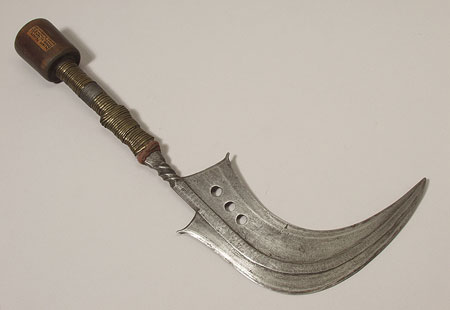
Here's an "iron" Mangbetu blade with some nice cold forged details, planishing and a work hardened edge... pretty cool. :)

Mangbetu sickle knife:
1917.25.27_a.jpg


I suspect they did some hot work on the blank, but still mostly cold forging.
 
Last edited:
That's pretty slick. Sometimes you just have to go with what you've got, and fire isnt one in the got column.
 
That's pretty slick. Sometimes you just have to go with what you've got, and fire isnt one in the got column.

Relativism ALWAYS beats absolutism. :D

Cold forging a few blades might be a cool science project. :)
 
I believe that this website is improperly using the term "cold forging". Cold forging is a processed often used to shape aluminum into bicycle stems (the part that connects the handlebars to the front fork). It entails shaping a piece of aluminum with many tons of force in a mold of sorts.
 
Cold forging can be achieved but it takes a lot of annealing and research.
I would rather use S30V, S35V, or 154 CM ---grind it and heat treat it.
I know many good folks here forge Carbon Steel and other great steels.
We all generally find a path that is suited to our tastes.
I feel that they are all good. I have just found what I like.
There are hundreds of metal processes that can be used to make blades.
Find the ones you like.

DDR
 
Back
Top