Where's the scientific evidence that any of this is true? I've seen only one knife steel test in the mid-late '90s that used a truly scientific methodology: Every blade was made specifically for the test, controlling edge geometry, cut pressure and edge surface grit finish: 440C, an AUS-8 near-equivalent (as far as I know), blew away in raw edge-holding every steel of the time, and this in a wide variety of materials... This superiority including to greater or lesser extent D-2, ATS-34, 154 CM and the two earliest cutlery-used CPM steels. A particularly wide margin was found on manilla rope between 440C and the second best steel...
You hear so much talk how people can tell differences in steel: I've never had any confidence two identical knives ever performed the same for me, even with the same steel... So-called "Identical" knives can have huge differences in edge thickness at the top of the edge bevel from the factory, even within the same run of the same model: How do you even know what affects the performance you observe?
Once I fully re-sharpened the knife, I forget any significance to any edge-holding that happens: Whatever edge-holding objectivity there was is now lost in a sea of minute edge surface finish variations...
I only know AUS-8 as basically a 440C equivalent: 440C was sometimes used on dive knives (though 440A was more common)... If you need more corrosion resistance than that, you are in deep trouble...
I keep thinking of that custom knifemaker sharing his sadness of hearing another maker actually saying chrome lowers edge-holding and wear resistance... The nonsense when it comes to steel properties seems bottomless...
Gaston
On your first point, you are using outdated information, and there have been other tests performed since then, in order to be as scientific as possible in determining the qualities of each steel but you also have to take into consideration that heat treatment can play a very large role in the performance of most steels. Realistically speaking, I doubt that there were the same treatment processes for the steels more than 20 years ago, or that someone would be able to make a consistent and repeatable heat treat in their own personal setup across that many varieties of steel.
Then, yes, finishing qualities does become a major factor in the edge performance, but before any of that, we have a bigger issue:
AT NO TIME DID I MAKE THIS A CONVERSATION ABOUT 440C
First, AUS8's composition:
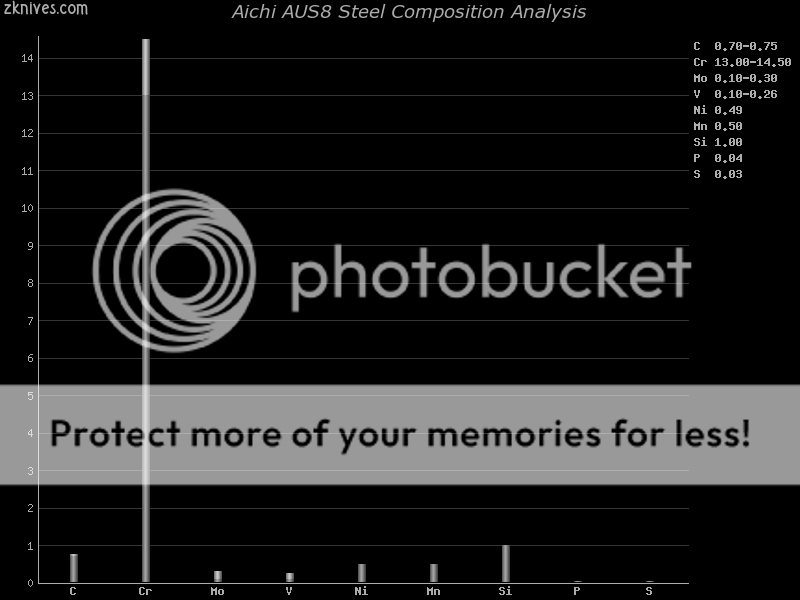
From the same source:
"AUS8(Aichi) - Aichi steel. Sometimes referred as A8, which isn't correct. More often it's called 8A, which is a common abbreviation.
Similar to 440B steel. AUS8A is the same steel, except it's annealed. Apparently A stands for Annealed."
Next, 440C, compared to that chart:
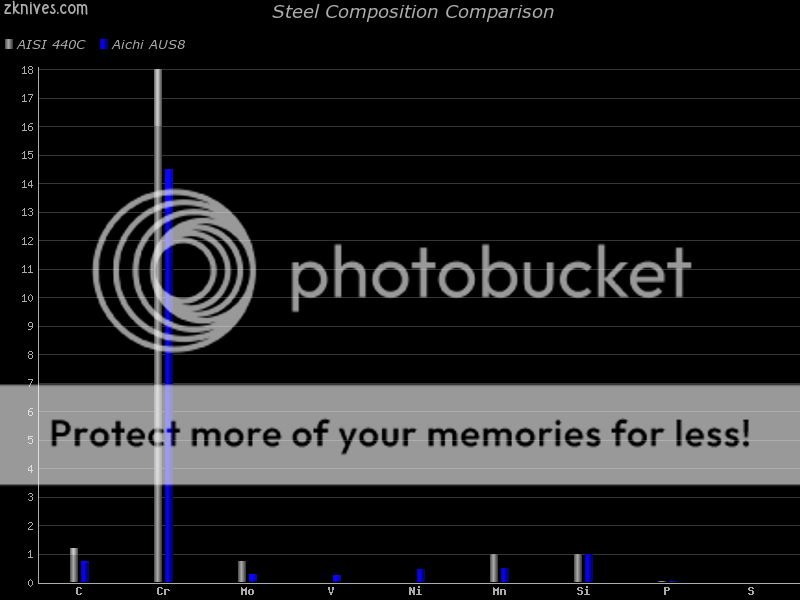
You can clearly see here, not only is the amount of Chromium much higher, the Carbon is as well. Though these differences seem minute, you will often find that it does not take a large difference in the amounts in relative percent to make a difference in the steel's performance. Also, you will find that Carbon is a key element, along with other metals, in forming carbides. Without those carbides, the majority of the steel's properties will not be at the desired level, primarily cutting performance.
You will also note that AUS8 also has much more Molybdenum in the matrix of the steel, which aids in making carbides, and allows Chromium to function more efficiently at preventing corrosion, since Chromium that is held in the carbides of the steel
does not actively prevent corrosion.
So, as we have actively proven that AUS8 is
NOT an equivalent to 440C, most of your argument becomes unsound.
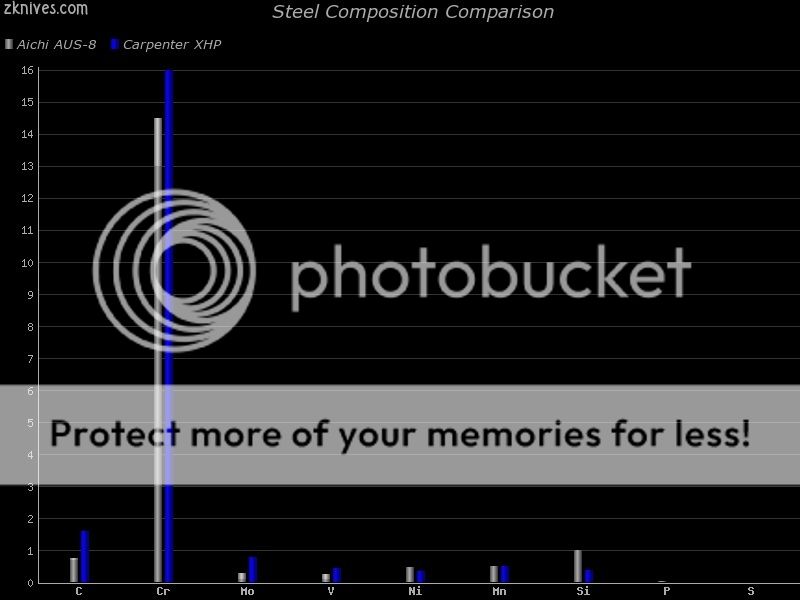
Lastly, let's compare CTS-XHP, 440C, and Aus8 all together:
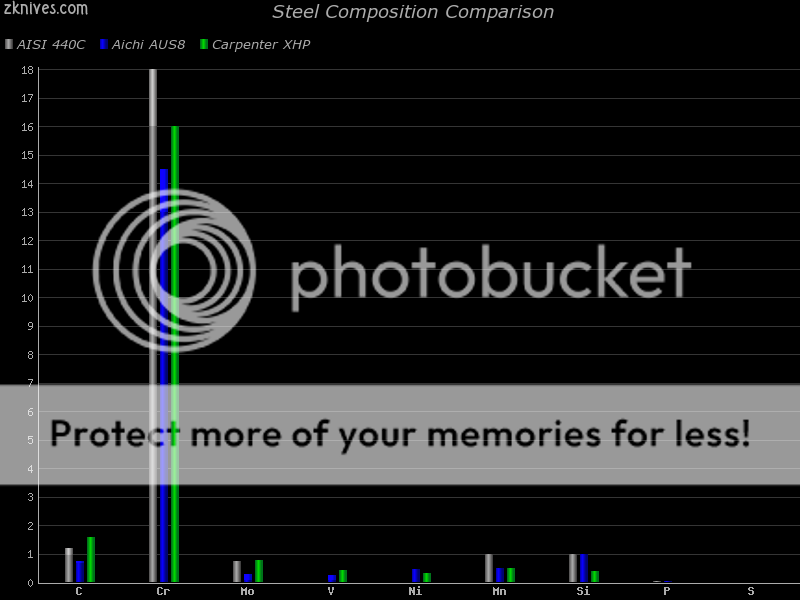
Now the differences become MUCH more apparent between all three of these steels.
This is a fairly common description of CTS-XHP:
"CTS-XHP is an air hardening, high carbon, high chromium, corrosion resistant alloy which can be described as either a high hardness Type 440C stainless steel or a corrosion resistant D2 tool steel. Possesses corrosion resistance equivalent to Type 440C stainless but can attain a maximum hardness of 64 HRC, approaching that of D2 tool steel."
So it is not AUS8 that is a comparison to 440C, but in fact XHP. So, you have, in fact, given an argument for why this steel
IS as good as it is, with your praise of 440C. If we take your arguments for why 440C is a good steel, and replace your false statement that AUS8 is an analog to 440C with the truth; that CTS-XHP is essentially an improvement over 440C, then we are left with something closer to the overall truth, though still founded on old information.
So, you have inadvertently supported the fact that CTS-XHP is an improvement over AUS8, in your attempts to do the opposite.
Now, about your arguments that edge finish and sharpening affect edge retention, I will not actively argue, because you are presenting too many variables at once to actually be able to argue without needing a whole thread on them (of which there are already enough), and we have seen many researchers, knife makers, and testers, who have come with evidence for a variety or results and comparisons, all of which I am not fully versed with.
Basically, I do not have enough evidence to argue with you, but you do not present enough evidence to support your own claim either, and your claim is intentionally vague and subjective, to the point that you are in essentially discrediting your own previous statements, trying to say that the steel does make a difference based on edge retention tests (which once more were outdated), and then following it up by saying "once I sharpen it, it doesn't matter".
Your last claim about corrosion resistance is also more support for XHP as well, as you are again using 440C as your basis for evidence.
Oh, and the comment about a custom knife-maker's conversation about the properties of Chromium in knife steels is irrelevant to this discussion. I get the point you were trying to make, but you are much more similar to the mistaken maker than the one who was displeased about their mistake in this instance.
SO, we are left with this conclusion:
Not only have you presented evidence that is outdated, you have used it to try and support the qualities of AUS8, when in fact the two are not related directly. Not only that, your evidence (assuming its validity), is in fact much more suitable to support the positive performance of CTS-XHP, not AUS8, as CTS-XHP is much more analogous to 440C.
Lastly, you invalidated your own argument by proceeding to claim that "Once I fully re-sharpened the knife, I forget any significance to any edge-holding that happens: Whatever edge-holding objectivity there was is now lost in a sea of minute edge surface finish variations".
Congratulations, you have a very unsound argument, based on false and outdated evidence, that in no way disproves any of my claims or my evidence. IF you can find reputable sources of evidence that prove me wrong, then I have no issues with being wrong, but I do not tolerate being critiqued without the needed evidence or rationale, thank you.
I do not intend to be harsh or unreasonable in this assessment, but I will admit I did get a little angry when I read your response, so I do apologize for any offense taken.