I finally got enough cardboard to do a decent random sample with Kurodrago's Bushlore :
http://www.siteground136.com/~knifetes/forum/showthread.php?t=2162
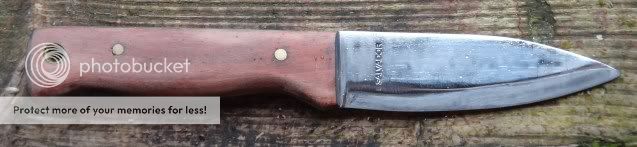
Before I did any work I reground this blade so it went from this :
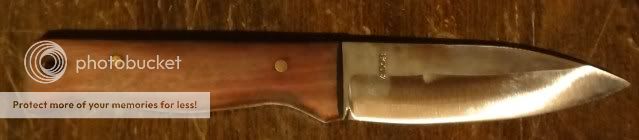
to this :
cutting the edge angle in half and completely removing the initial grind. This would allow me to sharpen much faster as I could now apply a 10 degree micro-bevel very quickly.
As a blunting medium, I was cutting 1/8" corrugated cardboard, the knives were honed to final finish with 0.5 micron CrO loaded leather.
Mora #1260 :
-1095, 60 HRC;
-200 grit SiC, 1000/4000 AO
-easily push cut newsprint
-cut 1/8" jute under 500 grams of tension with a 0.5 (1) cm draw.
Bushlore
-1075, 56-58 HRC;
Ok, this is where the interesting part starts. I repeated the sharpening above, at each stage the edge was easily catching on the thumbnail, very aggressive on a finger pad swipe but had NO aggression at all on a slice. The very edge was just fracturing at a microscopic level.
I then switched to a very fine and more importantly very soft, natural stone, this is almost like chalk you can scratch it deep with your finger nail. 100 passes per side and the edge could slice thick paper (photocopy stock). I then switched to the 0.5 CrO loaded strop and after 150 passes per side then it could slice newsprint.
I attempted the jute cutting, but even under double the tension, it would not cut the cord with a 3 cm draw, under this tension the Mora would cut the cord just as soon as it moved, draw length was < 0.25 cm, thus it was more than ten times sharper.
Now if these numbers don't mean anything to you and they won't unless you have done it, then compare this :
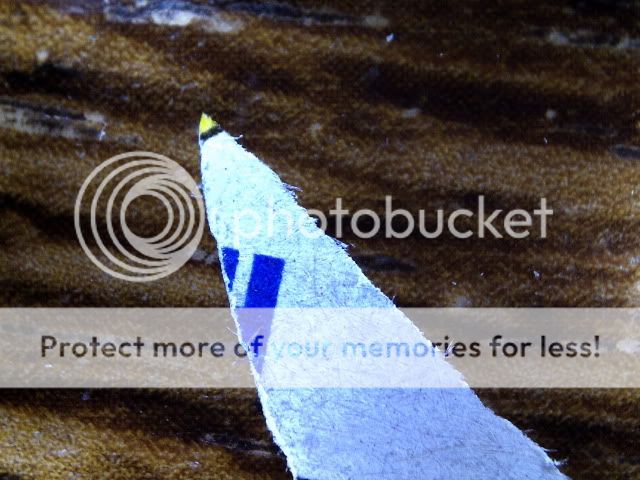
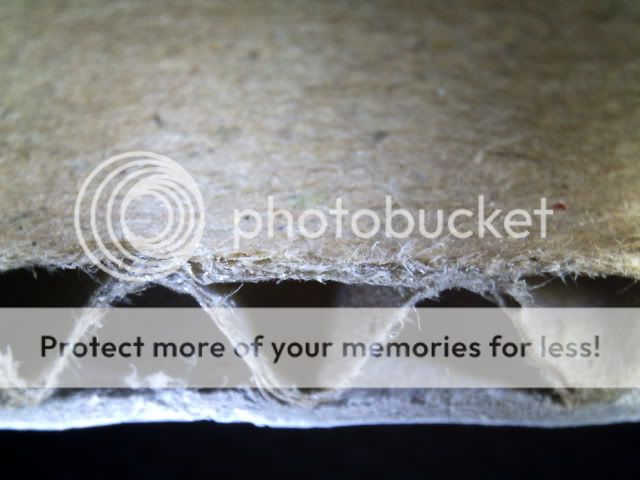
The top slice was made by the Condor and the bottom by the Mora, the Condor is much rougher on the cut. Now that may not look so bad but compare these two initial cuts (at 5X linear magnification) :
This is with the Mora, very little tearing with the cardboard. Now with the Condor :
The knife is tearing the cardboard.
I then did 50 slices through a 3 cm draw length with both knives through 30 cm of 1/8" cardboard stock. Total cutting length was 1500 cm, or 15 m of cardboard cut. At this point the Condor simply could not cut the cardboard at all and was ripping more so than cutting.
The Mora was still cutting clean, but there was some loss of sharpness observed.
Again, two pictures of the cut cardboard at 5X magnification.
First the Mora :
and the Condor :
No comparison. If you compare to the first two pictures, the Mora is cutting cleaner after 50 slices through 30 cm of cardboard than the Condor was on its first cuts.
In order to quantify the loss of sharpness, the Mora was used again to cut the 1/8" Jute under 500 grams of tension and now required 2.0 (2) cm of draw. Again showing how after the 50 slices through cardboard the Mora was sharper than the Condor when it started. The Mora would now slice newsprint but would no longer push cut.
I then ground the edges off of both knives by cutting into a 600 grit DMT stone, resharpened and did all of that cutting again and the results were exactly the same to within the tolerances of the measurement. The results are consistent and what I would expect of the Mora and what I would expect of the Condor given the behavior described.
As noted in my comments in the original thread, this steel is obviously faulty and is micro-chipping at the edge producing very low initial sharpness and very low edge retention. Since the edge itself is the thinnest part of the knife it is possible that it is just the edge that is damaged as the thinner parts of the knife heat/cool the fastest and thus they will be damaged long before the main part of the body during hardening.
So I started grinding :
Using an x-coarse DMT benchstone, 50 passes per side, the edge again had no slicing aggression. 100 passes per side and a little bit of the tip and a little bit of the edge near the handle are now shaving sharp and can push cut newsprint. Time passes, and hundreds of passes per side and I can see the sharpness starting to set in along the entire blade.
In order to remove all of the damaged edge I had to give the knife 1000 passes on an x-coarse DMT. This thickened the edge back and put a 0.025" thick secondary bevel on the knife. This was a lot of metal removed
However after all of that grinding the edge would now finally push cut newsprint, shave, etc. . I then refined the edge with a 600 DMT stone (fine) and it was now sharpening sensibly.
Without taking the knife to the belt sander and laying in the new primary grind it would have been nearly impossible to restore the edge as I would have had to plane off that very wide bevel, as there is a simple linear relationship with width and stock removal it would have taken approximately 100, 000 passes with a x-coarse DMT to remove the problem with the initial bevel as ground.
It appears the problem may be resolved, however as is obvious, the vast majority of users would have long since junked this knife because the initial geometry and problematic steel would have made it very difficult to sharpen and produced a very low cutting ability due to the extreme wedge shape.








 :thumbup: