Convex grinds

The absolute statement which started this was "the edge angle is always within the arc of a convexed grind." This absolute statement has NOT been proven to any degree.

When someone asks if the edge angle is on or within the arc of a convexed grind on a knife, the most anyone can say is "undefined."

I wouldn't go that far.

Assuming a pure mathematical representation of a convex edge with, as most of the pictures on this thread have been with the apex pointing straight up, then mathematically speaking, we could talk about the angle at the apex in one of 3 ways:

FROM THE LEFT - We can talk about the slope of the tangent at the apex as we approach from the left. Semi formally, we would have

lim f'(a) as x->a- (from the left), where a is the apex = say, 15 degrees in one direction.

FROM THE RIGHT - We can do the same from the right and have

lim f'(a) as x->a+ (from the right) = say, 15 degrees in the other direction.

AT THE APEX - But when we consider the (mathematically idealized) slope of the tangent at the apex then we have

f'(a) = undefined, since lim f'(a) as x->a- <> lim f'(a) as x->a+

In English, if the slope of the tangent at x=a is different depending on approaching from the right or the left, then there is no tangent line at x=a.

But, Chiral.Golum makes a great point. We're not talking about Calculus class, not matter how fun that is. We're talking about actual knives made of actual materials - materials that deform when being sharpened. The pictures don't lie. Magnify the most precisely formed apex and what you see is a rounded apex.


So, where does this leave us?

Where it leaves me is wanting to define "apex" in terms of a discrete approximation based on some delta x. If we could agree on a delta x value on which we can define "apex", then we can use one of several methods to defined a discrete approximation to the edge angle at the apex (as defined by the delta x). There are a variety of methods to do that. And Chiral is correct, all of them will be based on the width of the edge behind the actual apex (over the prescribed interval defined by the agreed upon delta x).

Angels are infinitesimally small. Smaller that 6000 grit. I just posted calculus to a knife forum and need a beer.
 
The absolute statement which started this was "the edge angle is always within the arc of a convexed grind." This absolute statement has NOT been proven to any degree.

Um, all edge-angles are measured from "within", i.e. between the bevels. Or did you mean something else?


For example:

1) For any "convex" the corresponding "flat" lies within/beneath it. That is the definition (both English and math) of "convex".

2) "Angle" is a measurement of space between to lines necessarily measured from some distance (arc-length) back from the vertex/intersection of those lines.

3) Measuring arc-length is accomplished via integration achieved via drawing straight lines within a curve: http://en.wikipedia.org/wiki/Arc_length
A curve in the plane can be approximated by connecting a finite number of points on the curve using line segments to create a polygonal path. Since it is straightforward to calculate the length of each linear segment (using the Pythagorean theorem in Euclidean space, for example), the total length of the approximation can be found by summing the lengths of each linear segment.... better approximations to the curve can be obtained by following the shape of the curve increasingly more closely. The approach is to use an increasingly larger number of segments of smaller lengths. The lengths of the successive approximations do not decrease and will eventually keep increasing—possibly indefinitely, but for smooth curves this will tend to a limit as the lengths of the segments get arbitrarily small.

Ergo: a convex edge-angle is calculated based on measurements associated with "flat" vectors within the curve.

Addendum: On a knife edge, the bevel faces (lines) necessarily round over into a curve (parabola) whereat the tangent to the vertex is 90-dps. Ignoring this fact, there is still still no practical way to measure the tangent to a theoretical (non existent) vertex between two arcs of unknown radius that intersect at a pint well ahead and outside of the actual blade edge. This method of establishing edge-angle lacks supportive argument, not so?

EDIT to add: pinnah is way more qualified than i am on this topic :thumbup: Also to pinnah - that Opinel No6 I complained about in previous threads will be going to my 6-yr-old daughter as her first pocket-knife, it fits her hands well although she has already complained about the shape of the handle :p We'll see if some carving improves the grip for her.
 
Last edited:
I wouldn't go that far.

Assuming a pure mathematical representation of a convex edge with, as most of the pictures on this thread have been with the apex pointing straight up, then mathematically speaking, we could talk about the angle at the apex in one of 3 ways:

FROM THE LEFT - We can talk about the slope of the tangent at the apex as we approach from the left. Semi formally, we would have

lim f'(a) as x->a- (from the left), where a is the apex = say, 15 degrees in one direction.

FROM THE RIGHT - We can do the same from the right and have

lim f'(a) as x->a+ (from the right) = say, 15 degrees in the other direction.

AT THE APEX - But when we consider the (mathematically idealized) slope of the tangent at the apex then we have

f'(a) = undefined, since lim f'(a) as x->a- <> lim f'(a) as x->a+

In English, if the slope of the tangent at x=a is different depending on approaching from the right or the left, then there is no tangent line at x=a.

But, Chiral.Golum makes a great point. We're not talking about Calculus class, not matter how fun that is. We're talking about actual knives made of actual materials - materials that deform when being sharpened. The pictures don't lie. Magnify the most precisely formed apex and what you see is a rounded apex.


So, where does this leave us?

Where it leaves me is wanting to define "apex" in terms of a discrete approximation based on some delta x. If we could agree on a delta x value on which we can define "apex", then we can use one of several methods to defined a discrete approximation to the edge angle at the apex (as defined by the delta x). There are a variety of methods to do that. And Chiral is correct, all of them will be based on the width of the edge behind the actual apex (over the prescribed interval defined by the agreed upon delta x).

Angels are infinitesimally small. Smaller that 6000 grit. I just posted calculus to a knife forum and need a beer.

Right, we're in the land of knives. Chiral said, and I'll take it at face value as he has no reason to lie about something that can be easily verified, that all edges end in a parabola. If true, not only can you not say WHERE the edge angle is you can't say WHAT an edge angle is without introducing a randomly selected variable which would be his point W. Theoretically speaking, I think we're on the same page.
 
That's to much :)
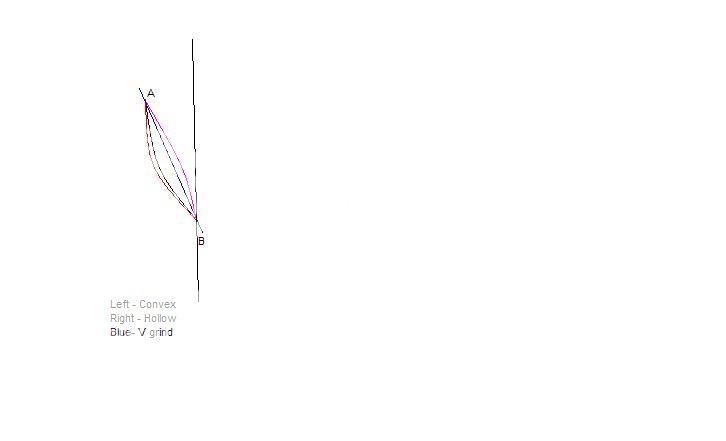
Imagine that we have ( in section ) two points on the blade, B on the edge and A. It's obvious that the convex grind has more "meat" ...We can change the angle, but for the same 2 points, the convex it's thicker :)
edge_zpstjfnazqn.jpg


( SORRY, THIS IS WRONG :) - and yes, all drawing curves, in the pic, in the point B, make the same angle with "the vertical" line
 
Last edited:
Um, all edge-angles are measured from "within", i.e. between the bevels. Or did you mean something else?


For example:

1) For any "convex" the corresponding "flat" lies within/beneath it. That is the definition (both English and math) of "convex".

2) "Angle" is a measurement of space between to lines necessarily measured from some distance (arc-length) back from the vertex/intersection of those lines.

3) Measuring arc-length is accomplished via integration achieved via drawing straight lines within a curve: http://en.wikipedia.org/wiki/Arc_length


Ergo: a convex edge-angle is calculated based on measurements associated with "flat" vectors within the curve.

Addendum: On a knife edge, the bevel faces (lines) necessarily round over into a curve (parabola) whereat the tangent to the vertex is 90-dps. Ignoring this fact, there is still still no practical way to measure the tangent to a theoretical (non existent) vertex between two arcs of unknown radius that intersect at a pint well ahead and outside of the actual blade edge. This method of establishing edge-angle lacks supportive argument, not so?

EDIT to add: pinnah is way more qualified than i am on this topic :thumbup: Also to pinnah - that Opinel No6 I complained about in previous threads will be going to my 6-yr-old daughter as her first pocket-knife, it fits her hands well although she has already complained about the shape of the handle :p We'll see if some carving improves the grip for her.

The math that your using doesn't define anything in an absolute sense. It's improper math but even if I excepted your math, by your own admission it's merely an approximation for a user at a randomly selected point. If you take measurements on a knife and tell me it's 30 degrees, that's flat wrong in an absolute sense. The most you can say in an absolute sense, by your math, is that the edge angle is somewhere between the arctan of the height of the blade and the spine thickness right up to infinitesimally close to 180 degrees which would be at the point directly behind the apex. There is NO absolute statement you can make about an angle if you can't actually define that angle.

Throw a ball. Your hand travels in an arc but the ball goes straight. The ball goes straight on the tangent to the arc of the hand rotating around the shoulder which is at the SINGLE point on that arc where your hand released the ball. The way your math would describe the direction of the ball is by using two points within that arc to calculate it. Which is flat wrong.
 
The math that your using doesn't define anything in an absolute sense. It's improper math but even if I excepted your math, by your own admission it's merely an approximation for a user at a randomly selected point. If you take measurements on a knife and tell me it's 30 degrees, that's flat wrong in an absolute sense. The most you can say in an absolute sense, by your math, is that the edge angle is somewhere between the arctan of the height of the blade and the spine thickness right up to infinitesimally close to 180 degrees which would be at the point directly behind the apex. There is NO absolute statement you can make about an angle if you can't actually define that angle.

1) What is the "absolute" mathematical definition of "convex"? That'll give you a starting point for theoretical principles referring back to physical reality with regard to the impossibility of "convex" being "thinner" than flat.
2) How is the math improper??? Because it gives an approximation?? That doesn't make it "improper" at all (e.g. the absolute value of Pi). The "randomly selected point" is less random that one you'd choose for establishing a "tangent" anywhere except the precise apex which I've already discussed as useless being in no way informative. Placing a tangent at any other point along the curve is not only more random, it asserts knowledge of the radius of the curve which is not to be had without more precise measurements which would, again, be mere approximations, thereby compounding the approximations being made and the error. THAT would be "improper math".

Throw a ball. Your hand travels in an arc but the ball goes straight. The ball goes straight on the tangent to the arc of the hand rotating around the shoulder which is at the SINGLE point on that arc where your hand released the ball. The way your math would describe the direction of the ball is by using two points within that arc to calculate it. Which is flat wrong.

"Tangent" is necessarily at 90 degrees to the radius of the curve - again, a definition.

picture-of-tangent-of-circle2.png

non-example-of-tangent-of-a-circle.png


In the above images, the trajectory of the non-tangent is ALSO accurate and can be obtained without knowing the radius - not "wrong" at all, indeed possibly the only way to describe the direction of the ball accurately in real life. Remember, two points define a line, even defining "tangent" requires at least two point - one of intersection and another that is not intersected.
 
Last edited:
This thread should have died or become a sticky after post #5.

marcinek hit a home run with that one. Most of the rest of this thread has been useless to someone posing the same Q as the OP.
 
This thread should have died or become a sticky after post #5.

marcinek hit a home run with that one. Most of the rest of this thread has been useless to someone posing the same Q as the OP.

Actually marcinek was exactly wrong on the geometry, as has been well elucidated.
 
picture-of-tangent-of-circle2.png

non-example-of-tangent-of-a-circle.png


In the above images, the trajectory of the non-tangent is ALSO accurate and can be obtained without knowing the radius - not "wrong" at all, indeed possibly the only way to describe the direction of the ball accurately in real life. Remember, two points define a line, even defining "tangent" requires at least two point - one of intersection and another that is not intersected.

You would fail my physics classes. The trajectory of the ball is a SINGLE line. Excluding external forces like gravity and atmosphere if you really want to get geeky. :D Not a parallel line to it AND the line that you drew could be cockeyed anyhow. You CANNOT use your method to define the trajectory of the ball. In fact you would not be able to verify that trajectory of the ball without more data. i.e. where the ball lands and the height it was released. Which is why the edge angle here cannot be defined. There's not enough data to suggest any kind of vector at all.
Your switching back and forth between approximations and absolute statements. Do you agree that the edge angle as you would approximate it is as I said? That it can be practically any value depending on the randomly chosen variable of "width" as drawn in your earlier diagram? You're dodging this question. Another way of saying it is that your math is improper because in order for the edge angle to be inside as you claim, the material you're cutting would have to be INSIDE the steel of the knife.

I'm content with the edge angle being undefined.
 
I don't have much to add to what chiral.grolim has already written.

I would just point out the method used in Gillette patents to describe the apex geometry

for example:http://www.google.com/patents/WO2013010049A1?cl=en

.....a cutting edge being defined by a blade tip having a tip radius of from 500 to 1500 angstroms,
said coated blade having
a thickness of between 0.3 and 0.5 micrometers measured at a distance of 0.25 micrometers from the blade tip,
a thickness of between 0.4 and 0.65 micrometers measured at a distance of 0.5 micrometers from the blade tip,
a thickness of between 0.61 and 0.71 micrometers measured at a distance of 1 micrometer from the blade tip,
a thickness of between 0.96 and 1.16 micrometers measured at a distance of 2 micrometers from the blade tip,
and a thickness of between 1.56 and 1.91 micrometers measured at a distance of 4 micrometers from the blade tip.....

No math, no angles, no approximations...

just thickness.
 
In fact you would not be able to verify that trajectory of the ball without more data.... Which is why the edge angle here cannot be defined. There's not enough data to suggest any kind of vector at all.
Your switching back and forth between approximations and absolute statements. Do you agree that the edge angle as you would approximate it is as I said? That it can be practically any value depending on the randomly chosen variable of "width" as drawn in your earlier diagram? You're dodging this question. Another way of saying it is that your math is improper because in order for the edge angle to be inside as you claim, the material you're cutting would have to be INSIDE the steel of the knife.

I'm content with the edge angle being undefined.

You didn't ask about "trajectory" beyond the release point you asked about "direction" which the parallel line gives. It cannot be cockeyed because it is 90-degrees to the radius. A "tangent" is defined as intersecting a curve at 90-degrees to the radius of that curve and at only one point, which demands the presence of ANOTHER point on the curve where it does NOT intersect. You see? They BOTH require two points. How close is that parallel line to the tangent? "Points" have no dimension, only position, so it could be indistinguishable from the tangent unless the exact position of the tangent was known which is not the case with knife bevels. With knife-bevels, we don't even have a radius from which to ascertain the 90-degrees required to give the tangent! :eek: It cannot be done. And even if we tried, we would still only be approximating the angle of the edge since the edge necessarily curves away beneath the bevel unless we are at the very apex where it is 90-degrees to the cutting edge, so anywhere back from that apex would be utterly random.

A "vector" is a line with an origin-point and some 2nd point along it's length to provide the direction, i.e. a vector is defined by 2 points. On a knife, we have an origin-point at the apex and a direction point along the surface of the bevel = sufficient data to provide a vector. The point along the surface is NOT chosen "at random" but according to the level of precision (integration) required, be it on the order of nano- or micro- or milli- or centimeters. For practical purposes of most knife edges, millimeters is sufficient.

The approximation: integrating the angle of a curved line using linear-segments of increasingly short length is the way this is done both mathematically and in reality.

The absolute: the corresponding "flat" to a "convex" must, by definitions both mathematical and lay, lie beneath (within, thinner) the curve of the convex.

The math (really the actual physical method of measuring) that i am using is the only correct way to establish the angle of a convex edge. Relying on a theoretical tangent demands data not available to establish an even worse approximation relying upon a contradiction of the very term "convex". Which is more "improper" - the approximation that relies on real available data and does not imply a contradiction, or the approximation which implies a contradiction and cannot be practically measured?
 
Chiral Grolim,
I don't understand all the math, But I thank you for showing that on a knife, a convex edge does retain more steel behind the cutting edge.

I knew that from reason and the thousands of knives I sharpen every year and knives I make, but couldn't Splain it!;)
 
I still maintain that when it comes to converting from a "V" or linear edge to a convex it is not possible to do so without EITHER increasing the effective angle and therefore thickening the geometry, OR maintaining the original effective angle and blending it back into a thinner shoulder.

Under the use of effective angle as approximation the debate about the specific mathematical approximation is mostly negated because so long as the medium is kept consistent then the effect of the conversion will be made apparent in whether or not the effective angle is changed. Either the effective angle will be preserved (thinned shoulder transition) be increased (thickened at the edge) or reduced (thinned at the edge).
 
I still maintain that when it comes to converting from a "V" or linear edge to a convex it is not possible to do so without EITHER increasing the effective angle and therefore thickening the geometry, OR maintaining the original effective angle and blending it back into a thinner shoulder.

Under the use of effective angle as approximation the debate about the specific mathematical approximation is mostly negated because so long as the medium is kept consistent then the effect of the conversion will be made apparent in whether or not the effective angle is changed. Either the effective angle will be preserved (thinned shoulder transition) be increased (thickened at the edge) or reduced (thinned at the edge).

OK! It's all good all good!
 
As near as I can tell, most people who have posted on this thread are probably wrong in their claims.

Knives don't cut just with their edge angles. So Marcinek comparing a convex with a V grind based solely on edge angle doesn't make any sense.

Chiral's argument that all edges are simply approximating some sort of V totally discounts the final edge angle. I doubt that is accurate, either.


The only way to compare two edge grinds is their quantitative ability to cut. That's something that no one without a lab is actually able to measure.


Ultimately, the ability to cut isn't a geometry question - it is more like a fluid dynamics problem. What shape moves through the ionic bonds of the cutting medium with the least amount of force?

The answer is: It depends. The leading edges of a 747 are blunt. The leading edges on an F-16 are sharp. Blunt edges are efficient at parting air at some speeds, sharp efficient at higher speeds.

With knives, the medium being cut is going to determine which shapes cut it efficiently. Chiral's thickness argument is probably an okay approximation for flexible mediums. Marcinek's edge angle argument is okay for parting something hard and thin, like flat paper. Neither are universal.


A good convex edge is supposed to cut as well a V edge that has more acute edge angle, as in Marcinek's "How people are told" diagram. It does that because the convex overall shape more efficiently passes through the cutting medium than the shoulder of the V edge, despite requiring more force at that more obtuse edge to begin the cut. And that relationship of where an acute V edge and a more obtuse convex edge will be equal in cutting force will only be true for one type of cutting material.

A different material might be more flexible but with higher surface tension, and cut easier with the V edge. If you never cut that material, you'll never see the V edge work better, but it will.


The actual "edge" should be measured as a tangent. It describes one part of the bigger picture. The efficiency of the total shape is not something that any sort of calculus can describe, since it is more of a fluid dynamics problem - which includes all sorts of things like wave propagation that you simply can't assume.


I have no doubt that (for certain materials) convex edges with more obtuse angles will cut as well as more acute V grinds, while being more durable because of the less acute edge. But not on all materials.


It is possible to model cutting action, but you can't do it just with geometry. The material being cut's surface tension, fracture strength, plastic deformation, ionic bond strength, etc are all part of the equation.
 
Oh, great ! After all this math and science mumbo jumbo we finally got a short explanation in plain English... :D
 
Back
Top