Convex grinds

Actually, the angle does matter, because in order for the edge to actually cut it must be the first point making contact with the target and approaching the cut at an angle shallower than the edge angle causes the shoulder to contact before the edge. It doesn't matter how thin your apex is if it isn't touching your target--you have to get that apex to the material before it can cut anything and that's partly where angle comes into play. It's the leading cause of glancing with choppers, in fact--approaching the cut at an angle too shallow for the geometry of the tool's edge to allow it to bite.
 
Actually, the angle does matter, because in order for the edge to actually cut it must be the first point making contact with the target and approaching the cut at an angle shallower than the edge angle causes the shoulder to contact before the edge. It doesn't matter how thin your apex is if it isn't touching your target--you have to get that apex to the material before it can cut anything and that's partly where angle comes into play. It's the leading cause of glancing with choppers, in fact--approaching the cut at an angle too shallow for the geometry of the tool's edge to allow it to bite.

As previously pointed out, the apex angle of even a razor-blade is 90-dps and rounded - FLAT BLUNT and yet it cuts without glancing :eek: It is not the angle, it is the thickness that cuts or does not.

A glancing blow most commonly occurs when shallow penetration (i.e. edge does contact) from sufficiently thin apex (regardless of angle) but excessively thick shoulder (behind the edge) wedges out a small chunk.
If the shoulder makes contact first, it is too thick or the user should simply stop whacking targets with the side of the blade (i.e. bevel-face) rather than the edge ;)

EDIT to add: Why won't the side of the blade cut? Answer: because it is too thick.
 
Last edited:
I am reminded of one of the observations made about fractal geometry... the length of the British coast line depends on whether it is walked by a giant, a man or an ant.

Unless/until you all start to define standard distances back from the apex as a way to start defining terms like "apex", "edge", "shoulder" and "bevel", your discussions about angles will to, um, glance off each other without biting. (ahem).
 
I am reminded of one of the observations made about fractal geometry... the length of the British coast line depends on whether it is walked by a giant, a man or an ant.

Unless/until you all start to define standard distances back from the apex as a way to start defining terms like "apex", "edge", "shoulder" and "bevel", your discussions about angles will to, um, glance off each other without biting. (ahem).
The British coastline is always the same size, but people/ants etc use different units of measure. That would correlate to people using different flats as reference to the convex grind. So yes, unless we define our words etc we are bound to argue.

But what we have here is someone saying "that's not 24 inches, that's 2 feet!" We say, " OK, but I used inches as a reference instead of feet" and the response is "no we measure using feet!". All it shows is an inability to see a different perspective.
 
The British coastline is always the same size, but people/ants etc use different units of measure. That would correlate to people using different flats as reference to the convex grind. So yes, unless we define our words etc we are bound to argue.

But what we have here is someone saying "that's not 24 inches, that's 2 feet!" We say, " OK, but I used inches as a reference instead of feet" and the response is "no we measure using feet!". All it shows is an inability to see a different perspective.

The coast line problem is actually harder than just disagreeing on measurement. It's a matter of scale. Ants walk around rocks that humans step over. Humans walk around coves that giants step over. Ants traverse a longer coast line. It's not a matter of units of measurement, per se, it's the units of measurement used for each discrete step. Ants take smaller steps than humans and that's the issue.
http://en.wikipedia.org/wiki/How_Lo...ical_Self-Similarity_and_Fractional_Dimension

The preceding discussion about angles is a very familiar one for former calculus professors (like me) when teaching on the subject of linear approximations to instantaneous rates of change (i.e. derivatives). In calculus speak, Chiral.Golum is utterly correct. Assuming a vertical orientation of the blade, the face of the blade forms a continuous function. There are no pure angles involved at a small enough scale, there is a critical point at the apex - that is, it is blunt.

But in practical linear approximation terms, nobody works at that scale. Not really. So if he and 42 Blades and the others want to make progress, they will need to agree on either the delta x or delta y units they're working in. If they can agree on how big the step sizes are, they can begin to define their terms like apex, shoulder and so on.

Of course, agreeing on definitions is a sure way to take the fun out of an internet discussion!!!
 
The coast line problem is actually harder than just disagreeing on measurement. It's a matter of scale. Ants walk around rocks that humans step over. Humans walk around coves that giants step over. Ants traverse a longer coast line. It's not a matter of units of measurement, per se, it's the units of measurement used for each discrete step. Ants take smaller steps than humans and that's the issue.
http://en.wikipedia.org/wiki/How_Lo...ical_Self-Similarity_and_Fractional_Dimension

The preceding discussion about angles is a very familiar one for former calculus professors (like me) when teaching on the subject of linear approximations to instantaneous rates of change (i.e. derivatives). In calculus speak, Chiral.Golum is utterly correct. Assuming a vertical orientation of the blade, the face of the blade forms a continuous function. There are no pure angles involved at a small enough scale, there is a critical point at the apex - that is, it is blunt.

But in practical linear approximation terms, nobody works at that scale. Not really. So if he and 42 Blades and the others want to make progress, they will need to agree on either the delta x or delta y units they're working in. If they can agree on how big the step sizes are, they can begin to define their terms like apex, shoulder and so on.

Of course, agreeing on definitions is a sure way to take the fun out of an internet discussion!!!
Touche, and thanks for your enlightening and thoughtful posts!
 
So what I've learned is all our knives are dull because, ultimately they ALL end in a convex grind apexing at a 180* angle. LOL. Dammit!
 
So what I've learned is all our knives are dull because, ultimately they ALL end in a convex grind apexing at a 180* angle. LOL. Dammit!

:) Compared to what a ceramic blade can achieve, yes, they're all "dull" as rock-chisels... but NOT because of the angle because angle does not cut, thickness (or rather the lack of it) is what cuts :thumbup: It's amazing what "dull" razor-blade can cut through!

In a previous post I presented a schematic of a bunch of knives with almost identical bevel angles but thicknesses "behind the bevel" (i.e. shoulder where primary bevel meets secondary) ranging from 0.025" down to 0.005". The 0.005" blade cuts MUCH much more efficiently than the 0.025" blade because it is 5X thinner and so suffers much less wedging-resistance during a cut, and razor-blades can get even thinner. But at the very apex, all of these blades have been sharpened the same and are equally sharp (or dull, depending on your perspective) - ALL shave with the same level of efficiency because they have roughly the same apex-diameter and the same thickness at 10 microns back from that apex which is all that matters in shaving, that first few microns (ant steps, to use pinnah's analogy). But chopping wood, those first few microns are effectively meaningless to the efficiency of the cut, they go unnoticed by the giant.
 
As previously pointed out, the apex angle of even a razor-blade is 90-dps and rounded - FLAT BLUNT and yet it cuts without glancing :eek: It is not the angle, it is the thickness that cuts or does not.

A glancing blow most commonly occurs when shallow penetration (i.e. edge does contact) from sufficiently thin apex (regardless of angle) but excessively thick shoulder (behind the edge) wedges out a small chunk.
If the shoulder makes contact first, it is too thick or the user should simply stop whacking targets with the side of the blade (i.e. bevel-face) rather than the edge ;)

EDIT to add: Why won't the side of the blade cut? Answer: because it is too thick.

It is BOTH the edge angle and the thickness of the apex that cut.

You know the reason why the FLAT BLUNT edge bites in a cutting medium. But the angle that, on a macroscopic scale, creates the reduction in thickness before that FLAT BLUNT to so great a degree that it is able to bite...has a noticeable and obvious effect on the angle of approach required in order for said edge to engage in its target. Presentation of a thin enough region of the blade to cut is a requirement of edged tool use. The angle of the edge bevel imposes a minimum angle of approach on the tool.

Place the edge perpendicularly on a flat surface and then pivot the blade on its edge...you will eventually reach a point where the edge lifts off of the surface, and that point is determined by the angle of the edge bevel.
 
It is BOTH the edge angle and the thickness of the apex that cut.

You know the reason why the FLAT BLUNT edge bites in a cutting medium. But the angle that, on a macroscopic scale, creates the reduction in thickness before that FLAT BLUNT to so great a degree that it is able to bite...has a noticeable and obvious effect on the angle of approach required in order for said edge to engage in its target. Presentation of a thin enough region of the blade to cut is a requirement of edged tool use. The angle of the edge bevel imposes a minimum angle of approach on the tool.

Ultimate convex-edge cutting tool - a cylinder!

2419MBW.jpg
 
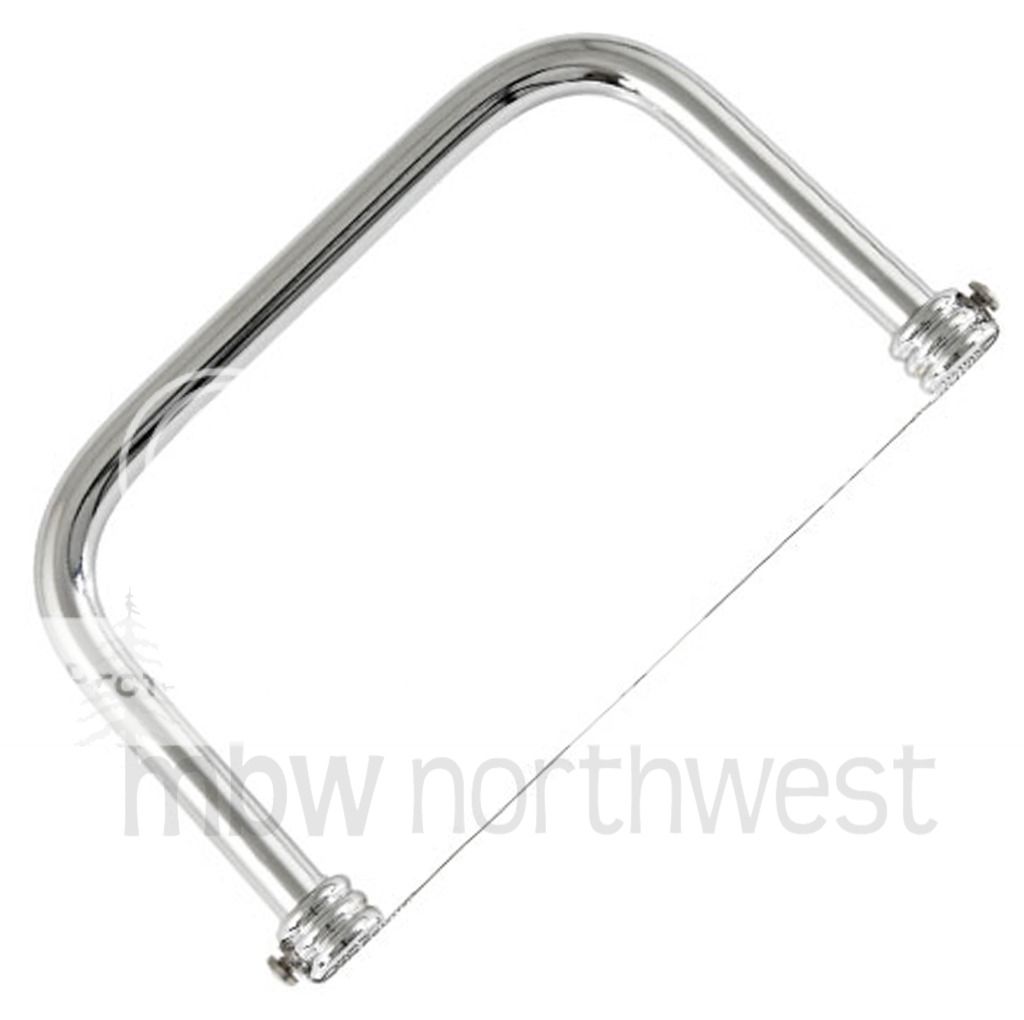
Well, technically that's how cheese and clay wires work! And they engage at any angle of presentation! :D

:D

That's what I'm getting at. The cheese-cutter is ultimate simplicity, it has no specific "edge" - it's smooth "bevel" and blunt on all sides - and yet it cuts as intended... because thickness cuts. It is ALL edge!
If it were thin enough wire, it could be used to shave.
But it won't carve hard media or chop very well. Why not? Because it lacks strength to support the thin "edge". To support the edge of a knife or axe, it has a blade behind it. The blade necessarily limits the "angle of presentation" because it thickens (widens) sections that might otherwise be "edge" for cutting. The angle of a blade bevel only exists by accident in order that a thin edge may be supported by material behind it. It is a necessary evil ;)

Look at a modern straight-razor with its deep hollow grind that produces a blade with a thick spine but very thin edge. The blade behind that edge exists to support the edge, to allow a user ease of control over the edge, and to provide material upon which a new edge may be ground as the old one is worn away.

Look at the thick convex of an axe blade - lots of material support for an edge subject to harsh forces, back to a heavy poll that lends mass for the force of the swing.

The best cutting implement of all has no edge, does it even technically have a blade? *shrug* :cool:

lightsaber-590x330.jpg
 
Really?? What is this problem people are having with scale?? Do you see any scale measurements on that schematic?
The point being, every point you measure from on that arc will give you a different value for the angle. This is why the math your using fails to fully describe what's going on. If you want to use this as an approximation for an edge angle that's fine with me. I don't really care. I just take issue that you're doing this math and stating that you know for sure what the angle is and that the angle is inside the arc. It's not. It's on the tangent. The fact that it's impractical to use the tangent as a bases for your measurement is beside the point.
 
:D

That's what I'm getting at. The cheese-cutter is ultimate simplicity, it has no specific "edge" - it's smooth "bevel" and blunt on all sides - and yet it cuts as intended... because thickness cuts. It is ALL edge!
If it were thin enough wire, it could be used to shave.
But it won't carve hard media or chop very well. Why not? Because it lacks strength to support the thin "edge". To support the edge of a knife or axe, it has a blade behind it. The blade necessarily limits the "angle of presentation" because it thickens (widens) sections that might otherwise be "edge" for cutting. The angle of a blade bevel only exists by accident in order that a thin edge may be supported by material behind it. It is a necessary evil ;)

Look at a modern straight-razor with its deep hollow grind that produces a blade with a thick spine but very thin edge. The blade behind that edge exists to support the edge, to allow a user ease of control over the edge, and to provide material upon which a new edge may be ground as the old one is worn away.

Look at the thick convex of an axe blade - lots of material support for an edge subject to harsh forces, back to a heavy poll that lends mass for the force of the swing.

The best cutting implement of all has no edge, does it even technically have a blade? *shrug* :cool:

lightsaber-590x330.jpg

Another problem with wires being that you can't really choke up on them and they have to be held taught by a framework, meaning you can't feasibly have a curved profile. So even if they would make them thin and durable enough they'd still have their issues.

I wouldn't say the rest of the blade only exists by accident...it's very deliberate! Rather I would say that it exists as a consequence of other design requirements. Cutting ability alone is not the determinant of an effective design. It's just one of a multitude of factors in need of optimization for a given context of use.
 
The point being, every point you measure from on that arc will give you a different value for the angle. This is why the math your using fails to fully describe what's going on. If you want to use this as an approximation for an edge angle that's fine with me. I don't really care. I just take issue that you're doing this math and stating that you know for sure what the angle is and that the angle is inside the arc. It's not. It's on the tangent. The fact that it's impractical to use the tangent as a bases for your measurement is beside the point.

No, the tangent is AT the apex and is always 90-dps. There's no way around that. Trying to put the tangent anywhere else is not just "impractical", it is utterly incorrect. The math I am using is the way it is done, using mathematical principles and geometry to approximate the value.

http://en.wikipedia.org/wiki/Arc_length
 
Last edited:
Another problem with wires being that you can't really choke up on them and they have to be held taught by a framework, meaning you can't feasibly have a curved profile. So even if they would make them thin and durable enough they'd still have their issues.

I wouldn't say the rest of the blade only exists by accident...it's very deliberate! Rather I would say that it exists as a consequence of other design requirements. Cutting ability alone is not the determinant of an effective design. It's just one of a multitude of factors in need of optimization for a given context of use.

I completely agree :thumbup: but wouldn't it be better to have a light saber? :D
 
I completely agree :thumbup: but wouldn't it be better to have a light saber? :D

I'd love to have one, but I actually find it funny how the lightsaber is considered the cliche ultimate cutting implement when they'd still be impractical for a lot of utility purposes and even within the Star Wars universe would have their own set of design constraints. :D
 
No, the tangent is AT the apex and is always 90-dps. There's no way around that. Trying to put the tangent anywhere else is not just "impractical", it is utterly incorrect. The math I am using is the way it is done, using mathematical principles and geometry to approximate the value.

http://en.wikipedia.org/wiki/Arc_length

Maybe I'm being too theoretical using what is classically a convexed edge shape. I actually don't care about knives on the microscopic level. Too nitpicky for me. Of course if we had the means to do it there would be no reason we couldn't take the tangent a step back from the edge. It would give the same approximation that you're doing. Your way being dependent on where you take your measurement from as well.

IME the edge angle doesn't actually matter a whole lot within a certain range. How many people have a microbevel on their knives and can only tell because they don't get edge damage? In actual cutting there's no discernible difference. I agree with you that the thickness matters but at a certain point people are just spinning their wheels. Practicality going out the window. This was a fun thought exercise. Thanks for being a foil. :D
 
No, the tangent is AT the apex and is always 90-dps. There's no way around that. Trying to put the tangent anywhere else is not just "impractical", it is utterly incorrect. The math I am using is the way it is done, using mathematical principles and geometry to approximate the value.

http://en.wikipedia.org/wiki/Arc_length

In a pure mathematical sense, this is not entirely true. When you a point on a curve defined by the intersection of two curves and if the limit of (f(a + dx) - f(a))/dx is different if taken from the left and from the right, then the derivative (slope of the tangent) at that point is undefined. That is, it's not flat. This is the mathematics of.

In terms of the physics, perhaps one can argue that there is always a blunt apex. But again, until there is agreement on defined ranges for delta x values, we really can't begin to define angles. I say this as a former calculus prof, taking about blade angles in terms of tangent lines doesn't make sense to me.
 
In a pure mathematical sense, this is not entirely true. When you a point on a curve defined by the intersection of two curves and if the limit of (f(a + dx) - f(a))/dx is different if taken from the left and from the right, then the derivative (slope of the tangent) at that point is undefined. That is, it's not flat. This is the mathematics of.

In terms of the physics, perhaps one can argue that there is always a blunt apex. But again, until there is agreement on defined ranges for delta x values, we really can't begin to define angles. I say this as a former calculus prof, taking about blade angles in terms of tangent lines doesn't make sense to me.

The absolute statement which started this was "the edge angle is always within the arc of a convexed grind." This absolute statement has NOT been proven to any degree.

When someone asks if the edge angle is on or within the arc of a convexed grind on a knife, the most anyone can say is "undefined."
 
Back
Top