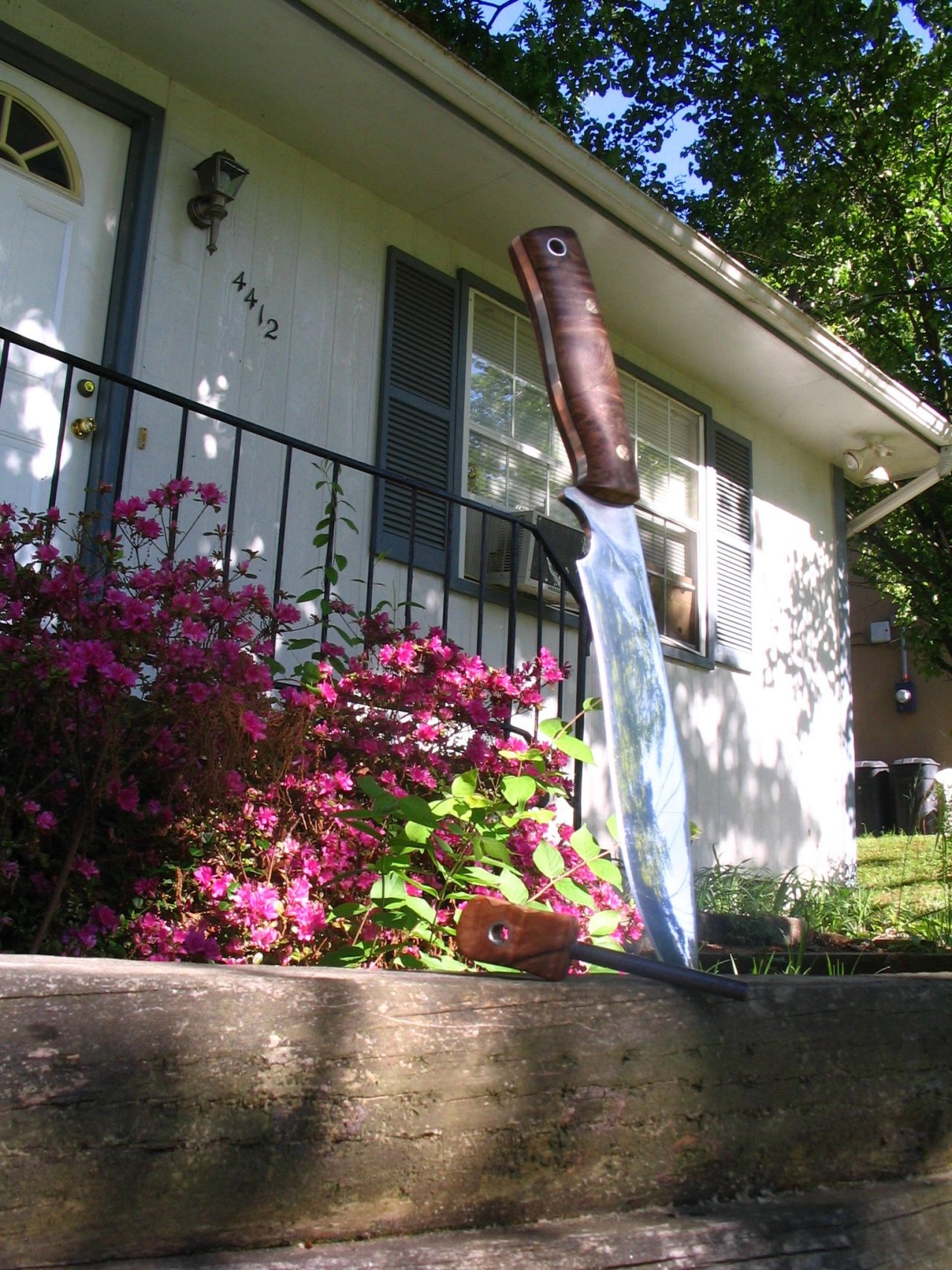
CPM 3V. Is it the perfect steel?

After reading the majority of everyone's posts I was thinking. I have had a knife design that has been floating in my head for a minute. It would be a utility type knife. Something that would be robust for my work. Do you all think that 3V would be a good steel for that? (Job is in my screen name.) :D I do wipe down all my tools that have been used for the day before I leave.
 
After reading the majority of everyone's posts I was thinking. I have had a knife design that has been floating in my head for a minute. It would be a utility type knife. Something that would be robust for my work. Do you all think that 3V would be a good steel for that? (Job is in my screen name.) :D I do wipe down all my tools that have been used for the day before I leave.

A thread from 2010? Your powers of necromancy are quite impressive. I think the best I could manage was to bump a thread from a couple of weeks ago. I'm going to have to give up on the dark magical forum arts, I think.
 
PmI think cpm3v is a jack of all trades. Good at everything but not best at anything.
Not as wear resistant as cpm10v
Not as tough as s7
Not as resiliant as 5160
Not as fine grained as elmax
Not as corrosion resistant than vanax or h1
Not as heat resistant as cpm m4
Not as easy to heat treat as 1084
Not as easy to sharpen as simple steels
More expensive than most steels
Harder to work than 1075
 
After reading the majority of everyone's posts I was thinking. I have had a knife design that has been floating in my head for a minute. It would be a utility type knife. Something that would be robust for my work. Do you all think that 3V would be a good steel for that? (Job is in my screen name.) :D I do wipe down all my tools that have been used for the day before I leave.

old thread aside, utility can mean a wide range of things. but I would go cpm m4 over 3v for any pocket knife or small to mid size fixed blade. a very tough steel with better wear resistance than 3v if what I read is correct. I will take the small drop in toughness for the edge holding, and m4 is still tougher than most super steels you find.
 
I must have misread this part. :D


The Spyderco collaboration knives were indeed choppers and have gotten pretty high marks in reviews, even the 6" and 7-1/2" models. I make the same knives in 3V as well as CPM Stainless which are better. In all, the edge thickness before sharpening is about 0.040" which is then convexed about 1/8" up the blade. I've no clue what that angle might be since it's determined by both the angle at which the blade is held and the tension on the abrasive belt. On my knives I do this on a rotary platen which gives me more control of the shape of the curve, but the angle is still a mystery. Anecdotally , that edge which is what I wanted used on the Spyderco knives greatly troubled them because it's the antithesis of their normal edges, so they called it the "Hossom Edge" on the box as a sort of disclaimer. It's not my edge of course, it's used by most knifemakers, but it worked well for the duties assigned in the steel used and I found the label amusing. The steel most certainly would not have done as well for heavy chopping with very fine edge, nor would 3V for that matter. If the edge is too fine it will distort. That's why it's not used in professional cutting competitions. And I might add, that distortion which can occur in extremely fine edges with 3V and has happened with M4 as well when chopping hard materials is not correctable with sharpening. It's a significant distortion of the edge alignment.

Regardless, we agree that 3V is an excellent steel, but like all steels even it and M4 have an achilles heel that bears mentioning.
Let me start by saying I read this whole thread and listen with DEEP INTEREST.
I just completed my first knife grind. It is in to Peters for heat treat. I was unsure of what steel but I figured for my first one use 3V. Because I was free grinding it and filing it already has a convex geometry (the entire blade). I left the edge roughly 1/16 thick for heat treating.
My intentions were to Convex the shit out of the edge.
If You don't mind do you have any suggestions for desired heat treat? I like edge retention. Also how much metal should I leave for heat treating.
Sorry for all the questions. You seem to know a little something.:eek:
First one


The rest of the 3 foot section waiting to grind and heat treat.
 
For starters let me say I'm impressed with your efforts on this knife. You've kept the design clean and simple, and skeletonized the tang which will give it excellent balance. Since I have the advantage of using a belt grinder, it's easier for me to leave more steel before HT than if you're hand finishing the steel. I'd say you are about right with 1/16". Finishing the steel will take that down to about 0.040", and if you convex that for your edge you should be fine. I HT all my 3V blades to Rc61, even swords. It won't break and that hardness will give you good wear resistance. The quality of the finish you put on the edge will be the final touch in determining how well it will perform and if you get all 3V has to give. I refine my edges to 5 microns (~2000 grit), then polish on a completely worn out belt with white compound before stropping on top grain leather. 3V has a very tenacious wire edge so you need to strop it more aggressively than with most steels to get rid of it. I often find myself wondering if I screwed up the sharpening because it's just not sharp, then strop it a little more, a little harder and pop!! There it is! It always makes me smile when I see how that edge chases hair off your arm. There is just nothing quite like it. Good luck!
 
I agree, that's a well-designed general-purpose blade. :thumbup: It will certainly be sturdy.

Peters' does a fantastic job of keeping 3V clean and straight during HT. I routinely send them 3V (and other blades) that are ground right down to final dimension and hand-finished as high as 2000 grit. When I get them back all I have to do is sand off the tempering oxides and sharpen them.

For absolute maximum toughness, 58Rc is the way to go. But even at higher hardness as Mr. Hossom mentioned, 3V is still really tough. For a medium size knife like that I would ask them to temper it to 61-62Rc and take full advantage of the edge-holding.

Back to the original topic, "is 3V the perfect steel?" Nah, nothing's "perfect". But I really wouldn't be bothered if 3V was the only steel I could ever use again. It just plain works.

From very thin slicers to big honkin' choppers, bushcrafters to kitchen knives, razors to fighters... with appropriate geometry and HT for the tasks you want to perform, 3V works very, very well across all the parameters that are important for a good reliable knife. Rather than think of it as a compromise or "jack-of-all trades", I refer to it as a really well-balanced alloy.
 
Incidentally, some folks have posted in the past that "You just can't get a nice finish on CPM-3V". I disagree...

tumblr_my29bddAEB1t96crwo1_1280.jpg


That's not buffed, just hand-sanded. The trick isn't how to finish it, but when. ;)
 
The fact that only one company can use it takes INFI out of contention as a "best all-around steel". What if a person just doesn't happen to like Busse designs?

Yes INFI is great stuff, no question about that. But whether or not it "beats" 3V depends almost entirely on whom you ask. (if you look around long enough you'll find reports from folks who've used both, and results are pretty well split down the middle between the two). I've yet to see a true blind test between the two steels...

Simple availability means you can get pretty much anything you like made out of 3V.
 
James- I agree but I just like the, "you can't mess me up" attitude with the INFI. My Busse knives are knives I never worry about.
rolf
 
The reason I recommend Rc61 for 3V blades in all sizes is because of its failure mode. ALL steels can fail. It's a question of how and under what conditions. There's a reason why CPM-M4 is the favored steel in cutting competitions, even though 3V is tougher and will take a finer edge. There are two ways steel fails in toughness tests. One is brittle fracture, the other is plastic deformation. You simply can't fracture 3V if heat treated properly. Bold statement but I'll stand by it in any reasonable use to which you might apply any knife for any purpose, including what most would consider abuse. You can, however, roll or flatten a fine edge if you hit something very hard. Doing that becomes more difficult if the steel is harder (pretty much the definition of hardness actually.) Most steel edges will chip or fracture at the impacts needed to do this with 3V, but it happens and that's why you don't see 3V in cutting competitions, even at Rc61 or more. Cutting the hardwood dowel will very slightly flatten a fine 3V edge, and that disqualifies the knife. At Rc58 it would flatten more. Is this a problem in use? Ask yourself, would you prefer an edge to flatten or fracture? Those are your choices, and since CPM-M4 resists both to a very high degree it is the favorite of cutting competitors, right up to when they have to sharpen it again and then it's a curse. A fractured edge compromises the whole blade, since cracks can extend and lead to catastrophic failure. Won't happen with 3V. It simply won't happen. How big a problem is edge deformation? A dozen or so years ago I had a sword tested by a very skilled martial artist. His ultimate cutting test was a leg of beef. With a one handed sword, he cut through that leg of beef so the bottom half was hanging by just the fascia on the outside on the meat on one side. It was a diagonal, #1 cut that transected 9" of meat and over 3" of bone. The outcut on the bone was clean with no fracturing, meaning the edge was still cutting when it cleared the bone. On examining the edge after the test, there was a slight, ~3/16" long flat on the edge. Not much, and you have to hold it to the light just right to see it, but there it was. Easy to sharpen out and the blade was still cutting well despite that. Rc61 CPM-3V. Beef leg bone is VERY hard stuff, much harder than most any wood you'll encounter. The point I'm making is that the edge is stronger at Rc61 and I don't think there's a reason to compromise that with a softer temper. It isn't going to break.

And I agree with James, if you only had one steel to choose for any use whatever, I honestly don't think you could do better than 3V. Other steels have qualities I would love to see in 3V, i.e. stainless, but nothing has everything and 3V has the most, in my judgement.

 
I believe Dan Keffeler said PD1 is tougher and able to run thinner than 3V at >60rc
 
gsx, that hole just behind the blade shouldn't be there ! It creates a weak point and does very little as far as balance or lightness of the blade.
 
gsx, that hole just behind the blade shouldn't be there ! It creates a weak point and does very little as far as balance or lightness of the blade.

I thought the exact same thing... i don't put any holes near the ricasso area for that reason. your weight savings mean more closer to the rear as far as balance goes and why weaken a high stress area just to save a couple grams. Great thread though... thanks James and Jerry for your imput on HT and toughness as this was something i was wondering about as well. My 3v adventures are only beginning and your imput is greatly appreciated.
 
gsx, that hole just behind the blade shouldn't be there ! It creates a weak point and does very little as far as balance or lightness of the blade.

I am totally not arguing but here was my thought. I have had knifes break at the begining of the blade grind but not the handle. The total area of the metal behind the last cutout behind the blade is basically 1/2 by 3/16 which is more area or metal then the blade it self. I left that material for being able to batton. On a unground blade i did a flex test and that area did not flex.
However I was waiting for that comment as I had some of the same thoughts in my head. I will do some serious testing and put it to a challenge.
I have done some pretty extreme things in fabricating motorcycle turbo systems which were so far stood the test of time but at the time were untested. I have seen some of these thing now implemented in mainstream systems. That said this was my first knife so I appreciate all the insight and suggestions and will make any changes needed going foward.
But based on the pressure I was exerting I feel comfortable so far. It is over 3/16 afterall. Sorry unground 3/16 CPM3V which is closer to 1/4.
Again thanks. I hate writting cause the interpretation can change.
 
The reason I recommend Rc61 for 3V blades in all sizes is because of its failure mode. ALL steels can fail. It's a question of how and under what conditions. There's a reason why CPM-M4 is the favored steel in cutting competitions, even though 3V is tougher and will take a finer edge. There are two ways steel fails in toughness tests. One is brittle fracture, the other is plastic deformation. You simply can't fracture 3V if heat treated properly. Bold statement but I'll stand by it in any reasonable use to which you might apply any knife for any purpose, including what most would consider abuse. You can, however, roll or flatten a fine edge if you hit something very hard. Doing that becomes more difficult if the steel is harder (pretty much the definition of hardness actually.) Most steel edges will chip or fracture at the impacts needed to do this with 3V, but it happens and that's why you don't see 3V in cutting competitions, even at Rc61 or more. Cutting the hardwood dowel will very slightly flatten a fine 3V edge, and that disqualifies the knife. At Rc58 it would flatten more. Is this a problem in use? Ask yourself, would you prefer an edge to flatten or fracture? Those are your choices, and since CPM-M4 resists both to a very high degree it is the favorite of cutting competitors, right up to when they have to sharpen it again and then it's a curse. A fractured edge compromises the whole blade, since cracks can extend and lead to catastrophic failure. Won't happen with 3V. It simply won't happen. How big a problem is edge deformation? A dozen or so years ago I had a sword tested by a very skilled martial artist. His ultimate cutting test was a leg of beef. With a one handed sword, he cut through that leg of beef so the bottom half was hanging by just the fascia on the outside on the meat on one side. It was a diagonal, #1 cut that transected 9" of meat and over 3" of bone. The outcut on the bone was clean with no fracturing, meaning the edge was still cutting when it cleared the bone. On examining the edge after the test, there was a slight, ~3/16" long flat on the edge. Not much, and you have to hold it to the light just right to see it, but there it was. Easy to sharpen out and the blade was still cutting well despite that. Rc61 CPM-3V. Beef leg bone is VERY hard stuff, much harder than most any wood you'll encounter. The point I'm making is that the edge is stronger at Rc61 and I don't think there's a reason to compromise that with a softer temper. It isn't going to break.

And I agree with James, if you only had one steel to choose for any use whatever, I honestly don't think you could do better than 3V. Other steels have qualities I would love to see in 3V, i.e. stainless, but nothing has everything and 3V has the most, in my judgement.
Talked to Peters this morning. 61 it is.
 
Back
Top