
-
The BladeForums.com 2024 Traditional Knife is available! Price is $250 ea (shipped within CONUS).
Order here: https://www.bladeforums.com/help/2024-traditional/
You are using an out of date browser. It may not display this or other websites correctly.
You should upgrade or use an alternative browser.
You should upgrade or use an alternative browser.
Cutlery Proposals for the Bladeforums 2015 Knife
- Thread starter waynorth
- Start date

r8shell
Knifemaker / Craftsman / Service Provider
- Joined
- Jan 16, 2010
- Messages
- 26,571
Horn is still bone!! We had antler (also a bone) last year!
I think horn is actually closer to hair than bone.
Antler is boneHorn is still bone!! We had antler (also a bone) last year!

- Joined
- Mar 10, 2014
- Messages
- 1,704
From 'Anatomy of a Horn'
"A horn is a pointed projection on the head of various animals consisting of a covering of keratin and other proteins surrounding a core of live bone. True horns are found mainly among the ruminant artiodactyls[not verified in body], in the families Antilocapridae (pronghorn) and Bovidae (cattle, goats, antelope etc.)."
That's boney enough for me! Let's see a different handle material this year!
"A horn is a pointed projection on the head of various animals consisting of a covering of keratin and other proteins surrounding a core of live bone. True horns are found mainly among the ruminant artiodactyls[not verified in body], in the families Antilocapridae (pronghorn) and Bovidae (cattle, goats, antelope etc.)."
That's boney enough for me! Let's see a different handle material this year!

- Joined
- Aug 17, 2013
- Messages
- 1,558
But horn has different characteristics from skeletal bone which make it less brittle. It's used for battle after all! So a knife hafted in horn could at least withstand a run in with a buffalo! Of the limited (affordable?) materials available for knife scales I think horn is the one we haven't used on the BF knife and it's typically been considered one of the toughest materials making it a contender for a shadow pattern. But wood'll do too. 


1066vik
Gold Member
- Joined
- Nov 28, 2009
- Messages
- 21,581
don't have any pictures handy at the moment, sorry.
cumaru has a tight "braided" grain without a lot of prominent figure - it tends to be reddish with gold streaks.
other names for it are Brazilian Teak and Tonka Bean.
it's moderately common in outdoor decking and flooring.
cumaru has a tight "braided" grain without a lot of prominent figure - it tends to be reddish with gold streaks.
other names for it are Brazilian Teak and Tonka Bean.
it's moderately common in outdoor decking and flooring.

- Joined
- Jul 26, 2009
- Messages
- 309
I'd prefer lignum vitae.
I know, I'm repeating myself. But if we're worried about durability on a shadow pattern, there is no better choice.
I know, I'm repeating myself. But if we're worried about durability on a shadow pattern, there is no better choice.

fishface5
Gold Member
- Joined
- Feb 3, 2001
- Messages
- 9,873
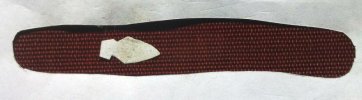
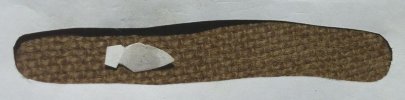
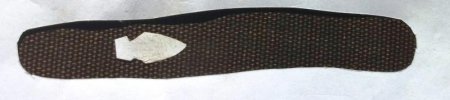
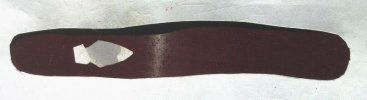
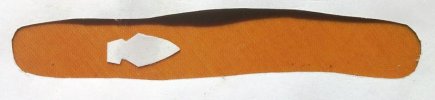
here are some half-assed playing-around mock-ups, first in micarta (color is a bit off since I used a phone for pics, couldn't find my camera)
burgundy linen, natural burlap (shadetree), green canvas, brown/natural canvas, and butterscotch (looks too orange here)
I like micarta a lot but I think the woods below are a lot more interesting on a shadow design like this one.
burgundy linen, natural burlap (shadetree), green canvas, brown/natural canvas, and butterscotch (looks too orange here)
I like micarta a lot but I think the woods below are a lot more interesting on a shadow design like this one.
Attachments
Last edited:
fishface5
Gold Member
- Joined
- Feb 3, 2001
- Messages
- 9,873
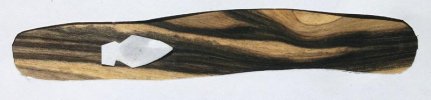
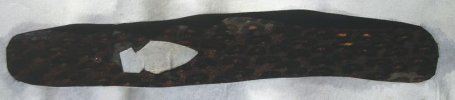
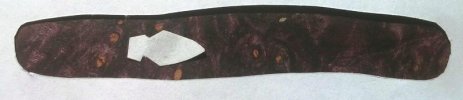
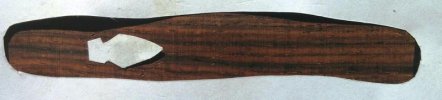
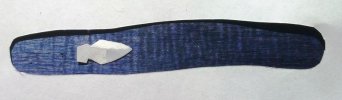
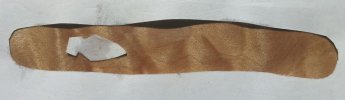
here are some woods: black&white ebony, black palm (cross-grain cut), dyed burl, cocobolo, and a blue dyed koa for fun
the shadows create a cool optical illusion as if I cut out the wood shapes individually, but in fact I just cut the shape out of the middle of a piece of paper and laid it over different blocks of wood, then added a really crappy paper shield. no pivots sorry.
the shadows create a cool optical illusion as if I cut out the wood shapes individually, but in fact I just cut the shape out of the middle of a piece of paper and laid it over different blocks of wood, then added a really crappy paper shield. no pivots sorry.
Attachments
Last edited:
fishface5
Gold Member
- Joined
- Feb 3, 2001
- Messages
- 9,873
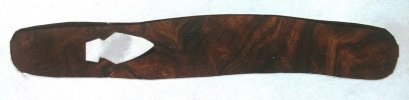
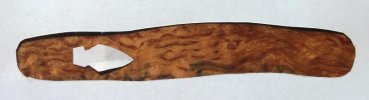
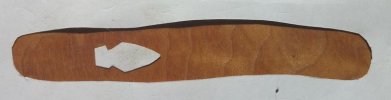
I don't have any horn alas, but here's some more woods:
ironwood, karelian birch, high-grade koa, dyed lacewood, and lignum vitae
ironwood, karelian birch, high-grade koa, dyed lacewood, and lignum vitae
Attachments
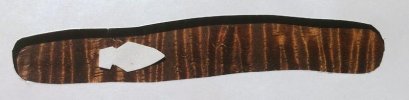
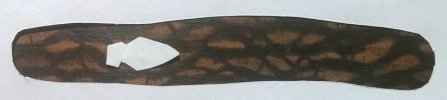
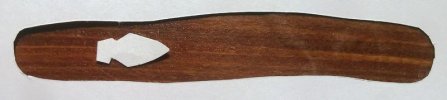

fishface5
Gold Member
- Joined
- Feb 3, 2001
- Messages
- 9,873
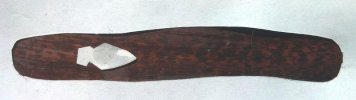
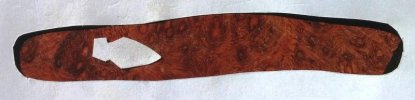
last batch of mock-ups in wood:
mango, maple, osage orange, snakewood and some unknown burl found in a scrap bin
mango, maple, osage orange, snakewood and some unknown burl found in a scrap bin
Attachments
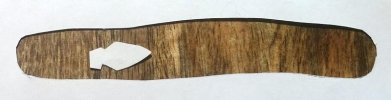
fishface5
Gold Member
- Joined
- Feb 3, 2001
- Messages
- 9,873
the sad thing is, that was my second attempt at the shield!
For this design I really like the vertical lines of the b/w ebony and the cocobolo, however it's much harder to get consistent lines in many pieces of bw ebony for 300 scale sets, than it is to get similar and consistent cocobolo.
I am also digging the mango, but didn't have a piece that would permit me to orient it vertically rather than horizontally.
Close behind for me are the tight patterns of the black palm and the snakewood. I really need to try again with the black palm b/c that picture doesn't capture it by half.
The lacewood is pretty boss as well.
The lignum vitae seems a little dull visually. It's a good strong wood but lacks visual snap compared to some other choices.
For this design I really like the vertical lines of the b/w ebony and the cocobolo, however it's much harder to get consistent lines in many pieces of bw ebony for 300 scale sets, than it is to get similar and consistent cocobolo.
I am also digging the mango, but didn't have a piece that would permit me to orient it vertically rather than horizontally.
Close behind for me are the tight patterns of the black palm and the snakewood. I really need to try again with the black palm b/c that picture doesn't capture it by half.
The lacewood is pretty boss as well.
The lignum vitae seems a little dull visually. It's a good strong wood but lacks visual snap compared to some other choices.
Last edited:

- Joined
- Oct 14, 2014
- Messages
- 3,301
here are some half-assed playing-around mock-ups, first in micarta (color is a bit off since I used a phone for pics, couldn't find my camera)
burgundy linen, natural burlap (shadetree), green canvas, brown/natural canvas, and butterscotch (looks too orange here)
I like micarta a lot but I think the woods below are a lot more interesting on a shadow design like this one.
Out of all the mockups you posted, my favorite is the natural burlap micarta. My next favrite is the high-grade koa, but isn't koa extra expensive?
Anyhoo, just my two cents. Thanks for the mockups

- Joined
- Jan 18, 2007
- Messages
- 34,222
Thanks for the trial 'patches' The Black&White Ebony DOES look interesting, Karelian Birch too. As for the Micartas, Burgundy or Natural be top.
- Joined
- Jan 18, 2007
- Messages
- 34,222
All this talk of horn is interesting but I'm not sure it's practical. A lot of European makers use horn and are experienced in working it but the stuff must be selected carefully and properly cured, otherwise warp/shrink is very likely. The other thing is that I don't think it would be suited for large Bird's Eye pivots, other pins and a shield. Most horn knives from Europe tend to avoid these features, there may be a practical reason too....
Here's an Italian knife in Blonde Horn, Shadow, 10cm shut.
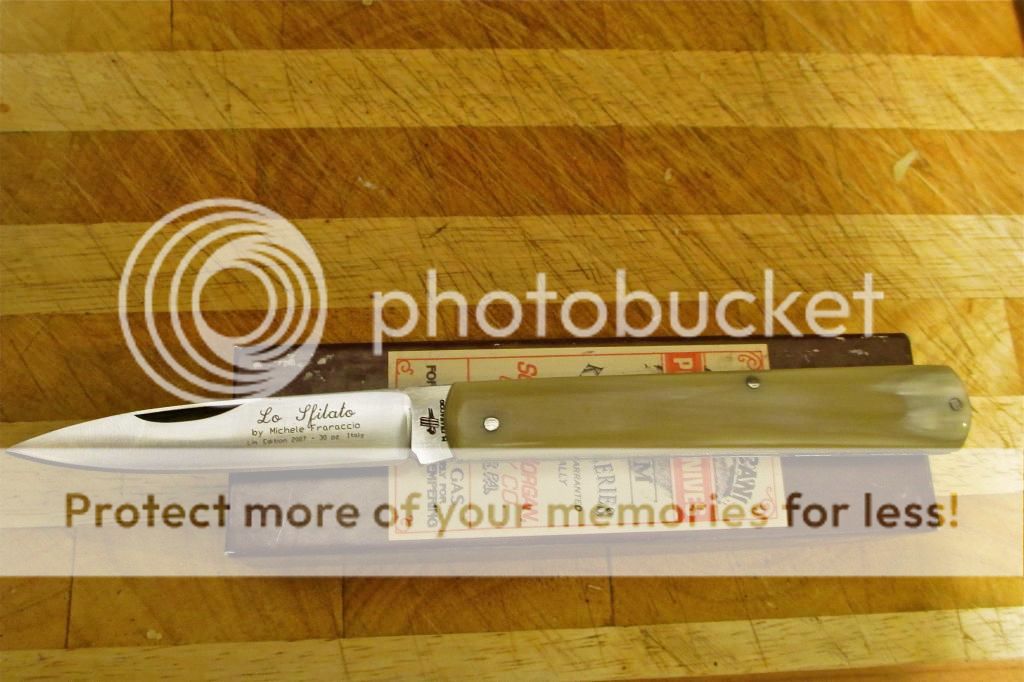
Here's an Italian knife in Blonde Horn, Shadow, 10cm shut.
- Joined
- Aug 30, 2014
- Messages
- 519
I don't have any horn alas, but here's some more woods:
ironwood, karelian birch, high-grade koa, dyed lacewood, and lignum vitae
Koa is beautiful stuff. Plus, the knife will sound great! (That's a guitar joke; don't beat me too hard)

- Joined
- Nov 16, 2013
- Messages
- 1,659
My vote on Lignum Vitae as well. Aside from the historical significance (being used as bearings, even before babbit), and it's unique properties in the wood world (so dense it won't float) - it's some pretty awesome stuff. Lots of color variation (streaked with greens to browns), VERY stable (not likely to crack, warp or check - or lift away from the liners), and a chatoyance not found in many woods. It has a peppery-menthol like smell too, very fragrant.
I only have 1 knife with lignum scales, but it's a modern OHO - carried a lot, but looks as good as new many years later.
Regarding price, we're talking about tiny little chunks to make scales from - it's not going to add that much, certainly no more than any other exotic (wood, bone, stag, etc...).

Edited to add: A few other notes about wood. Personal experiences only (I'm a hobbyist wood worker), YMMV....
Osage Orange (Hedge Apple 'round these parts) is beautiful wood. I have a particular fondness for it, especially for making mallets, axe handles and fence posts. However, it SUCKS for knife handles. It's porous, stains easily, only looks pretty when new, and is actually very toxic.
Purple heart only looks purple when freshly cut - it turns poo-brown when exposed to UV light and oxygen. It's VERY brittle and splinters easily. It would be very difficult to pin scales on without cracking, and a bare head design would be next to impossible.
Others, like maple, bocote, zebrawood, padauk, etc... are actually very soft and won't hold up to long term use very well. Cocobolo, being a nice oily rosewood, makes great knife handles - although it's very brittle as well. I don't think it would tolerate the stress of a bare head. Ebony is cool, the black & white stuff would have a unique look, but we've kind of been-there-done-that with plain ebony already.
Lignum Vitae addresses all of those issues, and would likely be one of the most durable (and, dare I say - most attractive) knife handles ever produced. Also, I just looked at a few lumber sources - it would cost approximately $2.50 per knife for the material. Seems reasonable (and a lot cheaper than micarta).
It would be interesting to hear the knife manufacturers perspective on woods - I'm not sure how they look at it, although they all seem to offer a fairly wide variety.
I would also offer up desert ironwood (Olneya tesota) as a suitable material. When stationed in Arizona, we picked up several Mexican woodcarving done in ironwood down in Nogales. Very dense, tough, and beautiful grain. I'm not an expert on wood, but I believe Lignum vitae is one of those woods also considered to be "iron wood."
I'm up for either one!