
D2 heat treatment, three processes, you can break to 90 degrees.By

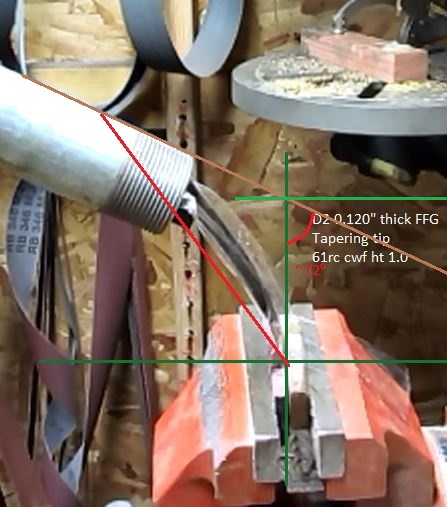
Intersected angle between 2 tangential line at end point. So here is a revised pic. Sure, a pipe isn't accurate on one end. At any rate, here is a revised pic - and it's inline with my guessed angle before - just calculated differently.
Ratio: 112/3.04 = ~37 (https://en.wikipedia.org/wiki/Young's_modulus)
cQmAnrB.jpg


I followed a few links you posted. Nice works :thumbup:


Your test is wrong. First, the angle is defined as the extension of two fixed points. Then,
1, the distance between the two fixed points.
2, the thickness of the material required
3, if the material and section into V type, then need to calculate coefficient.
4, the hardness of the material.
Distance / thickness = aspect ratio
My length to diameter ratio is about 35-40, thickness is 4.7MM, the length is generally within the appropriate range. If the ratio of length to diameter becomes larger, the angle will increase.

...


question1: Out of this 92º - what is the (or a guess) elastic angle?

question2 (from your links): what is the sharpening angle and behind the edge thickness(cross section at the sharpening bevel shoulder) of your test blade?

edit to add: I watched 2 videos of your tests. I sort of can figure out angles and sharpening angle but better ask to reverse-engineering :D. Maybe understand a little bit more on what you 'referred' as 3 processes ht.

Question/request 3: It would be great to see a video - if you would test a 65rc blade with your 3 processes ht.
 
Last edited:
iirc that small paring doesn't has very polish blade finishes (~220-320 grit?). Banana and plant sap would dye the surface quickly.

SU 52100 is quite tough and soft - too soft for my liking but maybe I can redeem myself with a coconut chomper 63+rc ;)
Chris "Anagarika";17069452 said:
Luong,

It was the small paring. I was actually shocked it turned black so fast :eek:
Some white compounds and balanced strop brought it back no prob. :D

The SU is an undefeated coconut breaker for now. Until I get the CWF chomper.
 
wucai(五彩) not five...Meaning a lot of color,Can not translate this meaning directly...
流氓-rogue,There are two words in Chinese.This is not the meaning of the bad guys.
I can not accurately translate the meaning of this ID, it is more like a mood.
Now I find out how badly it is to learn English at school.


It's ok. Thanks to Google translator I understand very well, and I think everyone else does as well. We all joke around, but please do not take it personally. We really appreciate you coming here to share your technique and skill with us.
 
I don think it s funny . Knife maker who does not know English language is trying to communicate here . If this continue , make fun of his google english ..... I wonder who will lose more? He or forum? He do something with D2 steel which look amazing ............... Or jealousy is in question?
I laugh at google ,they earn billions and can not make a good translator , shame :thumbdn:

Nobody's making fun of his google English, it was the accidental double-meaning of "sword polishing" that was funny. Just a simple dick joke. :)
 
OP,

Thanks for explaining. The Wucai is an idiom then, multicolored perhaps is a better translation.
I know Liumang isn't necessary bad guy. Perhaps vagabond is also a better translation. Interesting how Google translation works.
I remember reading San Mao Liu Lang Ji when I was a kid. The Liu part is likely the same, meaning 'wandering' I guess.

Luong,

Of course by the time chomper ready, me too :D
 
Intersected angle between 2 tangential line at end point. So here is a revised pic. Sure, a pipe isn't accurate on one end. At any rate, here is a revised pic - and it's inline with my guessed angle before - just calculated differently.
Ratio: 112/3.04 = ~37 (https://en.wikipedia.org/wiki/Young's_modulus)

cQmAnrB.jpg


I followed a few links you posted. Nice works :thumbup:


question1: Out of this 92º - what is the (or a guess) elastic angle?

question2 (from your links): what is the sharpening angle and behind the edge thickness(cross section at the sharpening bevel shoulder) of your test blade?

edit to add: I watched 2 videos of your tests. I sort of can figure out angles and sharpening angle but better ask to reverse-engineering :D. Maybe understand a little bit more on what you 'referred' as 3 processes ht.

Question/request 3: It would be great to see a video - if you would test a 65rc blade with your 3 processes ht.


I may guess the error of your reply, the translation software is not very accurate.
Question 1, your video inside the test blade is not already polished, cross-section is V-type. If the section becomes V-type, then the coefficient needs to be calculated because the V-type will increase the angle.
Question 2, your video inside the test blade is polished? Polishing will also increase the angle.
Explanation
1, the first question of recovery, elastic deformation only at the beginning of the initial, and then the elastic deformation and plastic deformation is the same time.
2, my test sample inside, a lot of samples of the cross section is rectangular, that is not polished into V-type. Nor polished.
3, i can not translate this question so i do not know what you are asking .65RC? My test sample is 59HRC, part is 57-58HRC. In the correct measurement mode, the hardness of D2 is 65HRC is very high, that is, there is no peak before tempering. I do not know if I have any understanding right.

Note: If the cross section is V-shaped, according to its area ratio need to determine a coefficient, usually around 0.5-0.8. That is, the length / thickness * coefficient or the angle * coefficient, which is an approximate value.

OR

I may guess wrong your reply, translation software is not very accurate.
Question 1, your video inside the test blade is not polished, cross section is V. If the section becomes V type, then the coefficient is calculated, because the V will increase the angle.
Question 2, your video inside the test blade is polished? Polishing will also improve the angle.
explain
1. The first problem is that elastic deformation occurs only at the very beginning, and then elastic deformation and plastic deformation occur simultaneously.
2, my test sample inside, a lot of samples of the cross-section is rectangular, that is not polished into V. No polish.
3, I can't translate this question, so I don't know what you are asking.65RC? My test sample is 59HRC, part of it is 57-58HRC. In the correct measurement mode, the hardness of D2 is very high, that is, the peak value of the 65HRC without tempering. I don't know if I understand correctly.

Note: if the section is V type, according to its area ratio needs to determine a coefficient, usually around 0.5-0.8. That is the length / thickness * coefficient or the angle * coefficient, which is a value of approximately.
 
Chris "Anagarika";17071166 said:
OP,

Thanks for explaining. The Wucai is an idiom then, multicolored perhaps is a better translation.
I know Liumang isn't necessary bad guy. Perhaps vagabond is also a better translation. Interesting how Google translation works.
I remember reading San Mao Liu Lang Ji when I was a kid. The Liu part is likely the same, meaning 'wandering' I guess.

Luong,

Of course by the time chomper ready, me too :D

囧~~~
Not vagabond......
Wucai Liumang - This is a vague explanation of life attitudes. The vast majority of people can not understand, because there is a story inside. Chinese words are complex and meaning a lot, each individual word has a lot of explanation, after the combination can have a variety of meaning, even if the same pronunciation, it does not represent the word, even if the word, can not represent the same meaning, even if Meaning the same, can not represent the meaning of the same combination.
OR
Wucai Liumang- this is an implicit interpretation of the attitude of life. The vast majority of people can not understand, because there are stories. China complex and the meaning of many words, each individual character has many explanations, combined can have many different meanings, even if the same pronunciation is not representative of the word, even the same word, can not represent the same sense, even if the same sense, also can not represent the combination of meaning.
 
Hence the often hilarious double-meanings that spontaneously arise out of translations between languages, not the least between Chinese and English! :)
 
Back
Top