Damascus Steels

Status
Not open for further replies.
We're open to seeing some quality cutlery from Pakistan. What can you show us?

Actually, I have a very nice Damascus straight razor I bought from a knife maker here, who happens to be from Pakistan. It is the only quality piece I've seen from Pakistan though...
 
Actually, I have a very nice Damascus straight razor I bought from a knife maker here, who happens to be from Pakistan. It is the only quality piece I've seen from Pakistan though...

I know there are knife makers in Pakistan that take pride in materials and craftsmanship. They are not very well represented here. What we see, as you well know, are the garbage knives or blanks being finished and passed off as custom.
 
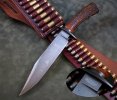
Man, that's spectacular, K.O.D.

Do you know (or care) what steels are in it, and all the the other stuff one looks for in Damascus?
 
I know there are knife makers in Pakistan that take pride in materials and craftsmanship. They are not very well represented here. What we see, as you well know, are the garbage knives or blanks being finished and passed off as custom.

There is one Pakistani knifemaker on the boards someplace. I have not seen much from him lately. I was pretty sure he was doing his own work, because he always posted lush WIP threads, but his work had one issue- it was stylistically very similar to a lot of the made-in-Pakistan junk knives that we're all familiar with.

I think he suffered somewhat unfairly from the association.
 
OP your question is pretty broad. There are highcarbon damascus steels and there are stainless damascus steels. To visually tell the difference and these are generalitites; high carbon damascus steels tend to be more contrasty after etching and stainless damascus steels less so. There is good dammy out there and there is bad dammy for sure. Good damasacus makes good knives, poor damascus will make poor knives regardless of how they may look.
 
OP your question is pretty broad. There are highcarbon damascus steels and there are stainless damascus steels. To visually tell the difference and these are generalitites; high carbon damascus steels tend to be more contrasty after etching and stainless damascus steels less so. There is good dammy out there and there is bad dammy for sure. Good damasacus makes good knives, poor damascus will make poor knives regardless of how they may look.

One thing though, Damasteel... man, the contrast on Damasteel is just out of this world.
 
It can still be misty, not contrasty. Depends on how it is etched. In fact I've found that most of my customers prefer the misty when I use damasteel.

A96X8Dv.jpg


High carbon contrasty dammy.

UKaTypj.jpg


Damasteel, what I call misty contrast.
 
A note re the Pakistan animus; there's nothing wrong with knives from Pakistan taken for what they are.

The issue is that there a lot of Pakistan made knives being relabeled and sold as custom knives made elsewhere with a reputation for high quality cutlery. In tandem with that practice there are a lot of shills who show up on these boards to tout said items as handmade in England or the US or Canada to name a few.

So they use misrepresentation and bald faced lies to sell and promote the made in Pakistan cutlery as something they'll never be. And it's not just one bad apple; there are a lot of these re-sellers who pop up and aggressively push their product. They prey on the uninformed and those prone to impulse purchase or who those who hunt for deals without fact checking. When they pop up here though they're quickly spotted and exposed.
 
If it's crap, it's crap. If it's not, it's not. Coming from Pakistan has nothing to do with it.

Are you really going to argue that, if it was made in Pakistan and is crap, it's something other than Pakistani crap? Especially in situations where the actual manufacturer is ambiguous or undetermined, or if the knife isn't sold under a particular brand name, what does that leave you with?

"I bought this knife, and it's complete crap."
"What brand?"
"I don't know."
"Where is it made?"
"I can't tell you. Someone on the Internet might be offended if I state that fact."

Country of origin is a valid detail in identifying a knife.
 
Warning issued. Do not imply that someone is a racist. That is a very serious offense which we take seriously around here
Country of origin is a valid detail in identifying a knife.

Only to you, and folks like you. To the rest of us, it's unidentified, and a useless data point. (You'll miss that.)
 
Country of origin is obviously not a useless data point. I suspect you are being willfully ignorant. You're too earnest to be a troll.
 
The phrase "Pakastani crap" is offensive.
Pakistan crap it is.


Only to you, and folks like you. To the rest of us, it's unidentified, and a useless data point. (You'll miss that.)

China has proven themselves and has produced many awesome knives and knife brands. Pakistan however has not. And I have yet to see a Pakistan made knife that could actually cut brass rod rather than brass rod cut it. You seem much the expert while also asking questions you should know if you were. Try not to speak on the behalf of others when you only represent yourself.
 
Last edited:
Yes, that's what I meant. Do they have some way of testing each layer individually?

For that matter, each steel has a different process for optimal HT. So when you take a few different steels and pattern weld them, then put those three different steels through the same HT, how can they each get optimal HT?
The layers don't need to be tested individually. The layers are thin. And a RC hardness tester uses a carbide tip and pressure to see how far that point makes an indent into the steel. This is usually done on a flat of the blade under the handle scale or on a folder near the pivot area so it is concealed. If you disassemble a folder and there is a little dot that looks precise but out of place it was probably RC tested. The sum of the layers as a whole will dictate the overall hardness. Not the individual layers themselves.
 
Man, that's spectacular, K.O.D.

Do you know (or care) what steels are in it, and all the the other stuff one looks for in Damascus?

I don't remember off hand, other than that it's a carbon and not stainless.

Country of origin can be important, but the quality of the knife and ethics/business practices of the company are more important to me.

While I prefer not to fund the economies of countries that use sweatshops, there are American that exploit the end user, which is almost as bad IMO.

I'll buy a Kizer, Reate, WE, etc over a Benchmade any day of the week.
 
Keep it simple and do it right. Alabama Damascus is as cheap as I would ever recommend going and that is because Brad will replace the steel if there happens to be something amiss.
This is what I use. 1084/15n20 harden to at least 60Rc. img1477s.jpg
 
Status
Not open for further replies.
Back
Top