dmt sharpening stones

David, Yes the Crystalon-- fine or medium works very nice for all the steels I use. Including the A11's, CPM S110v and CPM S90V. Surprisingly the India is very effective for taking off the wire edge or burr. I have a DMT fine flat diamond plate, fine grit that is also very good for the burr. I get the dollar store windex in the spray bottle and use on all the stones. Just spray on to get it good and wet, sharpen and rinse in water, quick easy and clean. I also use it for lube coolant on the surface grinder. Phil

Here is Mr. Phil Wilson's response to my question 'if he has used a Norton crystalline stone to sharpen S90V steel'. Since, he's a legend in custom knife making he should know a thing or two. Probably beyond many of us... So, now you know it can be used on these steels with no problems. DM
 
At current count we have Four knowledgeable people that have posted, 'yes, you can sharpen high vanadium steels using a Norton crystalline stone.' No problem. Bob6794, I'd say this is your answer. DM
 
Last edited:
At current count we have Four knowledgeable people that have posted, 'yes, you can sharpen high vanadium steels using a Norton crystalline stone.' No problem. Bob6794, I'd say this is your answer. DM

Partial answer, anyway. Curious as to the finishing grit preferred by these four (in all seriousness)? I'm betting it's not at the level where the carbides begin to interfere.

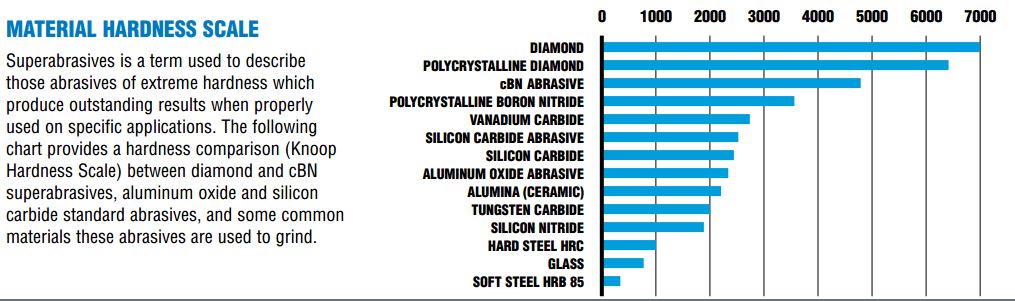
This image snip below is a hardness comparison chart from Norton's own catalog (p. 138) of their diamond & CBN 'Superabrasives' product line (link to .pdf file below). Values shown are Knoop Hardness. Note the values for Aluminum Oxide (2300), Silicon Carbide abrasive (2500), Vanadium Carbide (2700) and diamond (7000). If refining edges to a point of needing to abrade, shape or polish the vanadium carbides themselves (at 2-4µ average size), as opposed to just displacing them from the softer steel matrix (which SiC & AlOx can handle), the hardness of the carbides will be more of an obstacle. This is worth considering, and an additional part of the 'answer' in deciding if SiC or AlOx is enough, or if diamond is needed, depending on desired finish:

http://www.nortonindustrial.com/upl...talog-Superabrasives-8068-2014 Bookmarked.pdf

ikmPGGr.jpg


David
 
Last edited:
Partial answer, anyway. Curious as to the finishing grit preferred by these four (in all seriousness)? I'm betting it's not at the level where the carbides begin to interfere.

This image snip below is a hardness comparison chart from Norton's own catalog (p. 138) of their diamond & CBN 'Superabrasives' product line (link to .pdf file below). Values shown are Knoop Hardness. Note the values for Aluminum Oxide (2300), Silicon Carbide abrasive (2500), Vanadium Carbide (2700) and diamond (7000). If refining edges to a point of needing to abrade, shape or polish the vanadium carbides themselves (at 2-4µ average size), as opposed to just displacing them from the softer steel matrix (which SiC & AlOx can handle), the hardness of the carbides will be more of an obstacle. This is worth considering, and an additional part of the 'answer' in deciding if SiC or AlOx is enough, or if diamond is needed, depending on desired finish:

http://www.nortonindustrial.com/upl...talog-Superabrasives-8068-2014 Bookmarked.pdf
Norton_SuperAbrasives_2014_Catalog_p138_hardness_comparison_chart_zpsdee1f16d.jpg


David


WOW... Awesome chart...... I just love it when people tell me things I didn't know.... ;) That chart is for machine grinding....... Belts and Wheels...... Not sharpening stones .......


I have personally Sharpened steels ranging from 1080 all the way up and including the A11 steels and S110V, S90V to down .5 Micron without using Diamonds and never had an issue.....
 
The simple objective of the chart is just to illustrate the differences in the physical properties of the base abrasives themselves. Their fundamental hardness doesn't magically change when used only on one tool or another (stones vs. wheels or belts). Point being, I'm aware it works to some extent for relatively coarse grinding (such as down to ~22µ, the grit size of Norton's EF India). But when making an initial decision about buying a sharpening tool for high-wear steels, it's useful to see these things early on, to make an informed decision about what will meet the objectives of a user, and specifically what will work better at the finer end of the finish spectrum. The OP did say he's interested in polishing these high-VC edges; diamond at <10µ and finer will do that much more effectively, with much less work (having learned this after spending too much time trying to polish & refine an S30V edge with SiC sandpaper, which never quite got it done).

Not everybody who reads these threads is going to be aware of such things; that's why it's posted.


David
 
Last edited:
The simple objective of the chart is just to illustrate the differences in the physical properties of the base abrasives themselves. Their fundamental hardness doesn't magically change when used only on one tool or another (stones vs. wheels or belts). Point being, I'm aware it works to some extent for relatively coarse grinding (such as down to ~22µ, the grit size of Norton's EF India). But when making an initial decision about buying a tool for high-wear steels, it's useful to see these things early on, to make an informed decision about what will meet the objectives of a user, and specifically what will work better at the finer end of the finish spectrum. The OP did say he's interested in polishing these high-VC edges; diamond at <10µ and finer will do that much more effectively, with much less work (having learned this after spending too much time trying to polish & refine an S30V edge with SiC sandpaper, which never quite got it done).

Not everybody who reads these threads is going to be aware of such things; that's why it's posted.


David


It's more related to equipment wear and tear.... When grinding using machines...... Mostly in a Production setting.......

Not about sharpening a knife blade....

One thing really doesn't have anything to do with the other....
 
I've used my DMT bench hones for 20+ years now and they still work as good as when new. That's a bargain in my book. I wore out quite a few carborundum and soft Arkansas stones before discovering diamond.
 
I've used my DMT bench hones for 20+ years now and they still work as good as when new. That's a bargain in my book. I wore out quite a few carborundum and soft Arkansas stones before discovering diamond.

Arkansas stones don't work very well except on the low alloy simple carbon steels.

Been using SIC since the Mid 70's.... ;)
 
It's more related to equipment wear and tear.... When grinding using machines...... Mostly in a Production setting.......

Not about sharpening a knife blade....

One thing really doesn't have anything to do with the other....

As you've learned a lot in your sharpening (and posted a lot of good info here as well), I've also learned some things. One of which is the difference in aggressiveness and work required in using each of SiC, AlOx and diamond hones to work a particular blade. As I've mentioned (and I truly mean it), the differences between them are significant, and I wish I'd been more aware of that from the beginning. I'm not trashing SiC or AlOx stones, and especially those from quality makers. But the lingering questions I always had about why SiC or AlOx work very well with some steels, and not quite so with others, is confirmed in knowing what the makers of such stones have been diligent enough to research thoroughly and document for the end-user. For me, it's entirely about sharpening a knife blade, and there certainly is a connection between that and the 'wear and tear' seen in industry, with sharpening or grinding tools used for high-wear steels. For a hobbyist knife sharpener, it's a sharp edge versus a somewhat dull edge for a given amount of time or effort expended. In the industrial setting, it's about how many tools/blades or other hardware they can grind efficiently before they have to replace their grinding media. Both of those things come straight down to the physical properties a particular abrasive, and how it handles the job.


David
 
Last edited:
As you've learned a lot in your sharpening (and posted a lot of good info here as well), I've also learned some things. One of which is the difference in aggressiveness and work required in using each of SiC, AlOx and diamond hones to work a particular blade. As I've mentioned (and I truly mean it), the difference between the two is significant, and I wish I'd been more aware of that from the beginning. I'm not trashing SiC or AlOx stones, and especially those from quality makers. But the lingering questions I always had about why SiC or AlOx work very well with some steels, and not quite so with others, is confirmed in knowing what the makers of such stones have been diligent enough to research thoroughly and document for the end-user. For me, it's entirely about sharpening a knife blade, and there certainly is a connection between that and the 'wear and tear' seen in industry, with sharpening or grinding tools used for high-wear steels. For a hobbyist knife sharpener, it's a sharp edge versus a somewhat dull edge for a given amount of time or effort expended. In the industrial setting, it's about how many tools/blades or other hardware they can grind efficiently before they have to replace their grinding media. Both of those things come straight down to how well a particular abrasive handles the job.


David


I haven't found any that they don't work well with... And I have dealt with most of the High Alloy Steels over the years...

In the industrial setting, it's about how many tools/blades or other hardware they can grind efficiently before they have to replace their grinding media. Both of those things come straight down to how well a particular abrasive handles the job.

Not really, they are still two separate things.... And not related to each other...

There is a huge difference in a knife maker grinding out a blade or CNC machines, surface grinders etc and some dude sitting around putting an edge on a knife......

The issues have been mostly that people have gotten bad information and have jumped straight from the basic Arkansas stones that Grandpa used to diamonds.....

The old I can't sharpen 440C or S30V and they get the response..... Oh you need diamonds to sharpen that stuff...... WHAT? HUH?

SIC, that is good quality SIC will handle any steel without much of a problem when it comes to sharpening.

Now yeah, for the production stuff CBN is the way to go and for the knife makers Ceramic Belts for the High Alloy Steels when grinding out blades because they last longer before they go dead.
 
You can argue this subject to the end of time but facts are facts be it a grinding wheel or stone. The video I posted shows a expert in the field of abrasive grinding speaking of the interaction of abrasive and steel. It's funny there is even a argument.

If silicon carbide was all that was needed then we wouldn't have things like diamond an CBN, but thanks to Experts like the Grinding Doc we know that using the right tool for the job is very important.
 
You can argue this subject to the end of time but facts are facts be it a grinding wheel or stone. The video I posted shows a expert in the field of abrasive grinding speaking of the interaction of abrasive and steel. It's funny there is even a argument.

If silicon carbide was all that was needed then we wouldn't have things like diamond an CBN, but thanks to Experts like the Grinding Doc we know that using the right tool for the job is very important.

Still two different subjects... ;)

He was talking about commercial grinding.... Not sharpening knives...
 
Jim,

I've read your postings for quite some time and respect your time in this game and the knowledge you have. I'm a sharpening enthusiast, but my metallurgical knowledge is limited. I try to use logic and the little I know as a basis and of course listen to others that know more and see how that information combines.

I'm a little puzzled by this current back and forth over the hardness of SiC, AlO2, and Vc. I know from a previous discussion that "you have to use diamonds dude!" is a hot button issue for you, so maybe that plays into this?

Here's my question: What are you arguing? That SiC (etc) can cut Vanadium carbides despite the difference in hardness (with VC being harder)? Or that it doesn't cut it and it just doesn't matter because the results are good? That would imply that the VC is tearing out (I think). Or is there something else at work? Like the shape or ductility of the particles allows SiC to cut VC?

I'm trying to ask this from a pure knowledge standpoint. "I don't have a dog in this fight."

Thanks,

Brian.
 
Jim,

I've read your postings for quite some time and respect your time in this game and the knowledge you have. I'm a sharpening enthusiast, but my metallurgical knowledge is limited. I try to use logic and the little I know as a basis and of course listen to others that know more and see how that information combines.

I'm a little puzzled by this current back and forth over the hardness of SiC, AlO2, and Vc. I know from a previous discussion that "you have to use diamonds dude!" is a hot button issue for you, so maybe that plays into this?

Here's my question: What are you arguing? That SiC (etc) can cut Vanadium carbides despite the difference in hardness (with VC being harder)? Or that it doesn't cut it and it just doesn't matter because the results are good? That would imply that the VC is tearing out (I think). Or is there something else at work? Like the shape or ductility of the particles allows SiC to cut VC?

I'm trying to ask this from a pure knowledge standpoint. "I don't have a dog in this fight."

Thanks,

Brian.


That's not the debate...

The debate is THEY basically are saying that SIC won't handle the VC when it will and using commercial grinding with machines to try and justify their point...

SIC will handle the VC when sharpening a knife, and that's what the original topic is about.. That's to keep it on topic..... Sharpening a knife blade...

Now yeah when grinding out a blade in the high VC Steel using a SIC belt it will go dead pretty fast compared to a Ceramic belt. That's not even debatable along with using CBN for grinding in commercial grinding use..... But that's not what the topic here is about......
 
I don't have a dog in this issue either but I've watched guys on this forum type stuff that's just not correct. For what ever reason they don't have the experience of some others. Who have been making, using and sharpening knives for decades. I'll go with the guy with long term experience and who defends his findings. Some others here won't post this. Just think about it, one would need some SERIOUS laboratory equipment to determine the hardness of a vanadium carbide. Then more microscopic equipment to photo and show that a SiC stone grinds away the steel around a vanadium carbide and shows it falling out rather than getting ground and sharpened. HeavyHand has posted some photos of this nature at 1000X you can't verify it's happening. Thanks, DM
 
Verification: Today I sharpened my favorite knife of S30V steel on a early Norton fine India IB-8 stone. I noticed the blade got nice and sharp but struggled to remove the burr in a timely fashion. It could cut newsprint in any direction and overcome wrinkles and shave any hair it touched. After thinking on this and arriving home I took it to my broke in DMT duo coarse stone. After working it for as long as I had worked it on the India, it finally had removed the burrs. Perhaps 15% quicker and I noticed the edge to be 'maybe' a little sharper. I'll give it 10-13%. This is what I find over and again, not a great deal of difference between the two. I'd say the SiC stone would have cut this difference in half and come even closer with the diamond. I know all 3 materials will cut vanadium steels and are close in abilities. Thanks, DM

"Data in the real world beats lab data any day." Jeff Hubbard, a long term Buck Knives employee.
 
Last edited:
I don't believe a vanadium carbide is as hard as some state. Because SiC and India stones can cut them. DM
 
You guys still aren't hearing what I'm saying. Nobody (so far as I can tell) is saying high-VC steels (as a whole) can't be ground or sharpened at the grit levels offered in most SiC & AlOx stones (using the full range of Norton AlOx/SiC stones as an example: from ~22µ thru ~127µ). What I am saying is, if using a grit size similar to the EF from DMT (9µ) or finer down to 3/1µ, the differences in how the abrasive interacts with the steel become more obvious in attempting further refinement in sharpness, as it polishes. At the grit size equivalent to a Coarse DMT stone (45µ), this is basically stripping all steel away from the edge (carbides and all), as opposed to getting down to shaping the 2-4µ carbides within the edge itself. It will be toothy sharp, and capable of shaving, sure (and I've seen this myself, using something like SiC sandpaper at coarser grits). But if taking it further in attempting to polish, diamond (or CBN) are the only two physically hard enough to both shape and refine the carbides with any finesse at all. That's when I've seen the bite in the edge fall away, if using something like high-grit SiC or AlOx, but a contrasting increase in sharpness if going through the 9µ diamond and finer. That's all.


David
 
Last edited:
Back
Top
