dmt sharpening stones

You guys still aren't hearing what I'm saying. Nobody (so far as I can tell) is saying high-VC steels (as a whole) can't be ground or sharpened at the grit levels offered in most SiC & AlOx stones (using the full range of Norton AlOx/SiC stones as an example: from ~22µ thru ~127µ). What I am saying is, if using a grit size similar to the EF from DMT (9µ) or finer down to 3/1µ, the differences in how the abrasive interacts with the steel become more obvious in attempting further refinement in sharpness, as it polishes. At the grit size equivalent to a Coarse DMT stone (45µ), this is basically stripping all steel away from the edge (carbides and all), as opposed to getting down to shaping the 2-4µ carbides within the edge itself. It will be toothy sharp, and capable of shaving, sure (and I've seen this myself, using something like SiC sandpaper at coarser grits). But if taking it further in attempting to polish, diamond (or CBN) are the only two physically hard enough to both shape and refine the carbides with any finesse at all. That's when I've seen the bite in the edge fall away, if using something like high-grit SiC or AlOx, but a contrasting increase in sharpness if going through the 9µ diamond and finer. That's all.


David

I have taken CPM 10V all the way to .5 Micron without much of a problem at all....

And that was CPM 10V at 64.5 RC.....

And I didn't need diamonds to do it either.... Same with CPM S110V, S90V and a host of others like S30V, M390, ELMAX......

These days I don't take any edge above the 40 Micron level, haven't for a while now, I don't need it.....

Done with all that polished edge stuff.... :)
 
Excuse me David, as I probably over looked your point. I don't own a EF diamond stone. The fine diamond stone is as far as I go. Plus, I rarely use that one and usually stop at the coarse diamond level or the fine India (40u) like Ankerson. I wouldn't doubt Spyderco's ceramic stone could cut it. A stone I do have which is finer. In the neighborhood of the EF diamond. I did attempt to polish a blade of S30V steel. Not the edge but the entire blade. I finished with a 800 grit ceramic belt and took it on to a sisal buff wheel with the grey compound applied. This gave it the frosty, satin finish. Then on to a sewn cotton wheel with the green chromium oxide brick applied. This gave it a 'start to take a polish look'. This took some work and my goal was to give it more stain resistence not to completely polish it. So, I stopped at that level. These steels resist a polish because of the vanadium carbides. Agreeing with your point. Still, at first you said, 'sharpening attempts would result in rounding the edge or merely burnishing it'. Whereas, mine got sharp. DM
 
Last edited:
I have taken CPM 10V all the way to .5 Micron without much of a problem at all....

And that was CPM 10V at 64.5 RC.....

And I didn't need diamonds to do it either.... Same with CPM S110V, S90V and a host of others like S30V, M390, ELMAX......

These days I don't take any edge above the 40 Micron level, haven't for a while now, I don't need it.....

Done with all that polished edge stuff.... :)

I think he meant to say, 'BELOW the 40 micron level.' I usually see grit charts start at the high numbers and work down to the lower grits. Or I'm thinking of it backwards. DM
 
It cut very well for a long time also.

I still miss that knife.... A lot..... I could cry thinking about it..... Only had it for a very short time to test... :(

Beautiful piece of pure artwork. :) :thumbup:
 
Jim,

.5 micron in what form? I might be missing out here, is there a SiC stone that's .5micron? Or you're referring to SiC sandpaper?
 
Chris "Anagarika";13784411 said:
Jim,

.5 micron in what form? I might be missing out here, is there a SiC stone that's .5micron? Or you're referring to SiC sandpaper?

Polishing tapes.
 
I have taken CPM 10V all the way to .5 Micron without much of a problem at all....

And that was CPM 10V at 64.5 RC.....

And I didn't need diamonds to do it either.... Same with CPM S110V, S90V and a host of others like S30V, M390, ELMAX......

These days I don't take any edge above the 40 Micron level, haven't for a while now, I don't need it.....

Done with all that polished edge stuff.... :)

Excuse me David, as I probably over looked your point. I don't own a EF diamond stone. The fine diamond stone is as far as I go. Plus, I rarely use that one and usually stop at the coarse diamond level or the fine India (40u) like Ankerson. I wouldn't doubt Spyderco's ceramic stone could cut it. A stone I do have which is finer. In the neighborhood of the EF diamond. I did attempt to polish a blade of S30V steel. Not the edge but the entire blade. I finished with a 800 grit ceramic belt and took it on to a sisal buff wheel with the grey compound applied. This gave it the frosty, satin finish. Then on to a sewn cotton wheel with the green chromium oxide brick applied. This gave it a 'start to take a polish look'. This took some work and my goal was to give it more stain resistence not to completely polish it. So, I stopped at that level. These steels resist a polish because of the vanadium carbides. Agreeing with your point. Still, at first you said, 'sharpening attempts would result in rounding the edge or merely burnishing it'. Whereas, mine got sharp. DM

To David and Jim.

I've never doubted either of your abilities to sharpen knives. My point was that there's a finite limit to how far SiC or AlOx will go in refining vanadium carbides within the steel (which are way harder than the steel matrix's 64RC; Crucible Metals listed VC at 82-84 HRC). Polishing the steel (in aggregate) and producing sharp edges with a somewhat softer abrasive is one thing, and will go as far as the carbides in the steel will allow. Going further in abrading and polishing the vanadium carbides themselves is another, in using material that isn't hard enough to do it in the most literal sense, limited by it's physical properties at the molecular level; it's impossible when the basic physics of the abrasive material won't support it. This is (still) the point I'm emphasizing, and is something worthwhile to consider for someone looking to maintain, refine or polish to levels limited only by their own preferences and abilities, and not limited by the materials or tools they're using.

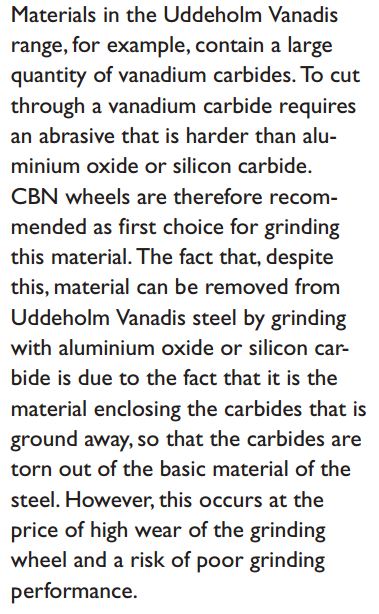
From Uddeholm, on the topic of grinding high-VC tool steels (yes, with powered means, and they recommend CBN for that; basic physical properties/hardness of the materials still apply, and won't change when used on stones by hand):
(text excerpted from .pdf document at site -->: http://www.uddeholm.com/files/TB_grinding-english.pdf )

qRlA52t.jpg


David
 
Last edited:
To David and Jim.

I've never doubted either of your abilities to sharpen knives. My point was that there's a finite limit to how far SiC or AlOx will go in refining vanadium carbides within the steel (which are way harder than the steel matrix's 64RC; Crucible Metals listed VC at 82-84 HRC). Polishing the steel (in aggregate) and producing sharp edges with a somewhat softer abrasive is one thing, and will go as far as the carbides in the steel will allow. Going further in abrading and polishing the vanadium carbides themselves is another, in using material that isn't hard enough to do it in the most literal sense, limited by it's physical properties at the molecular level; it's impossible when the basic physics of the abrasive material won't support it. This is (still) the point I'm emphasizing, and is something worthwhile to consider for someone looking to maintain, refine or polish to levels limited only by their own preferences and abilities, and not limited by the materials or tools they're using.


David

OK, that all has some value in the Commercial grinding part of it all as tool wear can have a real effect on the whole process, and it would actually show up in the process as in tool wear in commercial grinding....

When sharpening a knife blade, and that's what this thread is all about about in the 1st place it doesn't really matter all that much when some dude is just sitting around and wants his knife to get sharp.

Things start to get over complicated when they really don't need to be as in it's not really all that difficult of a process to begin with.... That is making a knife blade sharp.....

So in the end people can over think things and get all technical about it all while complicating the heck out of it and use this media like diamonds or that media like CBN and put it all under a microscope and write all about how complicated they try and make it all out to be.....

Or....

They can just sharpen the knife with a SIC stone because in the end the result will be the same, the knife will be sharp.... And then cut stuff.
 
For my own curiosity and perhaps re-confirm my view about abrasives vs carbides. Oh and was bored this morning. So I used 3M Auto 2000 grit w/d SiC sandpaper to polish (rub all directions) the edge bevel of 52100 & 20cv/m390 blades. 52100 blade under 15x loupe (Peak Lupe) looks quite bright and almost mirror. 20cv blade has that carbide hazy look (carbide haze). carbide haze represents shadow cast by protruding carbides from steel matrix - where SiC (maybe a bit fractured by the end) abraded more to the softer steel matrix than vanadium carbides. I don't think polishing technique nor backing(fingers) are relevant. Apex is where bevels meet and very thin in junction, thus more flexible (i.e. less resists to abrasion), which make difficult to abrade carbide whether it is much or hardly harder than SiC.

For me - diamond fixed & compound work better for high alloy and high grit finishes. ymmv.
 
Well, we've now moved from; SiC won't sharpen steels with vanadium carbides only diamond-- to ok you've shown SiC can sharpen steels with vanadium carbides BUT diamond works better. For Me.
That would be a good trick to prove that carbide haze represents a shadow cast by protruding carbides. i.e. unshaved down vanadium carbides all using 15X magnification. When others could not find this using a
1000X microscope. Jim said he did it, he's only been a member here for 10 yrs. more. This is good,-- it's causing folks to do some thinking on this. DM
 
Well, we've now moved from; SiC won't sharpen steels with vanadium carbides only diamond-- to ok you've shown SiC can sharpen steels with vanadium carbides BUT diamond works better. For Me.
That would be a good trick to prove that carbide haze represents a shadow cast by protruding carbides. i.e. unshaved down vanadium carbides all using 15X magnification. When others could not find this using a
1000X microscope. Jim said he did it, he's only been a member here for 10 yrs. more. This is good,-- it's causing folks to do some thinking on this. DM

All I can say is people need to use what they want to sharpen with. :)

That's not the same as what is really needed or will actually work though.... For me I like to keep things simple, SIC and ceramics work for me. :)

Thinking is a good thing as long as they don't think too much and make things more complicated than they really are. LOL :D
 
Last edited:
This thread makes me think about when I went over another members house for some talk and sharpening not all that long ago.

I took my Edge Pro with 2 SIC stones 320 and 400 grit, my Spyderco profile Set and another ceramic rod...... And my SIC loaded strop.... forgot about that...

I showed him how easy and simple things really can be.

It was an interesting afternoon.
 
Last edited:
Thank you for taking the time to demo simple sharpening for another Forum member. That is needed a lot here. Glad to see sharpening being discussed here. David 3151 you sure got some additional information out of this topic. DM
 
Well, we've now moved from; SiC won't sharpen steels with vanadium carbides only diamond-- to ok you've shown SiC can sharpen steels with vanadium carbides BUT diamond works better. For Me.
That would be a good trick to prove that carbide haze represents a shadow cast by protruding carbides. i.e. unshaved down vanadium carbides all using 15X magnification. When others could not find this using a
1000X microscope. Jim said he did it, he's only been a member here for 10 yrs. more. This is good,-- it's causing folks to do some thinking on this. DM


If you could get over yourself for 5 minutes you would see that both I and David were saying that ITS THE WRONG TOOL FOR THE JOB!

Never said sic won't cut the high V steels only said it's the wrong abrasive for the job.

I can sharpen S30V with my India stone too, still doesn't mean I'm using the correct stone for the steel regardless if it "works" or not.
 
320 Grit SIC, K294 at 64 RC and .010 behind the edge...... 10 DPS...... K294 is A11....

[video=youtube;EytTUsg3J6s]https://www.youtube.com/watch?v=EytTUsg3J6s[/video]
 
Last edited:
A nice video clip. I'm sure he didn't sharpen that blade correctly. I'm working at getting over myself... DM
 
Wow, that powder steel has very close to 10% vanadium and he got it that sharp on a crystalline stone. That's impressive!
But that's why Mr. Wilson is a Legend in custom cutlery. DM
 
Back
Top