edge geometry

Many of those who led the way in the out of doors knew a thinner blade was better. Look at the Marble's woodcrafter and its ilk, the Nessmuk skinner, and Kephart's knife. I'm in their camp. 3/32" - 1/8" for me. Sears and Kephart both had something go say about the poor geometry of many fixed blades all those years ago. If I want a chopper, I'll use a hand axe.

...while a huge majority of fixed blades are made for chopping and to withstand abuse...
It hasn't been my experience that a huge majority of fixed blades are made for chopping or to withstand abuse.
 
Last edited:
I can respect that. I also waited until I was decent at freehand sharpening before I got the 1x30". Even did a couple of full regrinds by hand with very coarse stones. That said, power makes material removal waaaaay faster and more enjoyable :D The harbor freight belt sander is very cheap, but I've had a lot of success with it for what it is.

I don't have any videos, but there are plenty of them already out there on youtube if you ever decide to pick one up. I watched a lot of Gavko's vids when I first got started. The main differences are that I put mine up on a workbench (he was short on space at the time,) and I rigged up a drip line for wet grinding.

[video=youtube;9ATukKnCbbE]http://www.youtube.com/watch?v=9ATukKnCbbE[/video]

Here are a couple of my ugly ducklings, (as a beginner, I liked regrinding hollow ground blades to thinner flat or high-saber grinds the most because it's fairly easy):

2ujjtc9.jpg


jjn1xz.jpg

Ya man I just think free handing is one of those invaluable skills especially when I'm not in the city. Like you said once I get good at free handing I'll move on to a belt grinder I would imagine. I like the look of that knife you did actually and I'm sure that took some time haha. When I bought my old kitchen knife I had to do a bit of a regrind and now it's a solid performer.
 
I realize now that all those Buck Reaper failures are due to batoning...

Yet my argument was all about hollow grinds and chopping performance: I don't know what chopping performance has to do with batoning, or why anyone would bring something completely irrelevant as an example of failure...

My increasingly relevant opinion of batoning is that it is not a legitimate way to use your knife, which is exactly why you never heard of it in the distant past, and why it is still not recognized as a word by the computer's glossary, even on this site... I does give a great excuse for makers to produce a great number of terminally dull pry bars though....

Gaston

Actually...in Europe it's commonplace to use various forms of billhooks to baton kindling for household use, to the point where many nationalities have their own designs made with the task specifically in mind (alongside chopping tasks performed on a chopping block) with the English term for such tools being a "block bill". It's a VERY old practice.
 
My increasingly relevant opinion of batoning is that it is not a legitimate way to use your knife, which is exactly why you never heard of it in the distant past, and why it is still not recognized as a word by the computer's glossary, even on this site... I does give a great excuse for makers to produce a great number of terminally dull pry bars though.... Gaston
I suggest you google "vintage kindling chopper". There were kindling splitting knives designed specifically for batoning.

Vintage-ELWELL-3541-8-Kindling-Spliter-Bullhook-Hatchet-_1.jpg

Vintage-Brades-419-Stick-kindling-Chopper-8-_57.jpg
 
Last edited:
It is a dirty rotten secret of good marketing that most consumer products are meant to be sold, not to perform.

I have never thought of it as being a secret...the object being to make money, NOT friends.
 
Actually...in Europe it's commonplace to use various forms of billhooks to baton kindling for household use, to the point where many nationalities have their own designs made with the task specifically in mind (alongside chopping tasks performed on a chopping block) with the English term for such tools being a "block bill". It's a VERY old practice.

Apparently, from the above posts, there were broad thick tools with low sabre grinds that don't really belong on a knife... This is the first time I hear of old knife-like tools specifically designed to be beat on, so it's nice to learn something new... I doubt they are widely used anymore, if they were that common to begin with...

There are still special axes that are specifically designed for splitting by hitting on the back of the head.

The most common thing had nothing to do with any of these tools, and was a simple steel wedge that we called in French "un coin"...

None of this should have anything to do with knife use..: Batoning inevitably cause edge micro-folds because a really sharp apex is forced to follow the wood's grain, which isn't straight... This means more rapid height loss from re-sharpening...: The only way to avoid this is to lug around a dull knife... Other than that I guess you can still do it, but the idea you subject the knife to something unnecessary that might break it, when out there far away from a replacement, seems to me particularly counter-productive...

I still don't know how an argument against hollow grinds for chopping is served by showing hollow grinds broken by batoning...

Gaston
 
Apparently, from the above posts, there were broad thick tools with low sabre grinds that don't really belong on a knife... This is the first time I hear of old knife-like tools specifically designed to be beat on, so it's nice to learn something new... I doubt they are widely used anymore, if they were that common to begin with...

Nope, they're not any thicker than 1/8" most of the time and have a grind for chopping. Because they're used for sensibly sized (small) targets they don't need to be thick and a more gradual split keeps it from flinging the small pieces everywhere. As already noted they were also used for chopping atop a block, so they were a cutting tool, not just a splitter. Lots of different varieties out there, but most resemble a variation of a cleaver of some sorts when viewed in profile. Still commonly used and made, though obviously not so common as they once were.
 
Is there any reason to baton except for getting firestarting material or batoning cross grain for notching a stick? I don't mean that question rhetorically, I'm really curious as I've never needed to. Most of the time I can gather enough dead fall and split some small stuff to get a good bed of coals going to light the bigger stuff. I regularly see people trying to baton big 4"+ pieces of wood and have to wonder why. If I'm at home I'll have a better way to split wood than a survival knife.
 
Is there any reason to baton except for getting firestarting material or batoning cross grain for notching a stick? I don't mean that question rhetorically, I'm really curious as I've never needed to. Most of the time I can gather enough dead fall and split some small stuff to get a good bed of coals going to light the bigger stuff. I regularly see people trying to baton big 4"+ pieces of wood and have to wonder why. If I'm at home I'll have a better way to split wood than a survival knife.

You have to be in a very wet environment where all the deadfall and easy fire wood is completely soaked.

If you are in a downpour and it's been raining in that area for a few weeks the only way your getting a fire is by cutting down a standing dead tree and process the wood with batoning or chopping to get to the dry stuff in the center.


You can use any combination of tools to do the job but the axe is the fastest and most effective way. But it has a high learning curve and can be dangerous if used improperly.

so large chopping knives can be used more effectively by a novice and can prevent massive injury from axe misuse due to fatigue or lack of experience and skill.

Either way though a large hollow ground knife is not the right geometry for this task. In fact, haha I'd argue that it's about the least effective grind for a "woods blade" in my experience.

Too fragile, no "meat" behind the edge to help knock out wood chips, spread the wood to help split or carve good feather sticks.

It's not impossible, just not as efficient.
 
I think a lot of the reason why a ton of knives are made with what most consider poor cutting geometry is because there are more knives carried by people who use them as general multi tools in ways that would make most people on this forum cringe. The things I myself and others in the middle of nowhere use our knives for, where everybody carries a knife are significantly different then what I have come to learn is "acceptable use" on these forums. We can all say all we want a knife is not a screwdriver, prybar, baton...etc all we want. The reality is, when you're out somewhere and it's the only or most convenient tool you have on you, that's probably the one getting used. The majority of knives in use in the US I can confidently say are not used by Knife enthusiasts like folks of this forum.

Of coarse on the opposite end of the spectrum are the tacticol folks who just want something that looks cool to whip out and ninja around in the faces of their friends. Who cares how it works as long as it looks cool right?
 
Apparently, from the above posts, there were broad thick tools with low sabre grinds that don't really belong on a knife... This is the first time I hear of old knife-like tools specifically designed to be beat on, so it's nice to learn something new... I doubt they are widely used anymore, if they were that common to begin with...
Nope, they're not any thicker than 1/8" most of the time and have a grind for chopping. Because they're used for sensibly sized (small) targets they don't need to be thick and a more gradual split keeps it from flinging the small pieces everywhere. As already noted they were also used for chopping atop a block, so they were a cutting tool, not just a splitter. Lots of different varieties out there, but most resemble a variation of a cleaver of some sorts when viewed in profile. Still commonly used and made, though obviously not so common as they once were.
Yup. Those cleaver like splitters are still mass produced today. Just not as common as they once where. But then, neither are fireplaces or wood stoves in homes as common as they once were.
 
You have to be in a very wet environment where all the deadfall and easy fire wood is completely soaked.

If you are in a downpour and it's been raining in that area for a few weeks the only way your getting a fire is by cutting down a standing dead tree and process the wood with batoning or chopping to get to the dry stuff in the center.

Most likely third of my life I spent in the wild and I never absolutely never thought that I need knive , axe or hand saw ................to start a fire :) Only I care is to have in my backpack some rubber strip ........:)

PS . If where you go there is no wood for fire, most likely it's not wilderness .................
 
I think a lot of the reason why a ton of knives are made with what most consider poor cutting geometry is because there are more knives carried by people who use them as general multi tools in ways that would make most people on this forum cringe. The things I myself and others in the middle of nowhere use our knives for, where everybody carries a knife are significantly different then what I have come to learn is "acceptable use" on these forums. We can all say all we want a knife is not a screwdriver, prybar, baton...etc all we want. The reality is, when you're out somewhere and it's the only or most convenient tool you have on you, that's probably the one getting used. The majority of knives in use in the US I can confidently say are not used by Knife enthusiasts like folks of this forum.

Of coarse on the opposite end of the spectrum are the tacticol folks who just want something that looks cool to whip out and ninja around in the faces of their friends. Who cares how it works as long as it looks cool right?

Exactly ! Probably I more used the knife for things which is not intended ...........
 
Actually...in Europe it's commonplace to use various forms of billhooks to baton kindling for household use, to the point where many nationalities have their own designs made with the task specifically in mind (alongside chopping tasks performed on a chopping block) with the English term for such tools being a "block bill". It's a VERY old practice.

Yep, but not only Europe!
Billhooks seems to have been used earliest in the Middle-East around 3000 years ago.
They have been used in most parts of the world, from China to northern Europe.

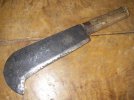
This one was a gift from a familymember, returning from Switzerland.

attachment.php


It's stamped Goldenberg, a French manufacturer.
Spine is 0,2"/5mm and bladelenght 9"/23cm.
The edge is convex.
It's very close to a model used by French Army in WW1.


Regards
Mikael
 

Attachments

  • IMGP6337.jpg
    IMGP6337.jpg
    76.3 KB · Views: 56
Yep, but not only Europe!
Billhooks seems to have been used earliest in the Middle-East around 3000 years ago.
They have been used in most parts of the world, from China to northern Europe.

This one was a gift from a familymember, returning from Switzerland.

attachment.php


It's stamped Goldenberg, a French manufacturer.
Spine is 0,2"/5mm and bladelenght 9"/23cm.
The edge is convex.
It's very close to a model used by French Army in WW1.


Regards
Mikael

In a pinch that thing would leave a mark.
 
And yet the original cleaver style CPM M-4 "race knives" were full height flat grind with an above the edge thickness of like 0.015........ Your mileage may vary.

I can attest to this. Can be brutal on an edge if not HTed right.
Scott
 
Most likely third of my life I spent in the wild and I never absolutely never thought that I need knive , axe or hand saw ................to start a fire :) Only I care is to have in my backpack some rubber strip ........:)

PS . If where you go there is no wood for fire, most likely it's not wilderness .................

Hahaha right on, I just imagined you going full caveman in a torrential downpour :p

P.S if you can make a fire from deadfall, your not in a temperate rainforest wilderness unless it's summer time in August :D
 
I have made a fair number of large W2 blades that all had FFG's and convexed edges only. I know for sure that a few have been used for hacking at wood and animal carcasses. None have failed and some of the ones that were treated the most unkindly were early ones that I made before I had really sussed out the best heat treatment that I could do for W2. One was sold to a guy who was replacing a fairly well known "hard use" 2 plus pound saber ground 5160 blade that had chipped out while cutting up a goat for an after mission party in Iraq. Once again, your mileage may vary.
 
Firestarting in rainy conditions is really tough and I know what you mean by needing to get to the dry part in the center. Situation may not always allow, but if you have need and can, use a hatchet to process larger bits of wood. My 2" diameter rule is not a hard cap, I'll do what it takes to get by if the situation changes, I just try to keep the lateral stress off the knife as much as possible.

I would say the biggest point to be made is that high hardness thin hollow grinds aren't great for batoning or hard use. They never have been, nor were they designed for it, just look at an axe head's shape. Hopefully Buck will listen and thicken the blade on the Reaper, maybe turn it into a saber grind.
 
Last edited:
Back
Top