Final hand rubbing woes

Joined
Sep 16, 2002
Messages
1,577
I'm following what I believe to be the correct process for final hand rubbing based upon tutorials and posts I've read here, but I'm not getting the desired results. I rub in alternating directions with each step up in paper grit using WD-40 for lubricant and a piece of micarta and/or a file as a sanding block.

I rub each grit until the scratches from the previous one are gone, and I check several times in fluorescent light, incandescent light, and sunlight. When I get to the final grit (usually 320x, 400x, or 600x) I work out the scratches from the previous grit then I switch to a fresh section of dry paper and rub in one continuous stroke trying to remove any swirls or hooks in the finish. I go maybe 10 strokes, then check it, and then repeat.

The problem I have is that when I get to this final step, the blade gets to looking pretty good under the artificial lights, but when I take it outside into direct bright sunlight, it's sort of a mess. Swirls, hooks, etc. galore, and repeating the final step multiple times doesn't really seem to help much. I do not believe that what I'm seeing are scratches from a previous grit perpendicular to my final scratch pattern, but just random stuff swirls, hooks, etc.

Am I missing something in my process along the way, do I need to do the final step for a long period of time too, or what might help me out at this stage?

Thanks in advance for any help or tips anyone can offer.
 
I use only water for lubrication (in fact it is not lubricant as far as I see, water increases the cutting performance of sandpaper for me). Also I use only two directions, first is perpendicular to the spine second is parallel. Also I sand latest grit dry. I dont know why you are experiencing this but I guess it is about the motion. Try to rub in one direction, especially at the end. Also to go back one grit back and rub a couple of times then return back to the final grit helps often when those swirls and hooks are too stubborn.
 
Wash your hands and the piece with the soap when change the grit. Clean the desk with the dump cloth or a shopvac. Should help.
 
Thanks for the input, Emre. As you recommend, I am also going only perpendicular and parallel directions with the final grit being parallel. I am rubbing the final grit in both directions until I am satisfied that the previous grit scratches are out, then I switch to the fresh dry paper and only go one direction to try to remove the swirls.

I will try your suggestion of going back briefly to the previous grit, I haven't done that yet. If I understand correctly, using oil or water helps keep the paper cleaner and cutting for longer as opposed to being an actual lubricant per se, and for me using WD-40 eliminates any possibility of any rust forming as opposed to using water.

Thanks for the advice.
 
Wash your hands and the piece with the soap when change the grit. Clean the desk with the dump cloth or a shopvac. Should help.

Interesting, I hadn't thought of this. It sounds like there is the possibility that I'm contaminating my paper with particles from a previous grit?
 
I use water on carbon steel and have never had any rust. Just wipe it off after each grit change.
Sounds like you need different and/or more light at your bench.
 
I get that too,mostly at either 400 or 600 grit finish.try a little wd-40.i dont know if there is a way around it,other then rub till it looks good :) try going into the 1000 grit range.
 
Going back and forth is likely getting you the fish hooks. If you do go each direction with the final grit, go in long, slow, complete strokes. Don't stop and reverse in the middle of a stroke. That will decrease the number of fish hooks in the middle of the blade. Slowing down will also increase your accuracy and prevent unwanted lateral movement during direction changes.

After removing all prior scratches, immediately switch to one direction, full strokes from plunge or ricasso to tip. It will take a good while to remove any final fish hooks going in one direction only. Settle in to your happy place and take a vacation there.

--nathan
 
I love to use Windex as a lubricant (or rather, the cheapest knock-off I can find)...

Cheers rody
 
Fish-hooks from the very first step can seem to disappear, then sneak back up on you during higher grits, when the surface starts to get smooth enough to really show imperfections. Now is not the time to deal with this, let's not discuss how I found this out :o

I'm trying to discipline myself to treat the first grit the same as the last. That includes not swirling around trying to cut fast, and not sanding with loaded paper.

I've only used water so far, rinsing the blade off often and using fresh dry paper for the final few passes. What would you guys say are the advantages of windex, WD-40, etc?
 
I've been using WD-40 just because it's sitting there already on the workbench, it won't promote rust, and I didn't really think it mattered that much as long as you used something. If it makes a big difference, I will gladly switch to water or Windex or anything else.

Nathan, do you do your whole final grit in one direction? That seems like it would take an eternity (it takes a long time even going in both directions without worrying about going slow or being super careful while working out the previous scratch pattern.)

I worked on it some more just now, and it's a lot better but not perfect. Other than starting with clean hands and clean blade, I'm not sure what may have helped other than just more time.

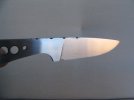
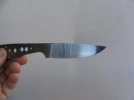
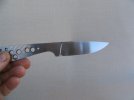
Are you all getting a PERFECT finish using this method, or is that not really realistic? It looks excellent in normal light, but in very bright direct sunlight (where I'm almost looking more into the glare off the blade than directly at the surface) there are still a few imperfections. This particular blade is currently at 320x, where I had planned to stop. Unfortunately I can't manage a good pic of what I can see visually.
 

Attachments

  • IMG_1521.JPG
    IMG_1521.JPG
    18.4 KB · Views: 128
  • IMG_1522.JPG
    IMG_1522.JPG
    26.1 KB · Views: 97
  • IMG_1523.jpg
    IMG_1523.jpg
    35.8 KB · Views: 108
Paul, I do as you do with the final grit, just making sure to be careful not to add extra fish hooks. And then I finish with just one direction strokes. It does take time to get everything out.

I use a honing oil for sanding instead of windex.

It's never going to be perfect. Just as close as we can get.

--nathan
 
"Perfect" is relative :D But yes, you should expect a finish without a pattern of fishhooks or the dreaded 2" bump. Whether it's a 400grit satin or mirror polish. Even if it only shows up in certain light at a certain angle, if it's there, the finish isn't done.

I do my final sanding along the length of the blade, because that's the easiest way to keep it nice and straight. I've also learned from folks here to sand up to a grit above the desired finish, then back down to it for the final polish. It really does work well.

I like the look of a satin finish that's perpendicular to the blade, but I think that may have to wait until I get better on the belt-grinder.
 
Last edited:
I use only water for lubrication (in fact it is not lubricant as far as I see, water increases the cutting performance of sandpaper for me). Also I use only two directions, first is perpendicular to the spine second is parallel. Also I sand latest grit dry. I dont know why you are experiencing this but I guess it is about the motion. Try to rub in one direction, especially at the end. Also to go back one grit back and rub a couple of times then return back to the final grit helps often when those swirls and hooks are too stubborn.

I actually do all my hand rubbing in the shower because the shower water acts as a great lubrication.
 
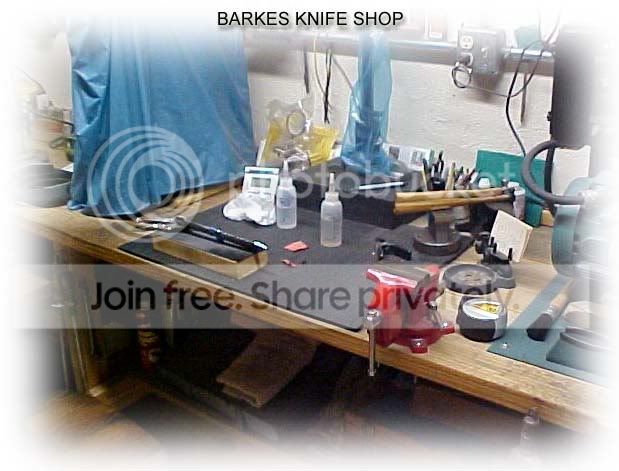
All my hand rubbing and finishing work is done utilizing this workbench. With a little kerosene and mineral oil for lubrication. Also, the next time you start hand rubbing your blade out get a piece of leather and use it for backing and pull one-way and do this 4 or 5 times changing the grit and that will get rid of the little hooks, swirls. That's what works for me. Hope this was of help. :)

Terry


FIELDKNIFE10.jpg
 
Something else to consider...

I cover my knife board with a paper towel that is wrapped around it and held in place with a small spring clamp. I change it often, especially when flipping the blade over. I have had more trouble with little pieces of grit getting under the blade than anything else during the hand rubbing process. A piece of leather under the blade as a padded surface is nice, but it can trap little scratching demons, so I dumped that method like a bad habit. (This is different that Barkes mention of leather use.)

Hope that helps.
 
Something else to consider...

I cover my knife board with a paper towel that is wrapped around it and held in place with a small spring clamp. I change it often, especially when flipping the blade over. I have had more trouble with little pieces of grit getting under the blade than anything else during the hand rubbing process. A piece of leather under the blade as a padded surface is nice, but it can trap little scratching demons, so I dumped that method like a bad habit. (This is different that Barkes mention of leather use.)

Hope that helps.

To keep grit and junk from messing up the opposite side, I completely finish out one side only. Then I clean everything up, and then tape the finished side up. This way, nothing can ruin the finished side while I hand sand the other side. When I'm hand sanding the first side, it doesn't matter if a little grit puts minor scratches on the other side, as I haven't started hand sanding it yet anyhow.
 
I don't think I was clear on my actual finishing techniques early (was being rushed out the door by my wife).

I flatten out any imperfections from grinding using a flat ground piece of angle iron and paper. After the initial grit (usually 320, sometimes 220), I switch to a leather covered angle iron and paper and do all the rest with the leather backing.

I place painter's tape on my knife holding fixture, switching it between sides, and finish each side to 400 grit sanding in both directions. After that, I finish one side at a time to 600 grit or 800 grit (depending on final grit finish) sanding usually only in one direction lengthways down the blade unless there is a stubborn area. Then I might work back and forth to work it out, but I still finish sanding in one direction. Then, I usually back up a grit for a few passes to finish it off. After it's completely done, it's immediately taped up well with painters tape and flipped over to finish the other side.

I had problems with fish hooks at first as well, but I think it was really from not completely getting out the early grit scratches. I also didn't spend near enough time in my finishing in my eagerness/haste to get the knife done. Since then, especially as I've started selling to customers, I find it much easier to spend the extra time (and it's hours) to fully finish the the blade to the best of my current ability. Each one is getting a bit better as grind finish improves and as I avoid mistakes that I've made in the past.

So, in a sense the process has sped up with new tricks and avoiding mistakes, but it has slowed down as well with extra time spent on finishing.

--nathan
 
This is a great thread, I love the putting ape on the side of the blade that has been finished. PJ we are still waiting on some finished up picks bro.:D
 
Back
Top