SNAPPER DEMO HIGHLIGHTS
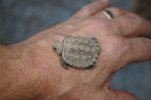
It was just after supper and a few of us headed back to the bunk house from the lodge. As we crossed the planked culvert and stepped onto the gravel/rock road bed, I spotted an unusually shaped rock. I stopped the others, and picked up this recently hatched baby snapper. It was probably trying to get to the pond. I took a photo, and released it in the pond. The others had never seen a hatchling snapper.They are still cute at this age. If we hadn't passed by and spotted it, it surely would have been smashed by the crowd in a few minutes.
I see these from time to time in my back yard. The snapping turtles ancient breeding grounds has been the creek along the side of my yard for hundreds ( thousands?) of years. It was not the turtles choice to build houses and work shops in their nursery, and their instinct will make them come back to lay their eggs where they were born ( and their ancestors were born), regardless of what man has put up to impede them. In the spring, I often see several 20-30 pound females crawling up past the workshop and crossing the yard. They are looking for soft soil, which the find in my flower beds. I allow them to dig things up a bit and lay their eggs. If I spot a fresh nest, I try and cover it with some mulch to keep the raccoons from digging it up immediately and eating all the eggs. Sadly they get nearly all the eggs. But, as with nature, a few get missed, and once in a while I see a baby in the beds, or trying to navigate the yard toward the stream. I don't mow the grass for a couple weeks ( to avoid making snapper tartar) and take any I find down to a spot where the bank is easier to climb. I release them about 20 feet from the bank and let them find their own way from there. I don't know if it will help re-program their instinctive memory to come back to the new spot, but it can't hurt to try. One year I moved three clutches of eggs down to that area, in hopes that the newly hatched turtles would have a better chance, but the coons got them all.
Even when one of these hatches, gets across the yard, and back to the stream, the chances of it growing up and coming back in 10-20 years to lay a new generation is very small. (About the same as Sam's chances of growing up into a normal person).



 hope your flight is going well.