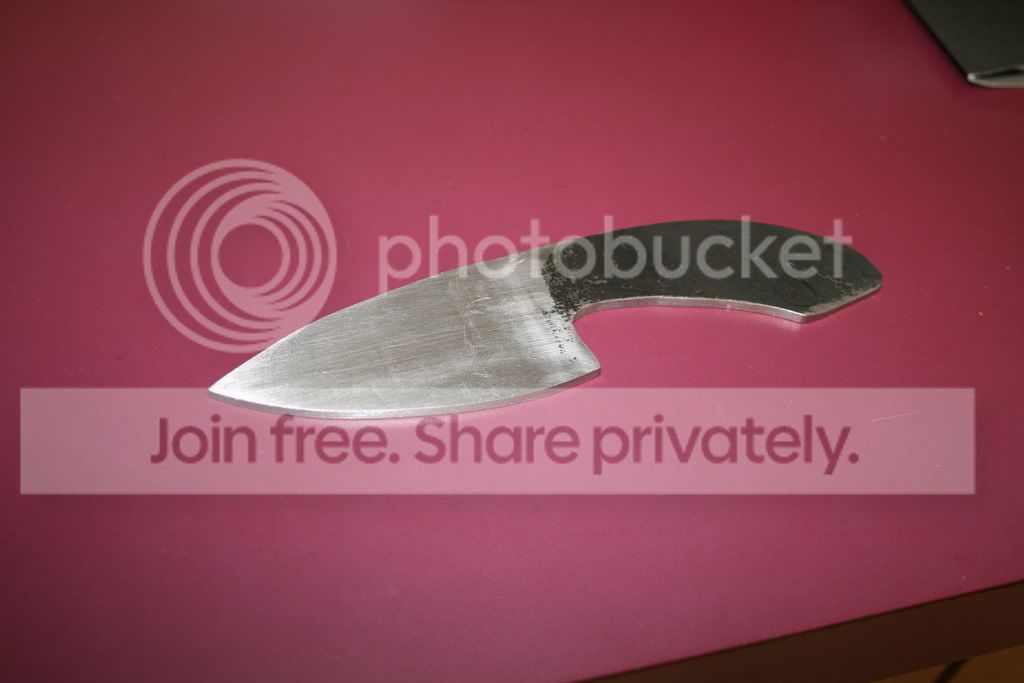
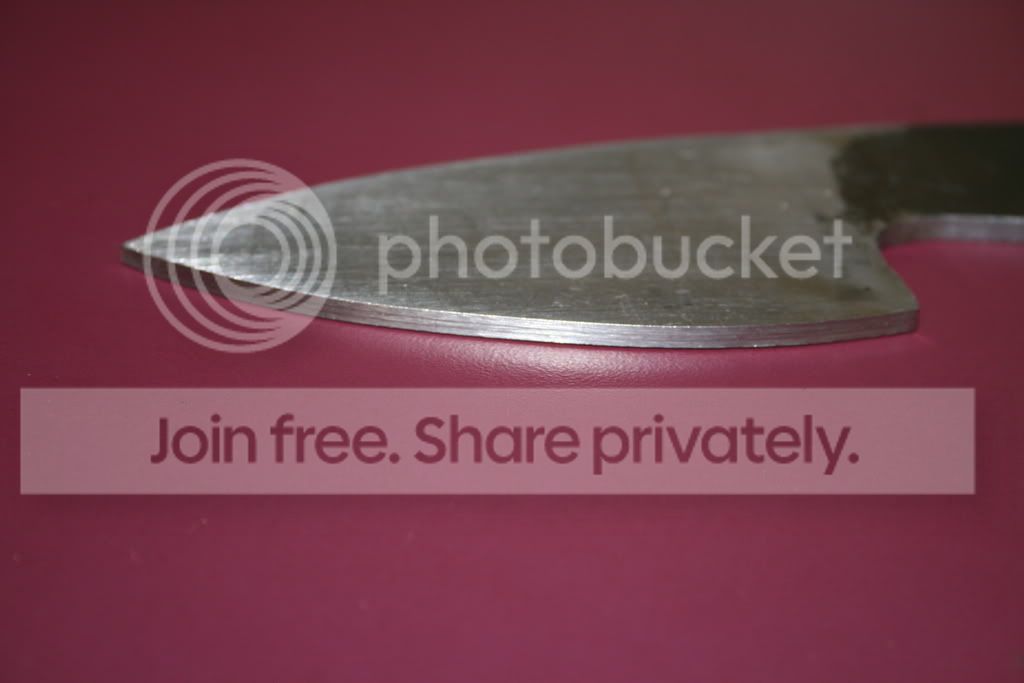
First Attempt

Wow Bruce that is very kind of you. Midnight Flyer (Robert) is right, you folks are class acts and nice to boot.

I tried this on both my jig saw (felt like I was standing on a trampoline with my kids) and my scroll saw. The scroll saw quickly said "ain't no way you gonna cut with me". So I'm going to check with the metal shop at work for a hand at cutting. If I can't find somebody local, Bruce may be getting a package. :) All my equipment is for woodworking - no bandsaw yet - so I'm handicapped from the get-go.

Thank you again for the advice and offers of assistance.

Thanks Clyde,
I am happy to do it, in fact if you had 2 or 3 it would be the same price...free.

The best investment you can make is a bandsaw. Harbor Freight has them for under $200 but you will need a bi-metal blade. Portabands are cool too but may be more money. I have a Jet (exactly like the Harbor Freight but painted grey) and love it.
Bruce
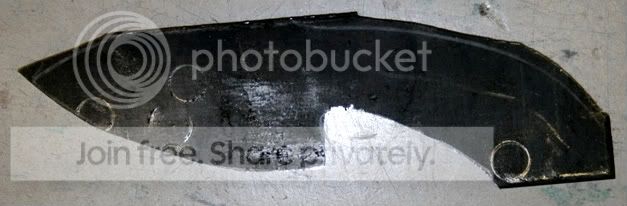
 
This is the blade after the initial cuts. Pretty rough but taking shape. I was pleasantly surprised at what my little B&D jig saw could muster. I'll dress this up on my grinder next.

Knife.jpg
 
Okay, now you are at the point where things get abit more serious. Scribe a center line for center of the edge. This may be tricky if you don't have access to a center knife scriber. But using a sharpened center punch, work a center line down where the cutting edge will be.

Then start the stock removal process. Gradually start removing material to form the bevel lines using hand files or belt sander. Double check your work as you go to make sure things remain symetrical. Symetry is critical for a good looking blade. Go slow and compare each side of the grind reguarly until you are satisfied with the grinds. Then work with progressively finer grits until the knife finish starts to look good.

I usually bring a knife blade to a 220 grit finish prior to heat treat. Drill all holes for the handle prior to heat treat.
 
I think it's starting to come together now. I still have some sanding to do. I just bought a new belt for my sander - wore the old one out. Now I can work on gettting a few of the ripples out of the blade. The spine has taken a little different shape than what I had planned, but I think I like it better this way.

IMG_1144.jpg


IMG_1142.jpg


Please feel free to offer any advice. All help appreciated.
 
That's coming along nicely! It also looks to me like you did a fine job scribing the edge guidelines :thumbup:

I suggest you plan out and drill your holes in the handle now, before any more grinding. At a glance, it seems you will be able to get the spine, the ricasso and the butt in a vise fairly steadily. With decent contact between the steel and the vise jaws.

Actually, I try to do my drilling before I even profile, because it's just easier and safer to vise-up a straight piece of barstock. This may be "backwards" to some folks, but IF I'm already sure how I'm going to profile it, it works better for me. I also suggest your next tool purchase be a small drill press; if I had to start over I would buy my press before my grinder. Yes, really :)

If you want a nice clean plunge, set it first with a file and some kind of guide. At least set the beginning of it for a reference point. As for beveling, start with a 45-degree angle on both sides, being careful to only go down to the scribed lines. Then start working the bevel back towards the spine.

You're definitely on the right track, keep at it! :)
 
Last edited:
Thank you James. I have a drill press and used it to grind down some of the tight spots here. I put a sanding barrell from my dremel in the drill press and went to town.

I am worried about sanding the bevels, afraid I'm going to get them lopsided. Any advice other than take it slowly? Should I make some type of jig to hold it at the same angle?
 
Those sanding mandrels are great. Since you have a press, follow Bruce's advice and look at a bandsaw next.

I think if you're careful, you shouldn't need a jig. You might try clamping the blade in your vise point-up, so you can see the angle you're working at compared to the spine more easily. Glue scrap leather from an old belt or something to the vise jaws to prevent nasty marks that are a pain to get rid of. Then set the 45's with a file... it's nearly as fast as a belt grinder when shaping a small amount and easier to see what's going on.

If I'm telling you stuff you already know, don't be offended! I just figure no one is born knowing this stuff...
 
Last edited:
No, your not telling me stuff I already know - I'm far from a "know it all". I understand the part about the 45's, but what about the rest of the blade. From the edge to the spine? Or, should I only bevel the very edge?
 
Start with that 45 degree bevel down to the scribe lines you made. This won't take long. You left enough space between those lines that you should be fairly safe from warpage in HT.

From that point until after the blade is quenched and tempered, keep that flat edge the way it is, and work the bevel back towards the spine. OR, since that's relatively thin stock, you could just do the 45's and grind the rest of the bevel after HT. It would take a bit longer to grind that way, but you would have extra insurance against warping in the quench.

Just go for it, man! Steel isn't that expensive, if you somehow ruin that blank, just chalk it up to experience. You think no one else ever goofed? :)
 
I'd say stop now before the addiction takes hold.... TURN BACK WHILE YOU STILL HAVE SOME SANITY LEFT!!!! probably too late.

Great looking start, simple blade that will lend itself to actually being finished. I like it!

I'd do a flat from spine to edge. A blade that wide with a full flat should be a really nice cutter.

Clyde, email me please.
 
A blade that wide with a full flat should be a really nice cutter.


That's exactly what I aim to do - use it to skin deer. A pretty knife is nice to look at, but useless to sit on a shelf. I'd like to have the satisfaction of using one and knowing that I made it.

If I understand what's being suggested, I should grind it from the edge all the way back to the spine, leaving the small gap between the scribe lines on the edge?

Oh and I know I'll probably goof, but who wants to do that?
 
None of us want to goof but that's probably 90% of knifemaking, learning to fix goofs.

Take it from the spine to about a nickle's width on the edge before heat treat, at least I think a nickel.... don't have one on hand. I'm poor :(
:p
 
If you can contrive to clamp the blade flat, on top of some support roughly the same size as the blade, you can use a large file like a double or single cut flat bastard, and draw file it, getting some good pressure against the metal with it in that position. For instance, you could find a piece of board like a 2x2, say twice as long as the entire knife and cut a radius on one end matching the curve of the belly of your knife blade. Lay the knife flat on top of it with the point flush with the end and the blade matching the radius, take a c-clamp or two and clamp the tang tight to the board, then take the long end of the board (sticking out past the butt end of the knife) and clamp it in a bench vise with the blade still flat. That way you have a sturdy support for the blade as you file or sand, and clearance for your knuckles on both sides of the blade to run the file or sanding block back and forth. It's called a knife board. Or you can go back into the past shoptalk threads and look for "knife vises." Similar idea, more versatile, a bit more complicated, but you can also make one on your own. Sorry if that didn't make sense or if you already knew about that...

Oh yeah, you do understand what's being suggested. The blade would be a perfect wedge in cross section. And it would be easier for you to draw file or grind first time without worrying about a grind line having to visually parallel the cutting edge!
 
I'm a little late to this thread but I thought I'd offer up some advise for anyone trying to cut steel with a sawzall or jigsaw. Or a hacksaw too for that matter.

Use lots of lube! It makes all the difference in the world. Back when I was framing tract houses I had to cut 12x6x3/8 I beams to fit onsite. Two to four beams per house depending on which model. The fastest way to cut them was with a sawzall and a metal cutting blade. Without lube I was lucky to get halfway through one cut but if I oiled the crap out of it I could cut three or four beams with a single blade. I just used whatever was handy. Usually air tool oil or motor oil. A true cutting oil might work better I don't know.


Clyde, the knife looks great so far. It doesn't get much more satisfying than using a tool you've made with your own hands.
 
Are the pins in a knife for decor or do they serve a function. If the handles are glued in place is there a need for pins?
 
Pins are both for decoration and they keep the scales from moving and popping off if you were to drop it.
 
So they really only need to be straight "pins" that go through the middle? They don't really need to have shoulders on them to hold the handle to the tang?
 
Bolts with shoulders, like corby bolts, are optional. Regular straight pins and epoxy are very strong... ask anyone who's goofed up a handle and had to take it back off :o (and I bet most of us have ;))
 
More adivce needed here. I think I'm at the place where I need to sand by hand. As I change to higher grits, do I need to change the direction I'm sanding in? Should I push and pull the blade across the paper or the paper across the blade?
 
Back
Top