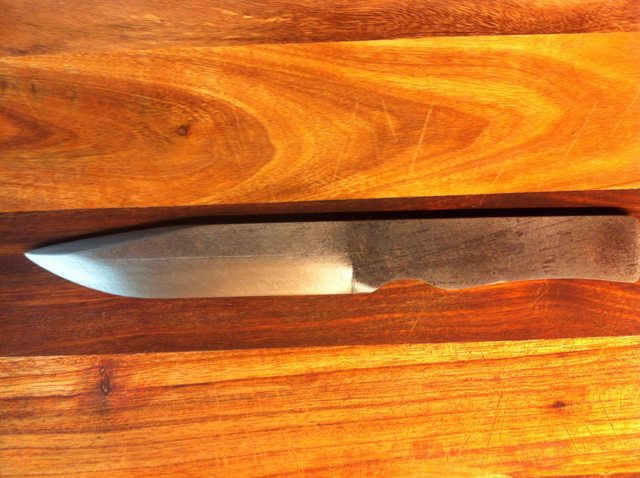
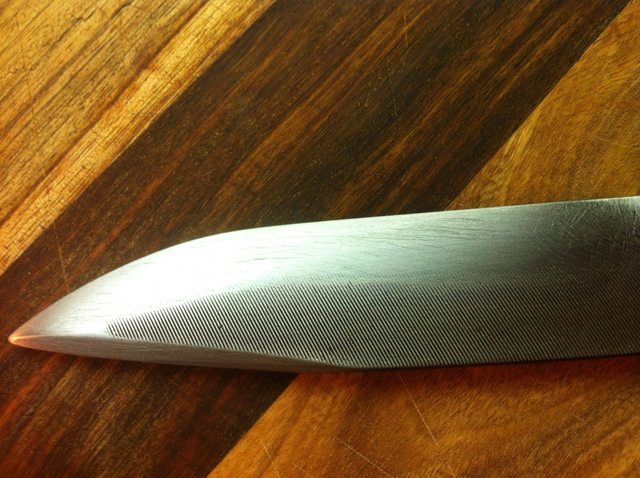
First knife - file knife, need advice!

Joined
Jun 6, 2014
Messages
28
Alright so I got inspired when browsing the awesome knives on this forum and decided to try to make my own knife.

I have no professional equipment, all I had/have to work with is a lot of sandpaper and a couple of files.
There is a few things I hope you guys can help me with before continuing on the knife.

1. This was a really old file that I got from a farmer, probably about 40 years old. I know that it's some kind of tool steel but I don't know which, so how should I go about the heat treating? Any ideas of what kind of steel it could be? (I'm guessing O1 or A2 maybe?)

2. The edge is only 1mm (0.04 inch) thick at the moment, I read a bit too late that it should be about 1.5-3mm thick if not HT in vacuum. I'm gonna do it in a homemade forge (charcoal and hair dryer) and quench it in vegetable oil. Is there any safe way to go about it to prevent it from warping since it's already too thin?
(the knife spine is 5mm/0.2 inch thick)

3. I want to keep the blade grind/file pattern line straight, any good idea how to do a nice jig for this only using a file for the grinding? (I tried covering up the file pattern in tape but it doesn't work very well)

4. As this is the first knife I've made any other advice is much appreciated!
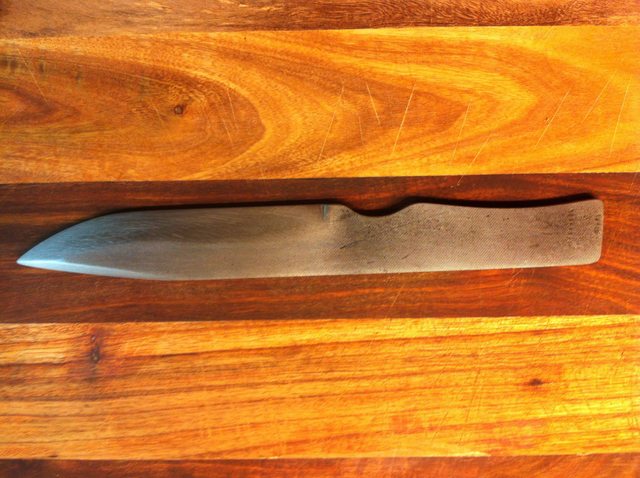
JGXSUbNl.jpg

HPanK9sl.jpg

PGvFLUUl.jpg

1PjlsT2l.jpg
 
Last edited:
To heat treat this, you are going to need a kiln, or a salt pot. Don't waste your time. Get some 1084 or 1075 and you will end up with a functional knife.
 
I don't know where you read that a blade should have an edge 1.5 to 3mm thick for HT, but that is totally wrong. About .015-.030" is good, which is 0.5 to 1.0mm
 
To heat treat this, you are going to need a kiln, or a salt pot. Don't waste your time. Get some 1084 or 1075 and you will end up with a functional knife.
I can't get my hands on any knife steel at the moment. I'm spending 4 weeks at a cottage in Norway, that's why I don't have any proper tools either. I've heard that you can temper it in 2 or 3 cycles in a regular kitchen oven? Will get it to around 450-480 farenheit max which should be enough?
And for the hardening I was planning to use a brick forge heated by charcoal and a fan to get it to non magnetic, which worked when I annealed the file.
Am i misinformed about this?

I don't know where you read that a blade should have an edge 1.5 to 3mm thick for HT, but that is totally wrong. About .015-.030" is good, which is 0.5 to 1.0mm
Alright good to know, was afraid that all the hours of filing being a waste if it warped. Thanks!
 
Usually the oil is heated to decrease the viscosity which helps increase the heat transfer from the steel to the oil. You should have enough oil to immerse the entire blade. Vegetable oil seems to be preferred, usually due to safety reasons. 500 F will give you a softer but more ductile blade. Many start @ 400 F. If the blade is too hard you can temper again at a higher temperature. Don't forget to normalize the blade before final quench.

Oh, drill holes in the tang before the heat treatment.
 
Usually the oil is heated to decrease the viscosity which helps increase the heat transfer from the steel to the oil. You should have enough oil to immerse the entire blade. Vegetable oil seems to be preferred, usually due to safety reasons. 500 F will give you a softer but more ductile blade. Many start @ 400 F. If the blade is too hard you can temper again at a higher temperature. Don't forget to normalize the blade before final quench.

Oh, drill holes in the tang before the heat treatment.

Okay, need to find some good info on normalizing haven't read much about it yet. Thanks for the advice!
 
How have you shaped the so far? If by stock removal only, no heat/forging, I don't really see a need to normalize. It use to cut steel, that should be good enough for you with your first knife. Heat it until non magnetic and then a little more, quench it in 120 degree f. veggie oil, and temper in kitchen oven for 2 rounds, 1 hour each at 400-450. You will have a good knife. Hard to get much better with what you have to work with.

Nice looking blade, and remember to drill pin hole in handle first!
 
Old files could have up to 1.2% carbon. Without precise heat control, your carbon is going to end up in places that are bad for a knife. I was at the Southern Alberta Hammer In this weekend, and spent most if the weekend discussing steel with Kevin Cashen. While I was on the right track with much of my process, I have been enlightened on a lot of the finer nuances. Retained austentite, micro fracturing in plate martensite, carbide problems, and carbon going where it will be harmful rather than helpful would be at the forefront of my mind using a high carbon steel, especially if you don't know the composition. The importance of learning the temperature needed for each steel was reinforced.

That said, I like what you have done with the file :thumbup:. Since you have limited resources at the cottage, have fun. Your plan for heat treat should work ok, which is as good as it can get with that equipment. When you get home, get some good steel, and make things easier on yourself.
 
How have you shaped the so far? If by stock removal only, no heat/forging, I don't really see a need to normalize. It use to cut steel, that should be good enough for you with your first knife. Heat it until non magnetic and then a little more, quench it in 120 degree f. veggie oil, and temper in kitchen oven for 2 rounds, 1 hour each at 400-450. You will have a good knife. Hard to get much better with what you have to work with.

Nice looking blade, and remember to drill pin hole in handle first!

Just by annealing the file and the no heat at all using sandpaper and files. Glad to hear that I don't need to normalize it. Really appreciate your input, got any tips for a nice knife handle design? Also would you recommend me trying some filework like a vine pattern on the spine over the handle, or would that be too much for my first knife risking to ruin it?
Will post a picture in this thread with the finished product.

Old files could have up to 1.2% carbon. Without precise heat control, your carbon is going to end up in places that are bad for a knife. I was at the Southern Alberta Hammer In this weekend, and spent most if the weekend discussing steel with Kevin Cashen. While I was on the right track with much of my process, I have been enlightened on a lot of the finer nuances. Retained austentite, micro fracturing in plate martensite, carbide problems, and carbon going where it will be harmful rather than helpful would be at the forefront of my mind using a high carbon steel, especially if you don't know the composition. The importance of learning the temperature needed for each steel was reinforced.

That said, I like what you have done with the file :thumbup:.

Yeah there is much more to the science of steel than I though, but on the other hand it's a lot of fun to have a hobby where there is always more to learn!
So what do you recommend? Since there is no way to figure out the composition at the moment what is the safest way to go about the HT? It was an extremely hard file when I got it, couldn't make a scratch and broke easily so I think the carbon percentage is pretty high.
 
Last edited:
Practice on something before you try filework on it. :) But otherwise, I would build a filing jig and get those grind lines straightened out before a filework attempt.

Try to not make the handle look like a rectangular block of wood. Rounded at the proper areas front to back and up and down will go a long way to counter the blocky effect. Think about how the scales should look where they meet the ricasso.
 
There is no easy solution to getting the right amount I'd carbon into solution. Just do the best you can and hope for the best. Brittle is from low tempering temps, which leaves the file very hard. If the file was overheated even by a small amount in the original heat treat, it can cause brittleness. Without a kiln or a salt pot, or a well controlled forge with a pyrometer, you don't really have any options. With carbon that high, if it is, austentizing would be 1440-1450f, and potentially a bit lower. If it is .95 to 1% carbon, you could go up to 1475f. That is a tight range that you will not be able to hit, so you will end up with micro structures you don't want.

If it warps, coming out of quench, pull it out when it is cool enough to not flash the oil as you pull it out, but when it is too hot to handle by hand. Use gloves and you will have two minutes while the blade is still quite plastic before the transformation is complete. You can just take any warp out by hand. :thumbup:This will also auto temper to a certain extent. Do two more tempers 1h each, cooling to room temp each time. This three temper cycle process is something Kevin Cashen recommended, as it decreases Rc reading variations compared to longer single or double tempers. This was demonstrated this weekend. I learned a hell of a lot from him this weekend.
 
Practice on something before you try filework on it. :) But otherwise, I would build a filing jig and get those grind lines straightened out before a filework attempt.

Try to not make the handle look like a rectangular block of wood. Rounded at the proper areas front to back and up and down will go a long way to counter the blocky effect. Think about how the scales should look where they meet the ricasso.

Alright will do, good point about the handle too! Will keep that in mind, maybe a groove for the index finger as well.
Unfortunately I can't make a filing jig since I only have like the most basic tools and limited material ( I'm spending the summer at an isolated cottage in Norway) but I think I managed to file it down pretty evenly anyway.
Only the HT, filework and handle + sheath left now. Who knew knife making could be so addicting and exciting!
 
Do you have a magnet? You should heat above the critical temperature. You need to go a couple of shades brighter red after you reach the critical temperature. Make sure the whole blade (not necessarily the tang) is at temperature. You can find color charts online, but the colors don't match up real well to the forge temperatures to my eyes. Let the blade heat up at the critical temperature +/- for a couple of minutes before going to the austenizing temperature. Don't dilly dally around going to the quench. Get your blade in the oil ASAP.
 
Do you have a magnet? You should heat above the critical temperature. You need to go a couple of shades brighter red after you reach the critical temperature. Make sure the whole blade (not necessarily the tang) is at temperature. You can find color charts online, but the colors don't match up real well to the forge temperatures to my eyes. Let the blade heat up at the critical temperature +/- for a couple of minutes before going to the austenizing temperature. Don't dilly dally around going to the quench. Get your blade in the oil ASAP.

Yes I do have a magnet, I used it when annealing the file. Thanks for your help, will come in handy when I heat treat the knife tomorrow (I'm a little bit nervous about ruining the knife..)
 
Before the HT or proceeding any farther, I would highly recommend you read the thread on making a knife from a file. It is in the Sticky FAQs, but I will give you the link;
http://www.bladeforums.com/forums/showthread.php/907667-How-to-Make-a-Knife-From-a-File
FAQ link - http://www.bladeforums.com/forums/s...mon-Questions-Asked-by-New-Makers-and-Members
You should read all the info in The Count's "Standard Reply" sticky as soon as you can:
post #3 - http://www.bladeforums.com/forums/s...reads-All-The-Good-Info-You-Want-In-One-Place
 
Before the HT or proceeding any farther, I would highly recommend you read the thread on making a knife from a file. It is in the Sticky FAQs, but I will give you the link;
http://www.bladeforums.com/forums/showthread.php/907667-How-to-Make-a-Knife-From-a-File
FAQ link - http://www.bladeforums.com/forums/s...mon-Questions-Asked-by-New-Makers-and-Members
You should read all the info in The Count's "Standard Reply" sticky as soon as you can:
post #3 - http://www.bladeforums.com/forums/s...reads-All-The-Good-Info-You-Want-In-One-Place

Thanks, already read a lot of it. Your "How to instructions for making a knife" was great!
 
The HT is finished now, the good news is it didn't warp or crack. But I'm not certain if it's evenly hardened, one side seems harder than the other? And I was able to make some scratches with a file.

I got it up to critical using a magnet and then kept it there for about 6 minutes, then got it straight into the canoa oil in less than 5 seconds. Maybe I should have used salt water (brine) since if it is 1095 it needs a faster cooling medium.
 
Back
Top