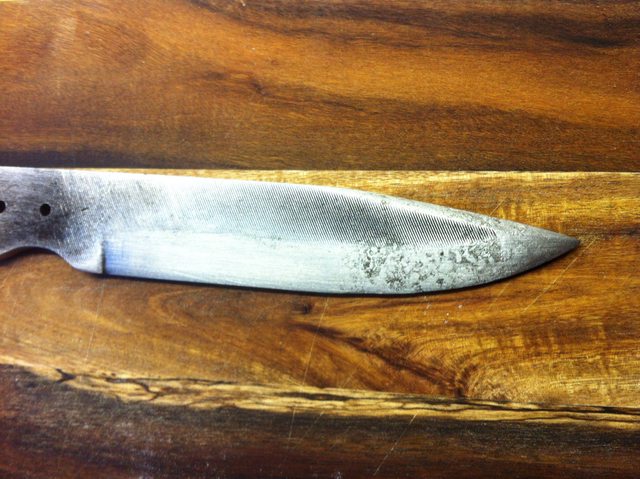
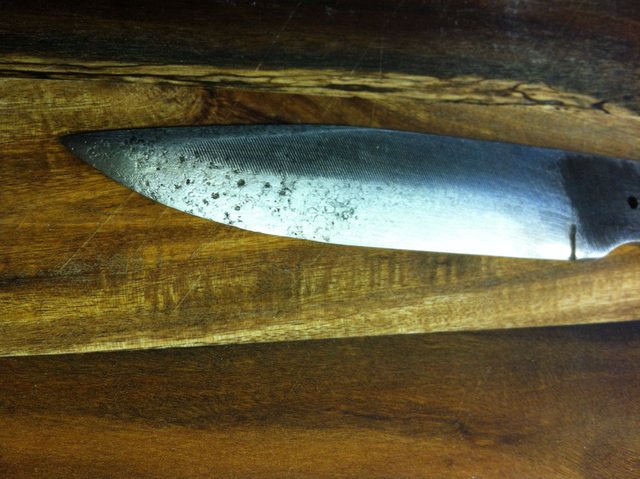
First knife - file knife, need advice!

Don't worry about hardness until you get all the decarb off of it. Soak it in a jar of white vinegar overnight, then sand it until your fingers bleed tomorrow :thumbup:. The vinegar will remove most of the decarb, reducing the sanding time. The speed of the quench is getting the steel from 1200f to 900f in less than 0.5 seconds. You austentized over 1450f probably over 1500f. To air cool to below 1200f in a few seconds is unlikely. Keep us posted!
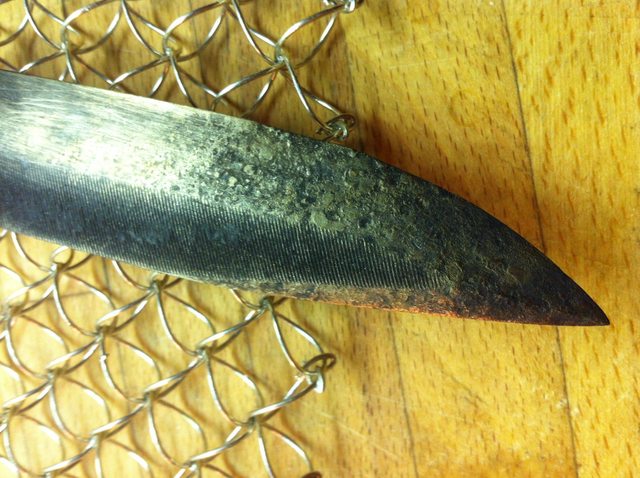
 
The HT is finished now, the good news is it didn't warp or crack. But I'm not certain if it's evenly hardened, one side seems harder than the other? And I was able to make some scratches with a file.

I got it up to critical using a magnet and then kept it there for about 6 minutes, then got it straight into the canoa oil in less than 5 seconds. Maybe I should have used salt water (brine) since if it is 1095 it needs a faster cooling medium.
Did you take it up a couple of shades brighter after holding at critical? Also 5 seconds is a long time. Your edge could certainly cool off quite a bit in that amount of time. If the blade is soft after tempering you can try again.
 
Did you take it up a couple of shades brighter after holding at critical? Also 5 seconds is a long time. Your edge could certainly cool off quite a bit in that amount of time. If the blade is soft after tempering you can try again.

Yes I did but I think I got the spear point too hot due to uneven air flow, looks like it began to melt.
Should I just file it even again and then sand paper/polish it and check the hardness? I can do the HT again if necessary, I just need to normalize it first right?
4LA6vcXl.jpg
 
Last edited:
Looks like you burnt the steel a bit, although I have done worse. Did the rest of the blade harden up? If it did, you can spend some time removing the burnt layer. The steel under the pits probably has some grain growth but may be OK otherwise. Or, you can anneal the blade and clean up the tip. In that case, you should normalize this time around before quenching.
 
Definitely overheated. Sand it down and see if there is enough "good" steel to see if its worth trying to save. There is likely heavy decarb in that area, and there is no way to get it back.
 
I have some good new and some bad news...

It does indeed look like I burnt the blade because of the increased air flow around the tip and maybe because of the tip having a tad smaller edge.

The good news is that the blade seems to have been properly hardened, after I removed the decarb surface (thanks for the advice about the vinegar Willie71) the blade was pretty damn hard. But on the other side I don't know how to remove the deformation on the spear point now, I tried filing but it's too hard. I don't really want to do the annealing and HT again since it's such a pain in the ass to HT mystery steel and I can't do it in a controlled environment with the exact same temperatures.
Should I just sand it to oblivion and try to get rid of it?

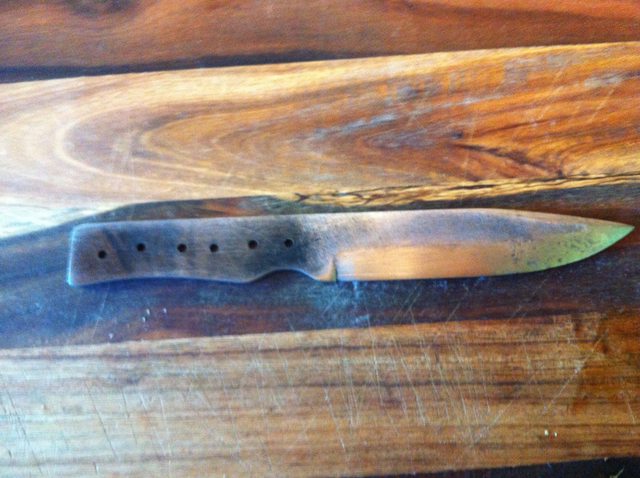
Pics after some cleanup.
4111B4yl.jpg

3kABVi8l.jpg
 
Last edited:
guHysL8l.jpg


Definitely overheated. Sand it down and see if there is enough "good" steel to see if its worth trying to save. There is likely heavy decarb in that area, and there is no way to get it back.

Seems pretty hard in that area still, can't really scratch it with a good file. Maybe the decarb from overheating isn't such a big problem since the original file may have been up to 1.2% carbon steel? (The file was a lot harder than my other files when I got it)
 
Temper it at 400f for one hour, test the edge for chipping, and increase 25f each time until you have an edge that doesn't chip. You will have to sand rather than file hardened steel. Buy name brand sandpaper.
I am assuming you won't have a good selection where you are. If you can get 3m or Norton sandpaper you will be ahead of the game. I would get some 80g, 120g, 220g, 320g, and do your best to make it look good.
 
Temper it at 400f for one hour, test the edge for chipping, and increase 25f each time until you have an edge that doesn't chip. You will have to sand rather than file hardened steel. Buy name brand sandpaper.
I am assuming you won't have a good selection where you are. If you can get 3m or Norton sandpaper you will be ahead of the game. I would get some 80g, 120g, 220g, 320g, and do your best to make it look good.

I have already tempered it, two times 1 hour each, first at 400f and the second one at 420f. The edge seems fine no chipping and really hard. Files and sandpaper is the only thing I have a lot of in my cottage^^, I have from 40g to 400g. Hopefully the sanding will be enough to get rid of the deformation.
 
Regarding hardness: a few of the things I learned this past weekend were that our tests of hardness are limited. An example was imagine the steel is plasticine with glass chips in it, the glass chips are hard and will skate a file, but an Rc tester will show it to be soft. You likely have large carbides, and a lot of microfractures in the martensite (its not ideal, but you have limited equipment, and you made a hardened knife :thumbup:. Your next one will be so much better based on what you learned here.) Temper it to a useable range, and use the heck out of it. Temper before you start sanding. You don't want to break it accidentally while it is this hard. What type of handle material are you going to use?
 
I have already tempered it, two times 1 hour each, first at 400f and the second one at 420f. The edge seems fine no chipping and really hard. Files and sandpaper is the only thing I have a lot of in my cottage^^, I have from 40g to 400g. Hopefully the sanding will be enough to get rid of the deformation.

Use windex to lubricate the sandpaper. Water with dishsoap will work too. It prevents it from loading up. Watch Nick Wheeler's sanding video. It will save you a lot of time. This has been a really fun thread. Thank you for posting this.
 
If you can't get rid of all the roughness, consider a forced patina. You could use white vinegar, lemon juice, mustard. I would try mustard though.
 
Regarding hardness: a few of the things I learned this past weekend were that our tests of hardness are limited. An example was imagine the steel is plasticine with glass chips in it, the glass chips are hard and will skate a file, but an Rc tester will show it to be soft. You likely have large carbides, and a lot of microfractures in the martensite (its not ideal, but you have limited equipment, and you made a hardened knife :thumbup:. Your next one will be so much better based on what you learned here.) Temper it to a useable range, and use the heck out of it. Temper before you start sanding. You don't want to break it accidentally while it is this hard. What type of handle material are you going to use?

So I should temper it again? Do you know any handy test for chipping? As you know I don't have a lot of resources laying around I'm not certain if my hardness test was adequate.
Also when I did the 2 temper cycles I put the knife in a package of aluminum foil, is it true that this will to some extent prevent decarb?

The only material I can get my hands on is oak, I would have prefered some masur birch but I have to work with what I've got. At least I found a rod of 1/8 inch brass for the pins.
 
Use windex to lubricate the sandpaper. Water with dishsoap will work too. It prevents it from loading up. Watch Nick Wheeler's sanding video. It will save you a lot of time. This has been a really fun thread. Thank you for posting this.

+1, And let us see the finished product.
 
Decarb isn't an issue at tempering temperatures. You will get some thin oxides, but they sand off really easily, or diappear almost instantly in white vinegar. I posted my tempering recommendations while you were posting your comments. I didn't realize you had tempered it already. I would just use it a bit, and cut a variety of materials with it. When I test for chipping, I use a really hard block of oak or maple, and chop into it hard, or chop into a piece of brass. If the edge rolls, its too soft or too thin, and if it chips its too hard. After doing a few knives, you learn the range of hardness for specific steels and geometries that work, so you don't have to reinvent the wheel with each knife.
 
Use windex to lubricate the sandpaper. Water with dishsoap will work too. It prevents it from loading up. Watch Nick Wheeler's sanding video. It will save you a lot of time. This has been a really fun thread. Thank you for posting this.

+1, And let us see the finished product.

I should be the one thanking you guys for helping me out, even if the knife is not perfect I've learned a lot from you and the experience for my upcoming projects ( hopefully it will be a bit easier with some more resources at home)
I still have to finish the knife + make a handle and I think I'm going to make a leather sheath for it as well. I will keep you guys updated until the end of the process.
 
Brokkr, fill out your profile. It'll help us help you more. What I appreciated is that you didn't argue every step of the way. Your rationale for using the materials you are using makes sense under the circumstances, and it is a great way to enjoy the cottage. I have access to several great steels, and yet I am doing a file dagger, just for fun. At the cabin, I will be forging a few railroad spike hatchets with a rudimentary coal forge.
 
Brokkr, fill out your profile. It'll help us help you more. What I appreciated is that you didn't argue every step of the way. Your rationale for using the materials you are using makes sense under the circumstances, and it is a great way to enjoy the cottage. I have access to several great steels, and yet I am doing a file dagger, just for fun. At the cabin, I will be forging a few railroad spike hatchets with a rudimentary coal forge.

Done, I live in Sweden and a few months a year in Norway. Unfortunately there isn't lot of places to buy knife material around where I live except if I order online.
Thats cool I've always wanted to make a knife from a railroad spike with a twisted handle. There is something special about working with your hands at times even if you have access to machines, especially if you're surrounded by nature.
 
Don't worry about hardness until you get all the decarb off of it. Soak it in a jar of white vinegar overnight, then sand it until your fingers bleed tomorrow :thumbup:. The vinegar will remove most of the decarb, reducing the sanding time. The speed of the quench is getting the steel from 1200f to 900f in less than 0.5 seconds. You austentized over 1450f probably over 1500f. To air cool to below 1200f in a few seconds is unlikely. Keep us posted!

Just a minor correction;
A soak in vinegar, sodium bisulfite, sparex, etc. will NOT remove any decarb. It will remove SCALE. Decarb is a thin outer coat of low carbon steel where the carbon was burned out. It will only be removed by something that will remove steel .... sanding/grinding.

For those who forge or do HT in a forge, to remove scale the best solution to use is sodium bisulfite/water mix. You buy sodium bisulfite at the pool supplies as PH-down or PH-minus. A big jug will last a year or more, and cost $10-15. Mix a cup-and-a-half to two cups in a gallon of water and let soak for 4-6 hours ( overnight if you want). That will leave bare gray steel. You can re-use it many times. Store in a plastic jug, use in a plastic pail. When done with a batch, pour it down the drain and rinse the sink...done.

For those who do a good bit of forging - I saved an empty 40# kitty litter pail and mix a big batch in that. It sits out in the forge. I snap the tight sealing flip-up top down when not in use. I make a new 4 gallon batch every six months or so with a 5# jug of SB and 4 gal water. It does a LOT of blades. When it slows down on removing the scale. I dump it in the stream behind the shop on a rainy day and mix a new batch.
 
Thanks for posting that Stacy. I was going to say something, but you covered it. Decarb and scale are often confused as being the same thing.
 
Back
Top