
-
The BladeForums.com 2024 Traditional Knife is available! Price is $250 ea (shipped within CONUS).
Order here: https://www.bladeforums.com/help/2024-traditional/
You are using an out of date browser. It may not display this or other websites correctly.
You should upgrade or use an alternative browser.
You should upgrade or use an alternative browser.
First Knife WIP--need some help
- Thread starter Mr. Bad Example
- Start date


- Joined
- Dec 4, 2009
- Messages
- 475
If you feel like a trip to Bangor, we can put it in my gas forge for heat treat. Not terribly precise - I go a little beyond non-magnetic and quench in peanut oil, temper in the oven - but it has worked pretty well for my first 20 knives.
Dick
Dick, thank you! I will gladly take you up on your very generous offer--I like the idea of having done all the aspects of my first project "personally".
I hope to have a propane forge set up this summer and I'd really like to see one in action.
What's the best way to contact you? I'm only an hour down the pike from you

Michael
- Joined
- Dec 4, 2009
- Messages
- 475
While I can't speak for them, I would guess that just about any maker in the New England area will do it for you. If you don't have any offers, I will be glad to do it for free. BTW, the knife looks good.
Thank you for the compliment and the kind offer!
- Joined
- Mar 14, 2009
- Messages
- 75
I haven't used 1084, but if it HT's like 01 then a torch will work.
I just got some firebrick from the local masonry supply and stacked them to make a small "forge".
Heated the blade until it was a dull red and non magnetic then quenched it in a soup can with preheated Canola oil.
A few pics of the process.
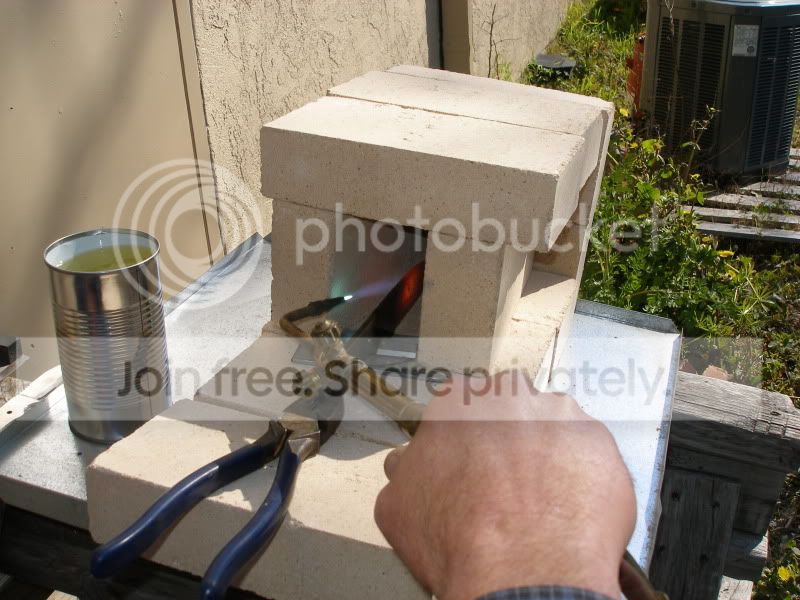
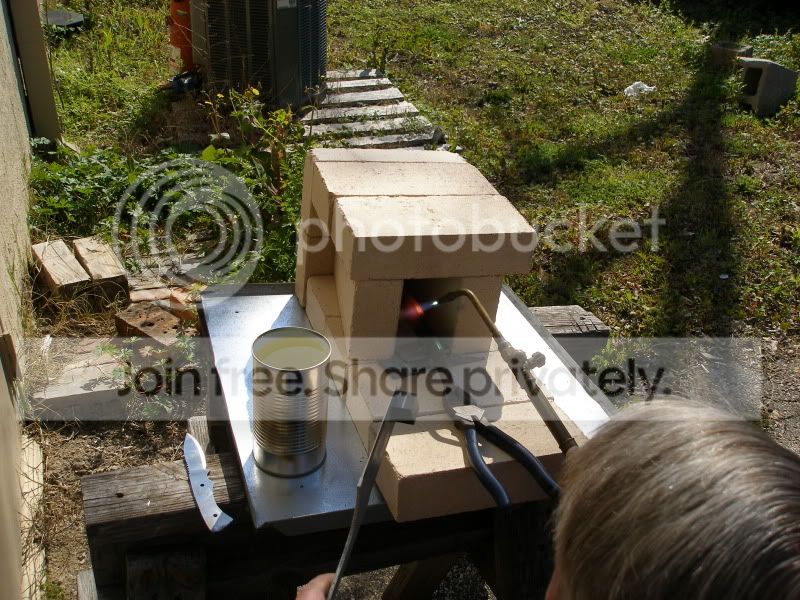
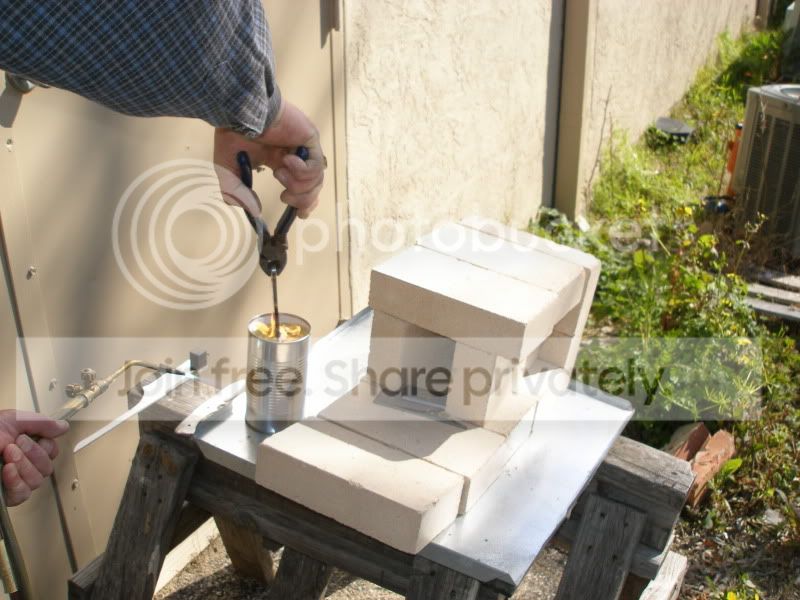
I just got some firebrick from the local masonry supply and stacked them to make a small "forge".
Heated the blade until it was a dull red and non magnetic then quenched it in a soup can with preheated Canola oil.
A few pics of the process.
- Joined
- Dec 4, 2009
- Messages
- 475
Diver Texas, do you have to temper it after the quench?
From the reading I've done, 1084 requires:
5 to 20 minute soak @ ~1450 F
Quench in oil preheated to ~150 F
Temper one to three times for 2 hours @ 375 F
From the reading I've done, 1084 requires:
5 to 20 minute soak @ ~1450 F
Quench in oil preheated to ~150 F
Temper one to three times for 2 hours @ 375 F

- Joined
- Feb 15, 1999
- Messages
- 11,566
I can Ht it too.:thumbup:

- Joined
- Sep 29, 2009
- Messages
- 1,614
Knife looks good. You definitely learn a lot making one. And that seems to be just the tip of the iceberg. 
- Joined
- Feb 15, 1999
- Messages
- 11,566
I hope to have a propane forge set up this summer and I'd really like to see one in action.
Michael
Have you seen my tutorial on build'g a gas forge????
http://www.indiangeorgesknives.com/building_a_forge.html
Last edited:
- Joined
- Dec 4, 2009
- Messages
- 475
Due to the generosity of a fellow member and his Indian George forge (thanks, Dick!), my blade is heat treated. It didn't even scale up too badly:

Time to hit the sand paper again!
Time to hit the sand paper again!
- Joined
- Feb 15, 1999
- Messages
- 11,566
Coooool!!!!!:thumbup:
- Joined
- Sep 29, 2009
- Messages
- 1,614
Cant wait to see it come along. Get to working 

- Joined
- Dec 4, 2009
- Messages
- 475
That really turned out pretty nice. I was really worried for you in the middle of the thread, but you pulled it out for the win!:thumbup::thumbup::thumbup:
Thanks (I guess ;-)
N1UTZ, BTW
- Joined
- Dec 4, 2009
- Messages
- 475
OK, back up to 400:

Just for the heck of it, went ahead and put a bit of an edge on it--it was taking hair off my arm and cutting paper OK. The edge was pretty thick, so I took it down some more with a slack fine belt (dipping often to keep her cool), then sanded it smooth. It's pretty much what I guess you would call a convex edge. It's still thick for cutting paper, wood, etc., but I bet it will cut soft stuff pretty easily.
Here's a crappy picture of the edge:

I may thin it out some more.
Now, on to more sanding!

Just for the heck of it, went ahead and put a bit of an edge on it--it was taking hair off my arm and cutting paper OK. The edge was pretty thick, so I took it down some more with a slack fine belt (dipping often to keep her cool), then sanded it smooth. It's pretty much what I guess you would call a convex edge. It's still thick for cutting paper, wood, etc., but I bet it will cut soft stuff pretty easily.
Here's a crappy picture of the edge:

I may thin it out some more.
Now, on to more sanding!
Last edited:
- Joined
- Aug 28, 2009
- Messages
- 7,951
Ok now that you have played with it, dull it up or tape the crap out of it. I did the same thing with my first one, put an edge on it before its time and managed to chew the crap out of my fingers trying to get the finish I wanted. I thought I had dulled it well enough to be safe, and even though I never drew blood, the edges of my fingers took a beating
I have learned my lesson and wont sharpen a knife till its finished now.
I have learned my lesson and wont sharpen a knife till its finished now.
- Joined
- Dec 4, 2009
- Messages
- 475
Spent some time in the shop today. After attempting to cut my black paper micarta (unsuccessfully--damn! that stuff is hard) I decided to use one of my free $5.00 slabs of Walnut from BurlSource. I epoxied black spacers to the slabs last night. The blade is sanded up to 800.
I think I might have put too much epoxy on--you can sort of see an extra layer and some oozed out on the ricasso (any tips on removing it?). Anyway, here are some pics:


Still lots of handle shaping to do, and I think I'm going to go ahead and thin down the blade some more.
Thoughts, suggestions and criticisms welcome!
I think I might have put too much epoxy on--you can sort of see an extra layer and some oozed out on the ricasso (any tips on removing it?). Anyway, here are some pics:
Still lots of handle shaping to do, and I think I'm going to go ahead and thin down the blade some more.
Thoughts, suggestions and criticisms welcome!

- Joined
- Nov 1, 2009
- Messages
- 183
I had almost the exact thing happen on my knife I'm finishing up. Except I'm using sycamore scales with black liners.
I just carefully sanded the black epoxy down where it squished out the front with some 220, 320 then some 400 grit paper. I taped off right up the the epoxy line on my blade so I wouldn't mark it up.
Another thing I found out, unstabilized sycamore will suck up some of the black epoxy and give it a dirty look along the tang, and the pin holes if they are too big. Not sure if that walnut will be the same way or not, but something to think about.
If I use black epoxy with a light colored wood again, I'll be sure and stabilize it first.
Anyways, knife is looking real good my friend!
I just carefully sanded the black epoxy down where it squished out the front with some 220, 320 then some 400 grit paper. I taped off right up the the epoxy line on my blade so I wouldn't mark it up.
Another thing I found out, unstabilized sycamore will suck up some of the black epoxy and give it a dirty look along the tang, and the pin holes if they are too big.
Not sure if that walnut will be the same way or not, but something to think about.If I use black epoxy with a light colored wood again, I'll be sure and stabilize it first.
Anyways, knife is looking real good my friend!
Last edited:

Looks very good, keep at it. You can make a scraper out of a brass pin or round to scrape the dried epoxy off. Just grind a flat point on the brass, it won't scratch your heat treated steel. It also helps to put something like a scrap of wood under your scales when drilling, they won't chip out so bad, brad point drill bits help too.