For freehanders, what stones do you use on your TRADITIONALS?

Like this?


Ie, Norton Combination India Stone?

~ P.

Sarah, the ones I have are separate Fine India and Medium Crystolon stones in 8"x2" size. At the time, I had a hard time finding the full size Fine India but was eventually successful.
The combination stone should serve just as well and is more readily found in my experience.

Fine India is aluminum oxide...Crystolon is Norton's name for silicon carbide. These stones are manufactured rather than "natural" but they are of very high quality.
 
im really liking these pocket translucent stones.is there any advantage over the dmt pocket diamond hone i currently have?
 
im really liking these pocket translucent stones.is there any advantage over the dmt pocket diamond hone i currently have?

The translucent stone will provide a fine finish on an already sharp edge. It won't be your go-to for a blade that needs sharpening, however.
 
Yes.

For the steels I mentioned (carbon steel, A2, O1, 52100 etc) a translucent arkansas stone has a lot of advantage. A diamond stone will simply cut scratch patterns quickly into the steel. A translucent will cut and polish due to the nature of the stone. It will give you much much less burr and a much more refined yet toothy edge. Think of microserations that are already polished in all the grooves and down to the apex. Making for a very very sharp edge. It leaves so little clean up with the strop. The other huge advantage is what we call feedback. On a translucent if you hone the edge leading into the stone and you are honing all but the apex it will be very very smooth. Just as you angle it enough for the apex to lightly touch you get feedback in the form of a sound and feel. Its more for fine sharpening to pick this up but it can make a world of difference. Once you get used to this they are natural to do this without thought.

Hope this helps.

Kevin

im really liking these pocket translucent stones.is there any advantage over the dmt pocket diamond hone i currently have?
 
The translucent stone will provide a fine finish on an already sharp edge. It won't be your go-to for a blade that needs sharpening, however.

Yes.

For the steels I mentioned (carbon steel, A2, O1, 52100 etc) a translucent arkansas stone has a lot of advantage. A diamond stone will simply cut scratch patterns quickly into the steel. A translucent will cut and polish due to the nature of the stone. It will give you much much less burr and a much more refined yet toothy edge. Think of microserations that are already polished in all the grooves and down to the apex. Making for a very very sharp edge. It leaves so little clean up with the strop. The other huge advantage is what we call feedback. On a translucent if you hone the edge leading into the stone and you are honing all but the apex it will be very very smooth. Just as you angle it enough for the apex to lightly touch you get feedback in the form of a sound and feel. Its more for fine sharpening to pick this up but it can make a world of difference. Once you get used to this they are natural to do this without thought.

Hope this helps.

Kevin

thanks alot...looks like i gonna have to get one now
 
Ie, Norton Combination India Stone?
One and the same.

- Christian

Sarah, the ones I have are separate Fine India and Medium Crystolon stones in 8"x2" size. At the time, I had a hard time finding the full size Fine India but was eventually successful.
The combination stone should serve just as well and is more readily found in my experience....

Thanks, guys!

Last question for now*: with this stone/material, do you use oil, water, detergent-water (dish detergent, watered-down Simple Green, etc.), or go dry?

~ P.


* Though of course now I'm wondering about dem Arkansas stones.

I'm beginning to understand sitflyer's array. ;)
 
I use the Norton honing oil on mine, Arkansas stones, same thing...of course the natural waterstones I use a spray bottle and water. Diamond stones I use a tiny drop of dish detergent in the water so it wets the plate better.the sandpaper and dowel is for Hawkbill blades;) which I finish on the little hard Arkansas slip stone...different blades, different approaches...
* the piece of white pine is for a stubborn burr, a few cross cuts will usually break the burr free, then a very light pressure final hone and strop and good to go ;)
Thanks, guys!

Last question for now*: with this stone/material, do you use oil, water, detergent-water (dish detergent, watered-down Simple Green, etc.), or go dry?

~ P.


* Though of course now I'm wondering about dem Arkansas stones.

I'm beginning to understand sitflyer's array. ;)
 
My pocket translucent leaves an awesome edge on my slipjoints.

0ndw.jpg


The leather sleeve also makes a handy strop.

- Christian

I got a few of these (real ones) as well as a few washitas from my local Surplus store. They were dust covered at the bottom of an old wooden display cabinet. They charged $4 a piece. :) I wish I knew about this sub forum then. I gave most of them away to whoever asked. I'd have rather they had gone to you guys, but that's how it goes. Maybe one day I'll come across another cache. Or probably not. :o

For sharpening I typically use an Edge Pro (clone) with EP stones. I also have an array of SiC and AlumOx stones, as well as a Lansky.
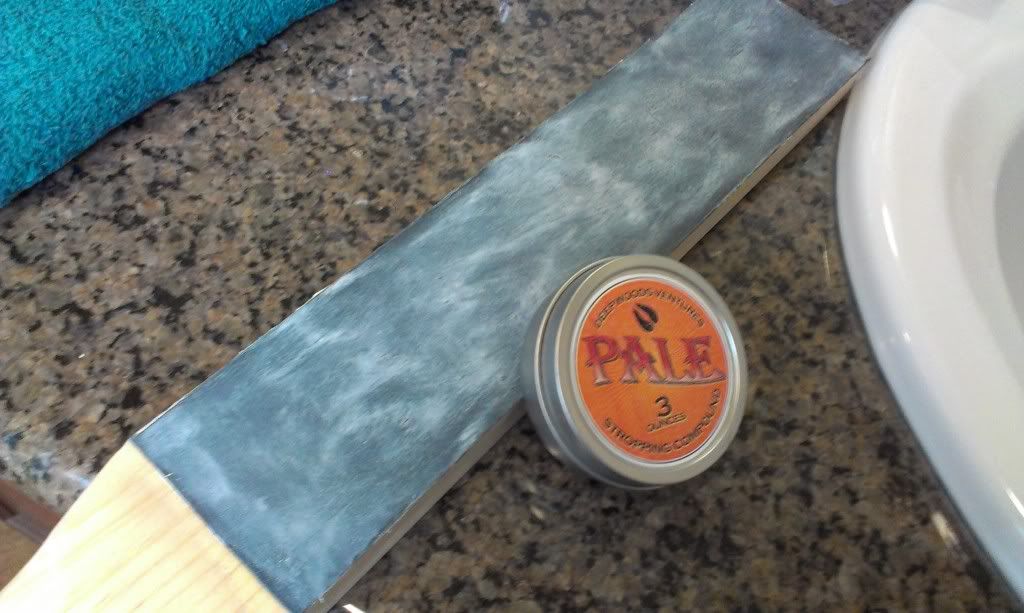
Most of my sharpening amounts to maintenance using any of several strops. I make them all myself using some excellent leather that is very thin and has an extremely short nap, which is just enough to take and hold compound. I use several compounds, but my favorites are green (ChromOx) and Deepwoods Ventures "Pale" stropping compound, which is an aluminum oxide based carving knife compound.

IMAG1178_zpsa310c12d.jpg


I also usually make a shallow cut across the top of my strops so I can slide a piece of 400 grit wet/dry sandpaper that I fold around the back and use in case an edge needs a little more attention than the strop alone can provide. Works great on simple carbon steels and regular alloy stainless like 440C, not high abrasion resistant "super" steels. :)
 
Last edited:
this thread has really made me want to buy a translucent pocket stone. ive got a bad hankering now
 
Thanks, guys!

Last question for now*: with this stone/material, do you use oil, water, detergent-water (dish detergent, watered-down Simple Green, etc.), or go dry?

~ P.

The Norton stones are "intended" to be used with honing oil (light mineral oil) but they can be used with water (with or without Dawn or other soap).

However, try it with water (with or without soap) FIRST. If you go to oil, you may not be stuck with oil for life, but it's a chore getting it removed. (I've used a biodegradable carburetor cleaner in the past.)
 
The Norton stones are "intended" to be used with honing oil (light mineral oil) but they can be used with water (with or without Dawn or other soap).

However, try it with water (with or without soap) FIRST. If you go to oil, you may not be stuck with oil for life, but it's a chore getting it removed. (I've used a biodegradable carburetor cleaner in the past.)

If you do use oil and you want to go back, another option is to boil your stone. I've done it and it worked very well.

As for lube, I like to use USP mineral oil. That's the laxative that you'll find in the medicine section. It's very inexpensive and a bit thicker than regular mineral oil.

One other thing. I got this tip from a member here that I consider to be extremely knowledgeable on stones and sharpening. If you have trouble with your stone soaking oil, you can apply a light layer of petroleum jelly on the surface of the stone. I did exactly this, working it in with my fingertips and applying a tiny bit of heat with a hair dryer. The petro and oil mingle well together and the jelly will (mostly) keep the oil near the surface. I haven't seen any downside to doing this, and I'll keep doing it with each new stone is get. ;)
 
If you do use oil and you want to go back, another option is to boil your stone. I've done it and it worked very well.

As for lube, I like to use USP mineral oil. That's the laxative that you'll find in the medicine section. It's very inexpensive and a bit thicker than regular mineral oil.

One other thing. I got this tip from a member here that I consider to be extremely knowledgeable on stones and sharpening. If you have trouble with your stone soaking oil, you can apply a light layer of petroleum jelly on the surface of the stone. I did exactly this, working it in with my fingertips and applying a tiny bit of heat with a hair dryer. The petro and oil mingle well together and the jelly will (mostly) keep the oil near the surface. I haven't seen any downside to doing this, and I'll keep doing it with each new stone is get. ;)

FWIW, ABS master smith Wayne Goddard recommended using odorless kerosene in place of mineral oil (or even WD-40 in a pinch) because the thicker oil is "slow cutting".
The kerosene also helped keep his stones clean. (He recommended the fine india and medium crystolon stones as his go-to stones.)

You just want enough oil on your stone (if you use it) to keep the stone cutting well without clogging often. (I also mostly use pharmaceutical grade mineral oil though I have a pint of Norton's oil in the shop. There is no end of (knife related) uses for mineral oil.)

I'd have recommended the boiling method but if I ever used one of my wife's pots for doing so, it'd be me that was boiled right afterward and probably in small pieces. :eek:


:p
 
Last edited:
Thanks, guys!

Last question for now*: with this stone/material, do you use oil, water, detergent-water (dish detergent, watered-down Simple Green, etc.), or go dry?

~ P.


* Though of course now I'm wondering about dem Arkansas stones.

I'm beginning to understand sitflyer's array. ;)

I use unscented lamp oil/deodorized kerosene. It works great and is super inexpensive.
 
FWIW, ABS master smith Wayne Goddard recommended using odorless kerosene in place of mineral oil (or even WD-40 in a pinch) because the thicker oil is "slow cutting".
The kerosene also helped keep his stones clean. (He recommended the fine india and medium crystolon stones as his go-to stones.)

You just want enough oil on your stone (if you use it) to keep the stone cutting well without clogging often. (I also mostly use pharmaceutical grade mineral oil though I have a pint of Norton's oil in the shop. There is no end of (knife related) uses for mineral oil.)

I'd have recommended the boiling method but if I ever used one of my wife's pots for doing so, it'd be me that was boiled right afterward and probably in small pieces. :eek:


:p

Ah yeah, I would definitely defer to his expertise over mine! :)

I use lamp oil on my motorcycles chain to clean it. Maybe I'll give it a shot on the ol' Norton. I've also seen some pretty knowledgeable sharpeners use wd40 on their stones, so I wouldn't disregard that idea either. One very respected sharpening guru here even uses his Crystolon dry, but I can't wrap my head around that personally.

I guess it's just like everything else sharpening related. Everyone seems to have a preferred method, and none are wrong so long as it works for you. That's one of the things that I love about sharpening, there is no end to the discovery and experimentation. :thumbup:
 
I guess it's just like everything else sharpening related. Everyone seems to have a preferred method, and none are wrong so long as it works for you. That's one of the things that I love about sharpening, there is no end to the discovery and experimentation. :thumbup:

You said it right. :thumbup:

(My motorcycle has shaft drive, so I don't bother cleaning it. Though I would grudgingly adjust the chain on the previous one I owned. :p)
 
I have very much to learn about sharpening, I have advanced from the old Carborundem stone to Arkansas stone to a Diamond Fine/extra fine.
I have only been sharpening by freehand ( or anything really ) for inside two years, I am lightyears frim when I first started, but I find myself inconsistent, some times I get an edge fairly fast and Strop-yet the other night had quite a bit of difficulty, and if I must be completely honest I have to be very careful or I take a bit off the belly of the blade-I have done this to two knives now - I have u-tubed-everything, just want to get it better.
I now use my Diamond stone, and from what I can figure @20 degrees, even strokes-tidy so theres no scratching on the blade, I get the edge so its starts to get "sticky" then turn over to the extra fine-repeat so I feel an improvement, then strop - I have a feeling my strop isn't that good, and I don't have any paste, I do find my edges - although ripping through paper like a scapel, and hair shaving sharp - the edge just doesn't last that long, so I am not getting the angle right -or something,
Sorry to sound like an absolute beginner - but that's what I am in the sharpening world, I am happy that I am progressing, but not happy about being too harsh on a blade when it doesn't go right ( sorry - when I don't get it right ), so I persevere - hence the blade loss.
But at most I put an edge on, and its darned sharp, but it just doesn't seem to last all that long.
 
Duncan, I'm far from the last word on sharpening (and I do occasionally still use the several strops I have on hand) but I have found over the years that it's fairly easy to ruin an otherwise good edge with stropping if one isn't particularly careful of their technique.

While I'm sure my edges don't compare to many, (and I no longer obsess over trying to get the perfect edge), I generally leave off the stropping unless I feel an edge needs it. Otherwise, a few swipes on my jeans or a piece of impregnated cardboard will do the trick. (In other words, I generally like to finish on the finest stone I feel a need to use for that particular blade.)

I've gotten to the point with sharpening that I did with washing cars and trucks. On the whole I'd rather be using 'em than trying to make 'em so perfect I won't want to. YMMV. ;)
 
so, I got my smith stones in, and a new opinel #8 to try them out on. I can say with 90% certainty that I have never been this frustrated in my entire life. For whatever reason, I just cannot do it right. Ugh
 
Duncan,

If you get an edge finished correctly the edge will last. The biggest reason I have found for premature loss of sharpness is a burr that you did not realize you raised. The trick is to master honing no matter what grit. Like I said earlier, and Elliot mentioned, the strop should be a tool for cleaning up the small stuff and NOT relyied upon to fix problems.

I say this in a helpful tone having been there and done that. I used to be very frustrated too, my friend. It gets better, much better. I would say it took me the better part of 15 years to get this good on stones. It was quite a journey, lots of frustrating failures. Keep trying my friend.

If I can give the best piece of advice, stop trying to get the edge a little better. I don't feel my edges to see if they are better. I do it by sight. If you have to get a 10x loupe to see well enough please invest you will be happy to see what is actually happening. So, if I can give a tip, sharpen until both sides hone down to the apex and STOP. This is the important part. Focus a lot hear. There is no burr and you don't wan't to form any more than you need.

Its so simple when you get it but I remember thinking it was impossible sincerely impossible.

Stropping can mess up an edge. It can also make you think your done when your not. Say you have an awful burr but you strop and think its good. Its not, its just aligned well and polished. Cut something it folds over and its dull.

I hope this stuff is helpful.

Kevin
 
Also, the reason you hear guys like me and Duane in this thread say get rid of that burr and LIGHT hone is because of the problem with burrs. Even Chris Reeves recommends going back to lightly hone after stropping.

When I maintain on a strop until the edge loses the teeth the apex is still very thin and refined razor sharp. I hone it only takes a very few light passes. The trick I have found to happiness is keeping them sharp.

I will stop blabbing now :)

Kevin
 
Back
Top