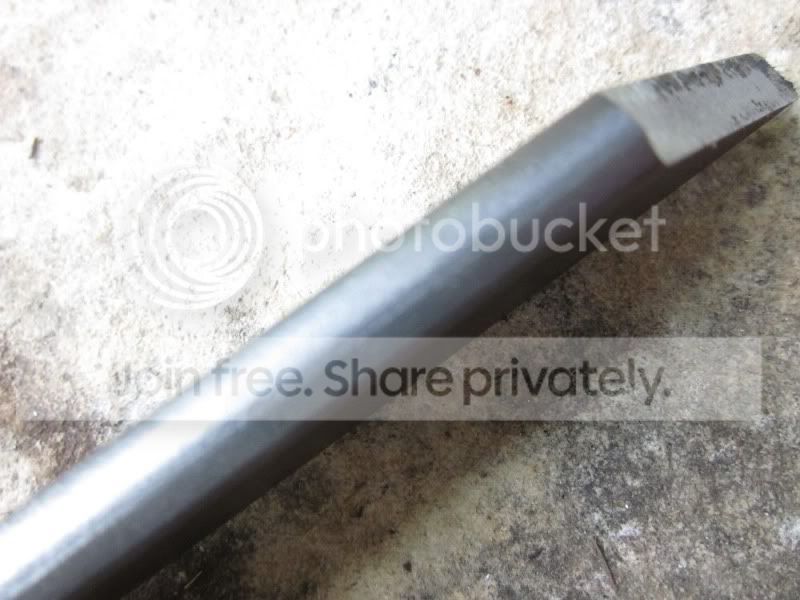
Thanks to all those who replied concerning posting photos. It seems "img" files are the way to go. I will try, but remain challenged.
And thanks to Nick for the push.
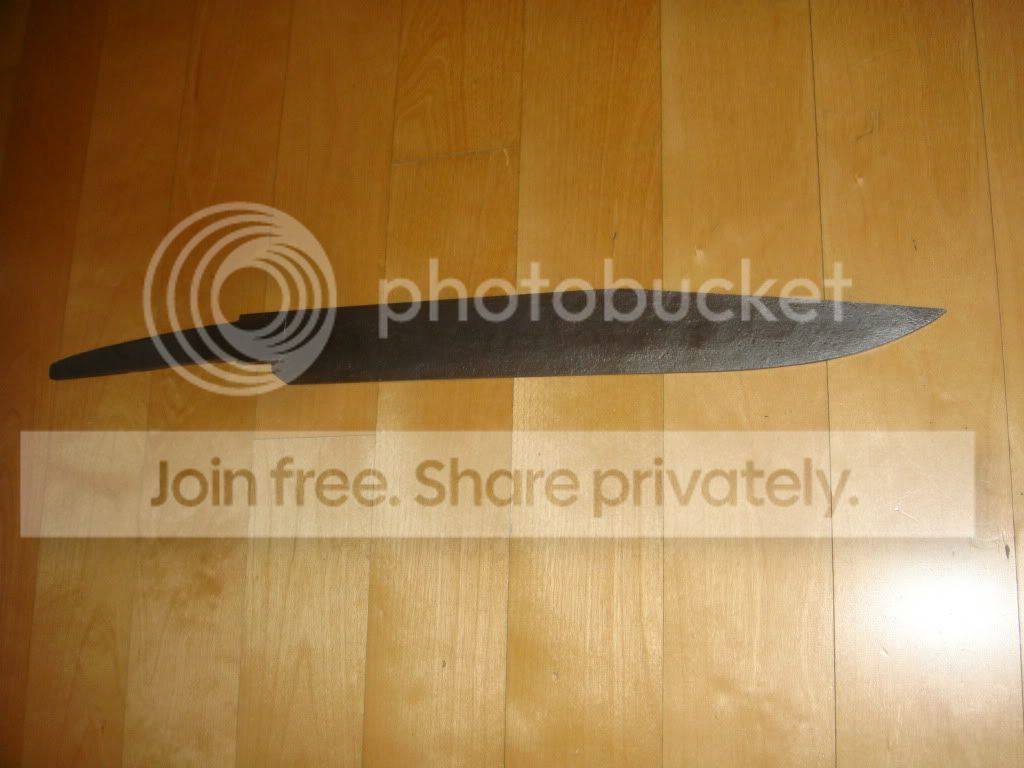
Here's the blade after 24 hours in vinegar. 99% of the scale came right off. The dark grey is not scale, but the dark and even patina laid down by the brown rice vinegar. I may try it as an etch on some finished knives in the future.
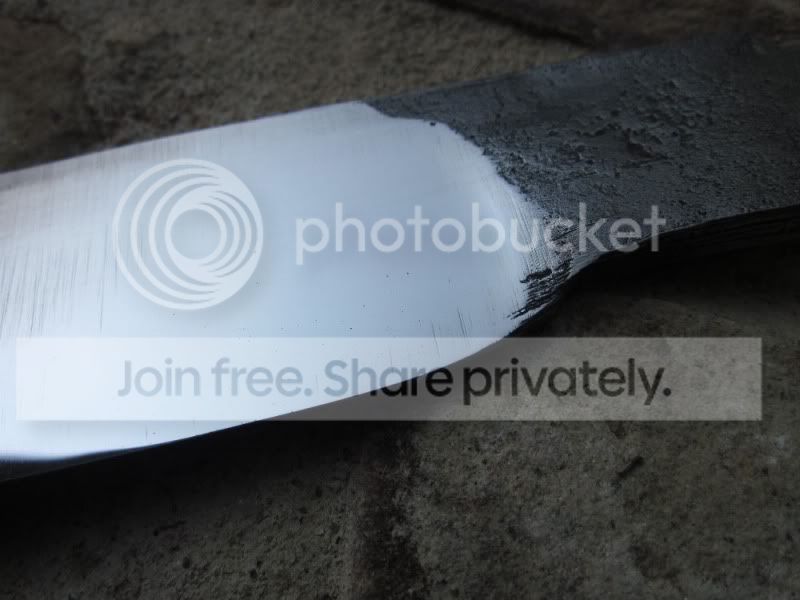
And, if you couldn't tell from the photo above, I suck at photography. But, anyway, here is a rough shot showing the blade after a bit of filing.
Some random thoughts are as follows:
1. This looked really good coming off the anvil and out of the vinegar. But man when you are using a file instead of a variable speed, 2 horse, 2x72 grinder do you notice every little uneven spot! So this winds up not only being a lesson in filing, stoning, and papering, but also a lesson in really tight forging in the future. Not only are divots a real bear to get out, but I also only forged my bevels in over about 50% of the width of the blade, which also means a lot of filing to get the edge geometry I want.
2. Despite what I just said above, a really good double cut mill bastard file hogs off a lot of metal! My floor looks like I do have a grinder. The blade gets hot to the touch, and my wife asked if something was burning

3. I'm really having to play around with a lot of different clamping setups, filing angles, filing directions, etc. I tried draw filing a bit too early. I need to hog at this point, and draw file later. Although it is tempting to run to a grinder, even a little 4" angle grinder, I am learning a lot.
That said, my problems are just like when using a grinder: Keeping the edge centered, keeping it an even thickness, and keeping the height of my bevel relatively even as well.
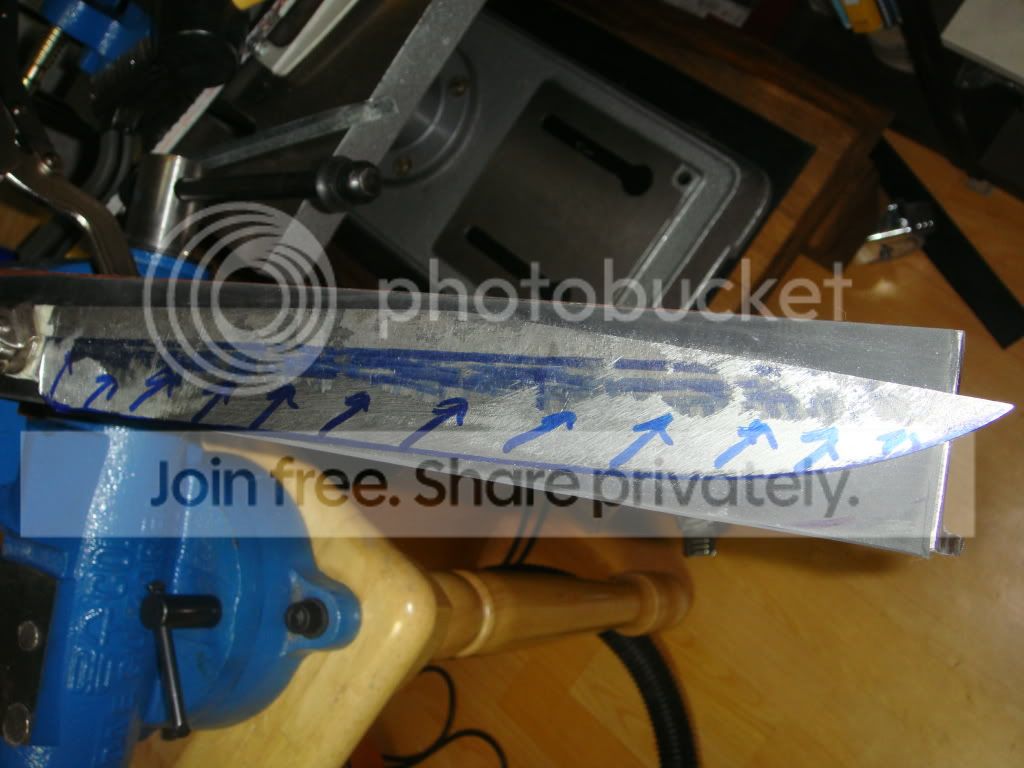
Perhaps for this reason, I have settled on an approach, for now, that is somewhat like using a belt grinder. I have established a decent centerline and relatively uniform edge thickness. Now I am filing from the edge toward the spine. Although this is the opposite of some recommendations (the Loveless and Barney book comes to mind), it allows me not to run into my edge making it too thin in places, and also to use the existing bevel as guide to raise the bevel slowly up toward the spine without grinding into the spine (in theory

).
Finally, about all that blue ink. The line along the edge is just a visual check to make sure I am not filing my edge thinner while trying only to raise the bevel. The arrows were put in hastily when I finished today's work. After many tries at different directions, etc., the one denoted by the arrows worked the best, and I wanted to remember and resume my work tomorrow without any hiccups.
The photos above are sort of a test to see if they post right. If they do, I will try to take better ones in the future, and maybe even start a separate WIP thread.
Thanks again.