Full flat ground chef

Joined
Dec 27, 2013
Messages
2,689
Hey guys, so i have made a few chef knives before by hand, but now that i have my grinder i am looking to make a few more. Most of my chef knives i have made have been out of 3/32 inch steel, and i was wondering if it was possible to do a full flat grind on that. Now it seems it must be, but the math works out that a 2 inch tall 3/32 inch blade would have to be ground at .97 degrees, which seems insanely shallow. Any advice you guys can give me? Thanks a lot
 
From my chart I'm showing 1.3 degrees for 3/32 with a 2in bevel. I go a little higher than the prescribed angles on that chart and walk it in so my plunge line doesn't hit the spine.

I'm attaching the chart I use(which I got here). It's been pretty close to being right for me so far.
 

Attachments

This is the classic error in understanding blade angles. It has been made worse by the many different descriptions of "Primary" and "Secondary" blade angles.

The main bevel angle is almost always a very low angle ( scandi grinds excepted). On a wide blade knife it can be very low indeed. My math says a FFG on a .093" (3/32)thick by 2" wide blade is 2.66°( isosceles triangle a=2.0,b=.093). This is not a "per side" thing. It is simply the apex angle formed by length and width. Almost all knife blades have main bevel angles between 3° and 10°

The edge angle is sharpened on the main bevel angle. The edge angle will be based on the intended use to provide edge durability. For a chef blade, about 10° per side, or 20° inclusive.

The lower the main bevel angle, the better the blade cuts. The higher the main bevel angle, the stronger the blade. The intended purpose will determine how thick the blade steel needs to be for a specific blade height to give the needed strength. On a kitchen blade, strength isn't as important as smooth cutting. On a camp knife it is the opposite.

The thickness left at the edge after the FFG will also determine the edge strength and cutting efficiency. Most FFG slicing blades are taken to a "near zero" edge thickness in grinding/sanding and the final edge angle is done on a very thin edge. Near Zero is usually around .005". Camp knives are often left at .010-.020"thick.
 
What kind of chef's knife are you going to do? I'm not the most experienced but I've done a few chef's knives and they aren't too bad. Just go slow. I have done some with tapered plunge lines and they have turned out well. Butcherblock had a video showing how he does it. Just take it slow. You can't put it back! Just remember that even if you take the edge all the way to zero, you can always knock it back. The first couple I did we're too thick. .010" will get very sharp and slice like nobody's business. I profile mine and then HT. I do all my bevel grinding post HT. It makes me go slower just uses belts a little faster. Post some pics as you go and good luck.
 
Almost all knife blades have main bevel angles between 3° and 10°

MY nest question "again this musts sound very new" is how can I hold that angle? When im grinding and get that shallow, i just get light grind lines going down the whole blade rather than a clean crisp line. Is it just practice and feel? I guess I could find the math of how far the spine would be from the platen, calculate that out and then draw a line on my table as a reference guide.
 
You don't grind by any angle.

You mark the centerline on the edge and grind the bevel until the spine is at one end and the centerline of the edge is at the other end. Do both sides that way.....done.
 
Unfortunately , the quick answer is "make a bunch of bad ones until they start to look right". Short of building a magnetic base that could be shimmed up so the "grinding" could be done on a milling machine, the angles, combined with thin stock make jigs to control the grind nearly impossible.

I do all of my grinding post heat-treat, so I'm not hogging material away quickly. One trick I've learned is that material gets ground away "where you're pressing" on the blade. I use this to control how the grind progresses across the width of the blade as the grind lines are forming.

Hope this helps, hang in there.
 
Like Stacy said, mark the center line and grind both edges close to it. Then, walk the grind line up to the spine. Figuring angles never work for me and neither did the jigs.
 
mark the center line and grind both edges close to it. Then, walk the grind line up to the spine.

I have watched several videos on grinding bevels and that is a pretty common description, grinding the bevel to the center line then using pressure near the spine bring it back. Is there any advice you would give on how far the bevel to the center line should be? Given that its a two inch wide knife, would i be grinding around an inch down from the edge and once they meet at the center bring it back? or would this be a more shallow bevel in the .75/.5 of an inch range?
 
Second on Rookie25's advice. It is a shallow angle indeed, it's really just a variation in pressure to get the angle dialed in. It would have to be a very precise and solid jig to nail the angle correctly.
 
I grind about a 45 degree angle toward the centerline on both sides and leave around .015" or .020" and then walk the bevel up to the spine until you have one continuous bevel from spine to edge. Once you get close to the spine I start working to get the edge thickness I want. Its hard to explain and I'm sure others do it different but once you start grinding you should understand.
I have watched several videos on grinding bevels and that is a pretty common description, grinding the bevel to the center line then using pressure near the spine bring it back. Is there any advice you would give on how far the bevel to the center line should be? Given that its a two inch wide knife, would i be grinding around an inch down from the edge and once they meet at the center bring it back? or would this be a more shallow bevel in the .75/.5 of an inch range?
 
Now is that continuing off from the 45 degree? put the 45 degree part on the platten and use pressure near the spine to bring it back? Or would I put where that 45 degree meets the flat on the platten and grind from there?

Looks like a cant quote things...
 
Last edited:
The part where the 45 meets the flat. You are essentially going to grind a 2 or 3 degree bevel until the 45 is gone. It may help to draw your bevel on paper so you can visualize. Maybe someone else can explain it better. The 45 is just to establish the center so you can grind to it and keep both sides even.
 
The part where the 45 meets the flat. You are essentially going to grind a 2 or 3 degree bevel until the 45 is gone. It may help to draw your bevel on paper so you can visualize. Maybe someone else can explain it better. The 45 is just to establish the center so you can grind to it and keep both sides even.

So the transition would be at about a 135 degree point between the flat 45 degree edge, and would I press that directly to the platten?
 
Second on Rookie25's advice. It is a shallow angle indeed, it's really just a variation in pressure to get the angle dialed in. It would have to be a very precise and solid jig to nail the angle correctly.

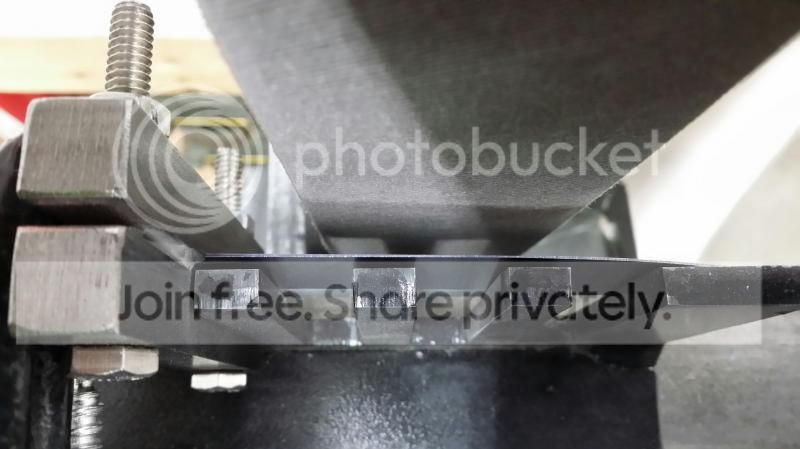
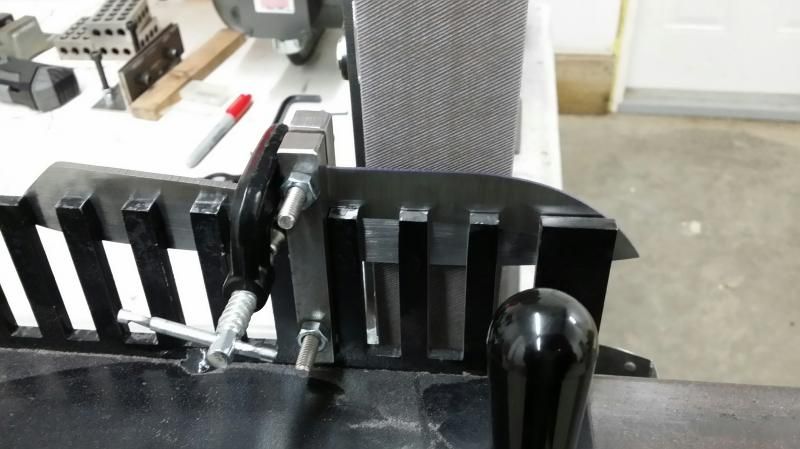
This is what I use. Set the angle on the tool rest and grind. I'm new to this and will learn free hand grinding some day, but right now there are a lot of things for me to learn first.

Thinedge_zpsb9e5fd91.jpg


Grindingjig3_zps0b0978fa.jpg
 
This is what I use. Set the angle on the tool rest and grind. I'm new to this and will learn free hand grinding some day, but right now there are a lot of things for me to learn first.

Thinedge_zpsb9e5fd91.jpg


Grindingjig3_zps0b0978fa.jpg

That looks like a good robust jig.
 
Personally, with 3/32, I would HT it unground, then take the edge down to say 1/32 or less flat ground. I would then do a convex edge grind up say at least 3/8 to darn near shape and then thin it behind the edge.
 
I'll offer my two cents as a fellow new guy. I tried to get scientific and thought about using jigs and what not when I started and it wasn't doing it for me. I took a step back and gave some thought to what I'm trying to accomplish, i.e. what have I done I can compare this to.

I concluded that I had the issue of knowledge getting ahead of my physical abilities. I know what needs to be done, I've seen it done many times, read about it, etc. But in the end no matter how many books I read or videos I watch or instruction I get I'm not going to hit a bullseye or sink a hole in one without my experience in actually swinging a golf club or knocking many arrows catching up with what's in my head. After a few decades I can hit the bullseye pretty regularly and I never think through the steps that years of practice has allowed to come naturally.

The same seems to be true of knife making in my case. I'm no expert or close to it but now like Stacy and others have said, I mark a center line and just grind away. I don't think about positioning the steel in the right place, I don't look at the bar from the side to see if my angle looks right or use an angle meter or jig. I just grind. And I've found that now I can put a pretty good bevel on a blade using dykem and a center line. Just my experience but for me practice is making perfect. I'm pretty happy with my progress at this point.

I hope this helps and whatever your method, keep at it and you will see improvement, that I can promise :)
 
It's difficult flat grinding tall thin chef blades, but not terribly so. The best advice I can give you is to just go out there and get your hands dirty trying it, with some tall thin stock, and develop a feel for it. That's what you'll have to do anyway. It's not something that can really be taught on the webz.
Here's a link to some grinding tips of mine that are applicable to chef knives, and a link to Fred Rowe's explanation of progressive grinding, which I find works great on chef knives, especially when grinding hardened steel. (Even without the bubble jig, which I've never tried.)
https://sites.google.com/site/vorpalcustomknives/shop-techniques-3/grinding-tips
http://www.bladeforums.com/forums/s...rogressive-blade-grinding-or-whats-your-angle
 
Last edited:
Back
Top