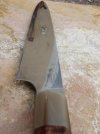
Full flat ground chef

Word!! You will be surprised at how accurate your USGI standard Mod 24 Calibrated Eyeballs can be at seeing if stuff is straight and even , BUT you must have proper lighting and sometimes, a proper contrasting background for them to work most efficiently. ;)

Agreed!!!!

For those who need a little extra help, you can feel differences of about 0.003" with your hands (I learned this working on autobody repair) or you can use a wide felt marker, and the low spots will show when grinding. Never sand a low spot, bring the highs down to the level of the low.
 
It would be interesting to understand what grits different makers use at these various points in the grind.

I use 36g until the grind is 80% the height I want it, then switch to 60 , clean it up as it moves up, then 120, all ceramic. I then switch to structured belts, and go to u200, u100, then heat treat. After heat treat, I use 120 ceramic, the u200, u100, u65, and sometimes u45. Then I go to hand sanding starting at either 120 or 220g Norton Ice, then 220+ is redline paper.
 
I think I could grind out half a dozen chef blades in the time it would take to read all these posts.

Sheez - Just take the bar of steel and grind the bevels. It isn't rocker science. All they need to be is flat.

I rarely scribe a centerline myself. If my eyes get bso bad I can't see that the edge is off center, maybe I will start again. With a coarse belt ir literally takes a few minutes to set the bevels on a chef blade.
 
Agreed!!!!

For those who need a little extra help, you can feel differences of about 0.003" with your hands (I learned this working on autobody repair) or you can use a wide felt marker, and the low spots will show when grinding. Never sand a low spot, bring the highs down to the level of the low.
You can really notice the feel thing when shaping sculpted handles. You can feel where a little more needs to come off.
 
I think I could grind out half a dozen chef blades in the time it would take to read all these posts.

Sheez - Just take the bar of steel and grind the bevels. It isn't rocker science. All they need to be is flat.

That's what I've been trying to say this whole time. It sounds much more respectabler when you say it, though.

:)

As for handles... I'm rapidly discovering that less/simpler is definitely more. I very seldom use a chef's knife in anything but a pinch grip.
 
That's what I've been trying to say this whole time. It sounds much more respectabler when you say it, though.

:)

As for handles... I'm rapidly discovering that less/simpler is definitely more. I very seldom use a chef's knife in anything but a pinch grip.

I think I could grind out half a dozen chef blades in the time it would take to read all these posts.

Sheez - Just take the bar of steel and grind the bevels. It isn't rocker science. All they need to be is flat.

I rarely scribe a centerline myself. If my eyes get bso bad I can't see that the edge is off center, maybe I will start again. With a coarse belt ir literally takes a few minutes to set the bevels on a chef blade.

I've heard the same said by brain surgeons " it isn't rocket science anyone can do it" but alas, just like the brain surgeons, there is nothing to it once you know how. But not everyone is at the same skill level, therefor the questions, therefor the qualified answers. :)
 
I have no problem with questions and answers. The problem here is making a simple task into brain surgery. All that has to be done to make a FFG chef blade is grind each side flat from spine to edge, leaving a small amount of thickness at the edge. Calculating angles, making jigs accurate to a tenth degree, and multiple steps of bevel development are not needed.

Place it on the platen and grind from the edge side until the bevel walks up to the spine. Flip over and repeat.
 
I have no problem with questions and answers. The problem here is making a simple task into brain surgery. All that has to be done to make a FFG chef blade is grind each side flat from spine to edge, leaving a small amount of thickness at the edge. Calculating angles, making jigs accurate to a tenth degree, and multiple steps of bevel development are not needed.

Place it on the platen and grind from the edge side until the bevel walks up to the spine. Flip over and repeat.

You make it sound so easy; its the wisdom of an old salt. :)
 
This is what happens when you go for an intentionally NOT flat grind on a kitchen knife. Let's play a little game called "find the plunge cut" ;)
IMG_0367_zps8164674d.jpg
 
You make it sound so easy; its the wisdom of an old salt. :)

But it really is that "easy". OK, maybe not "easy", because it definitely requires practice and skill, but it is simple.

I really think the biggest problem serious makers face is getting over their own ego-driven desire to complicate everything and make it seem like more than it really is.

For instance, I have nothing against jigs in general, but I often watch guys spend a weekend and a couple hundred bucks making some do-it-for-ya contraption, and I always think... "Dude, you could have made and sold two or three knives in that time... while increasing your skills and 'brand'." *shrug*

Many times I've been asked, "How does the magic happen? What's your secret?" There is no secret. There is no magic.

To make a high-performance blade, you simply remove everything that doesn't cut. To make a great handle, you simply remove everything that hurts your hand.
 
Last edited:
But it really is that "easy". OK, maybe not "easy", because it definitely requires practice and skill, but it is simple.

I really think the biggest problem serious makers face is getting over their own ego-driven desire to complicate everything and make it seem like more than it really is.

For instance, I have nothing against jigs in general, but I often watch guys spend a weekend and a couple hundred bucks making some do-it-for-ya contraption, and I always think... "Dude, you could have made and sold two or three knives in that time... while increasing your skills and 'brand'." *shrug*

Many times I've been asked, "How does the magic happen? What's your secret?" There is no secret. There is no magic.

To make a high-performance blade, you simply remove everything that doesn't cut. To make a great handle, you simply remove everything that hurts your hand.

It was sarcasm James :) Nothing is "easy" until the skill is acquired. It may be easy in theory but in practice, not so easy. Simple to me is flipping an egg in a skillet without breaking the yolk. Taking a piece of flat steel and turning it into a geometrically precise two sided bevel, is not easy. I've been grinding blades for 16 years and big bowies that are "correct" are still a challenge.
Knife making is a succession of challenges with an extended learning curve; none of it happens instantaneously. It takes time to acquire the skills. Each does this in their own fashion depending on how they learn. Some people are kinetic learners, I am; some learn best by reading about a technique, others learn using auditory means. We are individuals.
There is no magic that I know of. An accomplished wood carver told me that same thing when I ask him how he made a chunk of wood look exactly like an eagle; you remove every thing that doesn't look like an eagle. I tried that, it didn't work, I removed everything that didn't look like an eagle to me and it looked like something with two eyes, you couldn't tell what.
I've apprenticed 4 different makers at my shop and each one took his own path to become a knife maker, no two were the same.

Stacy, I'm sure, new it was sarcasm. He's been doing this for decades and can say this with conviction.

Fred
 
I disagree. A new box cutter cuts cleanly but it is not a kitchen knife. I dont know much about head exploding, but making a professional grade chef knife that is used all day, most days of the week, by an actual chef is probably the most difficult and nuanced aspect of knife making I have experienced. Of course once the maker figures it out, it is fairly straight forward but there are many makers that think they know, but are lacking in one or more important areas of knife design and execution.

+1000
 
Back
Top