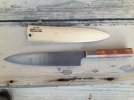
Full flat ground chef

I've found the head-exploding thing to be vastly overblown, and mostly perpetuated by people who neither make nor use a lot of kitchen knives. Relax. It either cuts cleanly or it doesn't. This is not rocket-surgery.

I disagree. A new box cutter cuts cleanly but it is not a kitchen knife. I dont know much about head exploding, but making a professional grade chef knife that is used all day, most days of the week, by an actual chef is probably the most difficult and nuanced aspect of knife making I have experienced. Of course once the maker figures it out, it is fairly straight forward but there are many makers that think they know, but are lacking in one or more important areas of knife design and execution.
 
Last edited:
I disagree. A new box cutter cuts cleanly but it is not a kitchen knife. I dont know much about head exploding, but making a professional grade chef knife that is used all day, most days of the week, by an actual chef is probably the most difficult and nuanced aspect of knife making I have experienced. Of course once the maker figures it out, it is fairly straight forward but there are many makers that think they know, but are lacking in one or more important areas of knife design and execution.
I would qualify that by saying that making a knife for an actual chef who knows a lot about kitchen knives and knows what they want is difficult and nuanced. There are still chefs out their who use mass market stuff, I am sure, but they can be converted to the one true faith eventually. :D
 
Here is an image I just mocked up that demonstrates "progressive angle grinding" a knife bevel. As you can see, just as Rookie25 said, the initial 45 degree grind just sets your desired edge thickness for either your pre-heat treat rough grinding or your post- heat treat finish grinding... Hope it helps :)

Edited to add: This approach to grinding makes grinding go faster, it produces much less heat due to less surface area being in contact with the belt, and it helps produce "crisper" grinds, IMHO.

progressive%20angle%20grinding%20steps_zps8nr2ftfk.jpg


~Paul

My YT Channel Lsubslimed

It would be interesting to understand what grits different makers use at these various points in the grind.
 
I would qualify that by saying that making a knife for an actual chef who knows a lot about kitchen knives and knows what they want is difficult and nuanced. There are still chefs out their who use mass market stuff, I am sure, but they can be converted to the one true faith eventually. :D

Agreed, making a knife for someone who is willing to drop $500+ on a work tool is not easy.
 
Agreed, making a knife for someone who is willing to drop $500+ on a work tool is not easy.
But once they are hooked, they may drop a lot more than that, although those low to mid 4 figure blade s probably get used a home more than work. But I bet that some of them still ride to work in the knife roll some days. ;)
 
Some interesting points raised in this thread.

Question for you guys on chef's knives; is there any reason a chef would not want a damascus or laminated knife?
 
Use a Bubble Jig, there's no need to mark a center line to get the edge in the center of the blade. When the grind lines are at the same height, the edge is in the center of the blade, the bevels match and the plunge lines match. Its not rocket science, but it helps to use a technique that offers success. It is a matter of practice, but practice a technique that will produce good results.

You can hold a 1.3 degree approach angle per side; the grind will go faster as well. No multiply facets on the bevel to correct or blend. No mistakes to throw away.

I can grind free hand; but never do, why risk failure.

Harden the steel before grinding and use brand new belts.

Good luck with the kitchen knives, Fred

PS I ground this set from forged W2 last year.
DSC02457.JPG
 
I think finding the Holy grail would be easier.


What you are asking for is what is learned by experience. No tutorial, sticky, or book can give you experience. The forums are filled with great information on the subjects that you mentioned, but there is no real way to tell someone how "walking a bevel up the blade" feels in your hands.

Make knives, critique and test them,...make more knives.

BTW, here is the BF search engine to find nearly any topic;
https://www.google.com/cse/home?cx=011197018607028182644:qfobr3dlcra

Whaaat, I had no idea that search engine thing even existed.
 
Use a Bubble Jig, there's no need to mark a center line to get the edge in the center of the blade. When the grind lines are at the same height, the edge is in the center of the blade, the bevels match and the plunge lines match. Its not rocket science, but it helps to use a technique that offers success. It is a matter of practice, but practice a technique that will produce good results.

You can hold a 1.3 degree approach angle per side; the grind will go faster as well. No multiply facets on the bevel to correct or blend. No mistakes to throw away.

I can grind free hand; but never do, why risk failure.

Harden the steel before grinding and use brand new belts.

Good luck with the kitchen knives, Fred

For me it is important to mark center lines, and I think it's more important for those who are *learning* to make knives to mark centerlines as well, so that they can develop an eye to tell if the edge is centered of not. Say there is a very slight curve in the blade stock etc., I think a granite surface and a height guage (which I 'FINALLY' just now got!) are two things a person would really want to have, especially grinding large kitchen knives. Of course that's just how I see it. Just like using a bubble jig to not risk failure, that's what I see using scribed lines doing for me.. well I actually don't trust my skills yet to do without the lines lol. BTW Fred, I love my bubble jig! :D Thanks man!


~Paul

My YT Channel Lsubslimed
 
For me it is important to mark center lines, and I think it's more important for those who are *learning* to make knives to mark centerlines as well, so that they can develop an eye to tell if the edge is centered of not. Say there is a very slight curve in the blade stock etc., I think a granite surface and a height guage (which I 'FINALLY' just now got!) are two things a person would really want to have, especially grinding large kitchen knives. Of course that's just how I see it. Just like using a bubble jig to not risk failure, that's what I see using scribed lines doing for me.. well I actually don't trust my skills yet to do without the lines lol. BTW Fred, I love my bubble jig! :D Thanks man!


~Paul

My YT Channel Lsubslimed

Hi Paul,

I can appreciate that. Scribed center lines help a new maker to be more assured that they are on the right track. A good visual check when grinding with BJ, the blade held in the grinding clamp; hold blade/clamp so that your looking through the end of the clamp down along the cutting edge of the blade with a back light shining on it. You can see immediately if the edge is centered, its similar to looking through an iron rifle site. When I used scribe lines I could see those along the edge as well. :)

Fred
 
Hi Paul,

I can appreciate that. Scribed center lines help a new maker to be more assured that they are on the right track. A good visual check when grinding with BJ, the blade held in the grinding clamp; hold blade/clamp so that your looking through the end of the clamp down along the cutting edge of the blade with a back light shining on it. You can see immediately if the edge is centered, its similar to looking through an iron rifle site. When I used scribe lines I could see those along the edge as well. :)

Fred

I actually bought just the jig from you without the clamp because I couldn't afford both at the time, it was a few years ago and I orderd over the phone :) I use a crappy homemade clamp (file guide type thingy) that I have to make sure the screws are tightened the same amount on the spine side and edge side so that both sides are parallel to eachother (which takes forever), otherwise when I switch the jig to grind the other side of the blade it could be off by a couple degrees, it's deff a PITA :( I really need to get one of your clamps sometime so I can actually enjoy using the jig instead of dreading having to set up my "file guide". Also it would be nice to use that as an extra refference for a centered edge. Thanks for the tip! :)

~Paul

My YT Channel Lsubslimed
 
Some interesting points raised in this thread.

Question for you guys on chef's knives; is there any reason a chef would not want a damascus or laminated knife?
If you are talking about chefs who are knife nuts, then only if the knife did not perform. A lot of the prized Japanese knives are laminated in one way or another. About two years ago, I sold this 400 layer ladder patterned one to a guy in the UK.
IMG_0052.jpg
 
I have heard people reference this before, what is the granite for exactly?

Google "surface plate"

I got mine fro enco for $40 when they were doing free shipping. I use one in conjunction with a height guage to scribe center lines. Its nice for rescribing the line after heat treat.

You can also use a cheap set of calipers to scribe center lines. Really, scribing a center line is so easy, there's really no reason not to.

Even if you do an even number of passes or measure the bevel height/plunge line on with side, the evenness of the grind can get away from you. Especially closer to the tip.
 
If you are talking about chefs who are knife nuts, then only if the knife did not perform. A lot of the prized Japanese knives are laminated in one way or another. About two years ago, I sold this 400 layer ladder patterned one to a guy in the UK.
View attachment 516859

That's what I figured. I had been hearing a lot lately about soldering the bolster or using integral bolsters to prevent food and bacteria buildup and that is what prompted it. Thought maybe I am missing something and damascus chef knives were for the home cook. Good to know.

Nice knife btw!
 
That's what I figured. I had been hearing a lot lately about soldering the bolster or using integral bolsters to prevent food and bacteria buildup and that is what prompted it. Thought maybe I am missing something and damascus chef knives were for the home cook. Good to know.

Nice knife btw!
Thank you, sir. Properly utilized epoxy is a good barrier.
 
I disagree. A new box cutter cuts cleanly but it is not a kitchen knife.

Well, of course not... neither is a skinner or a combat knife. Geometry should always be purpose-driven. I agree about the subtleties involved with kitchen cutlery, that's what makes them so much fun to make and use. :)

But I stand by my opinion that it's not rocket surgery. No matter how elegant, well-balanced, comfortable, beautiful or embellished it is, and no matter how complicated the processes and materials may be... at the end of the day it's still "just" a knife. ;)

Obviously other will feel differently, and I'm sure hoping no one goes off on the whole art vs. science vs. sculpture vs. tool thing.
 
Back
Top