
-
The BladeForums.com 2024 Traditional Knife is available! Price is $250 ea (shipped within CONUS).
Order here: https://www.bladeforums.com/help/2024-traditional/
You are using an out of date browser. It may not display this or other websites correctly.
You should upgrade or use an alternative browser.
You should upgrade or use an alternative browser.
Gaucho knives and cuchillos criollos of South America
- Thread starter CelloDan
- Start date


jfk1110
Gold Member
- Joined
- Mar 9, 2013
- Messages
- 29,769
Thanx!!!!!Reached out to Dan a couple of months ago. He's simply taking a break from the forum for a while.

A pre-"Arbolito" Böker, in cuchillo de campo format:


I know Böker acquired the razor trademark in 1905, but I'm not sure when they stopped using it. Any info on that, H herder ? As for the "Dos Caras" trademark, Domenech lists it as Böker's, but I've seen later examples stamped "France" too, with a slightly different logo.
That's a great old knife and an example I had not seen before. I also have not seen that "razor" mark used on any other Boker knives.
I couldn't find that razor mark used on any knives in Boker catalogs from the U.S. or Germany from the early to mid-1900s.
I wonder if it had any connection to "Casa Boker" in Mexico? Regardless, wonderful knife with a unique blade etch.
Trubetzkoy
Basic Member
- Joined
- Jun 3, 2022
- Messages
- 434
Thanks, Neal. I don't know about Casa Boker, but I've seen this same stamp on other knives of Argentinian provenance, including one shown by Domenech (in his book and in his English essay on the topic), pictured below:That's a great old knife and an example I had not seen before. I also have not seen that "razor" mark used on any other Boker knives.
I couldn't find that razor mark used on any knives in Boker catalogs from the U.S. or Germany from the early to mid-1900s.
I wonder if it had any connection to "Casa Boker" in Mexico? Regardless, wonderful knife with a unique blade etch.

The example I shared in my previous post was sold to me by an older lady who said the knife belonged to her Argentinian grandfather. Domenech dates the stamp in question to 1905 (before "Arbolito" started to be stamped on South American blades) and I remember reading that Böker had bought the trademark from R. J. Roberts Razor Co (New York).
Last edited:

kamagong
Gold Member
- Joined
- Jan 13, 2001
- Messages
- 11,024
That's a very nice knife to add to your collection
T
Trubetzkoy
.  Incredible that it came with the vaina.
Incredible that it came with the vaina.Trubetzkoy
Basic Member
- Joined
- Jun 3, 2022
- Messages
- 434
Thanks, and indeed! When I received it and noticed the "Dos Caras" trademark (which wasn't pictured), I thought: "What a bummer that it doesn't match the blade." But then I checked and confirmed that said trademark was used by Böker (or their Argentinian importer).That's a very nice knife to add to your collection T Trubetzkoy .
Trubetzkoy
Basic Member
- Joined
- Jun 3, 2022
- Messages
- 434
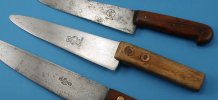
Here's a cuchilla I found on Ebay recently, marked "De Giacomi Hnos, Buenos Aires":


I hadn't heard of the importer before, but I assumed it had to be old, probably made in France, so I bid and ultimately won. To my surprise, under the bolster was an "El Casco" (Kirschbaum, Solingen) stamp (not shown in the listing), with the familiar brand's helmet, which made the knife all the more interesting. Because of the damage to the tip, however, I had to do extensive work on the blade to make it usable and nicer overall. Here's the result:


Now I only need a daga (a double-edged dagger) to complete my "creole" knife collection!
I hadn't heard of the importer before, but I assumed it had to be old, probably made in France, so I bid and ultimately won. To my surprise, under the bolster was an "El Casco" (Kirschbaum, Solingen) stamp (not shown in the listing), with the familiar brand's helmet, which made the knife all the more interesting. Because of the damage to the tip, however, I had to do extensive work on the blade to make it usable and nicer overall. Here's the result:
Now I only need a daga (a double-edged dagger) to complete my "creole" knife collection!

oldmanwilly
Gold Member
- Joined
- Mar 7, 2014
- Messages
- 4,904
Here's a cuchilla I found on Ebay recently, marked "De Giacomi Hnos, Buenos Aires":
I hadn't heard of the importer before, but I assumed it had to be old, probably made in France, so I bid and ultimately won. To my surprise, under the bolster was an "El Casco" (Kirschbaum, Solingen) stamp (not shown in the listing), with the familiar brand's helmet, which made the knife all the more interesting. Because of the damage to the tip, however, I had to do extensive work on the blade to make it usable and nicer overall. Here's the result:
Now I only need a daga (a double-edged dagger) to complete my "creole" knife collection!
Nice work, looks like it's ready to hop back into service!
- Joined
- Feb 7, 2005
- Messages
- 3,070
The De Giacomi brothers had a gun shop in downtown Buenos Aires, on Moreno street (it's a hotel now). There were three of them, all very active in the Argentine business scene.
One of them, José, would go on to be very well known in my province (Córdoba). He moved there in the '40s to look after his health and built a manor that's now a hotel (Ca' Montana). By then he'd been diversifying into construction for well over a decade, had quarries in Córdoba and even built some new housing developments in La Falda.
Alejandro opened another gun store with his sons on Piedras street (then called Victoria).
Juan kept the original store on Moreno street going. And he was the first vicepresident of the board of hunting, fishing and outdoors kit makers and sellers.
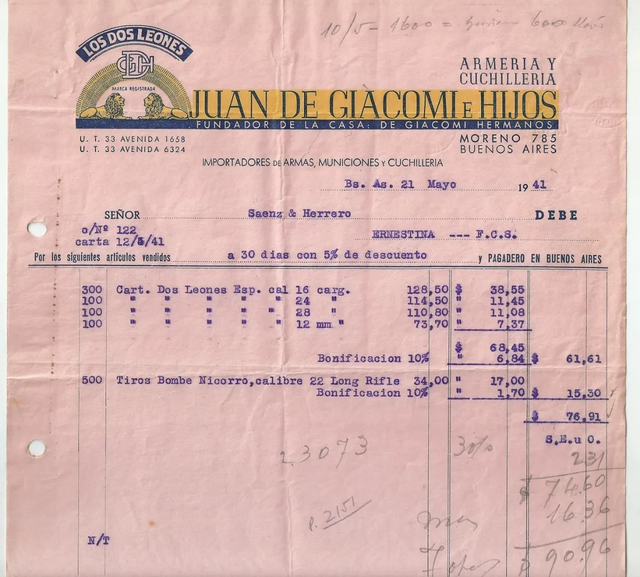

One of them, José, would go on to be very well known in my province (Córdoba). He moved there in the '40s to look after his health and built a manor that's now a hotel (Ca' Montana). By then he'd been diversifying into construction for well over a decade, had quarries in Córdoba and even built some new housing developments in La Falda.
Alejandro opened another gun store with his sons on Piedras street (then called Victoria).
Juan kept the original store on Moreno street going. And he was the first vicepresident of the board of hunting, fishing and outdoors kit makers and sellers.
kamagong
Gold Member
- Joined
- Jan 13, 2001
- Messages
- 11,024
Here's a cuchilla I found on Ebay recently, marked "De Giacomi Hnos, Buenos Aires":
I hadn't heard of the importer before, but I assumed it had to be old, probably made in France, so I bid and ultimately won. To my surprise, under the bolster was an "El Casco" (Kirschbaum, Solingen) stamp (not shown in the listing), with the familiar brand's helmet, which made the knife all the more interesting. Because of the damage to the tip, however, I had to do extensive work on the blade to make it usable and nicer overall. Here's the result:
Now I only need a daga (a double-edged dagger) to complete my "creole" knife collection!
You have assembled a very interesting and varied assortment of gaucho knives.
I thought the rounded tip fascinating, a testament to the use that knife endured. It reminded me of this knife from Domenech's essay.
Here's a cuchilla I found on Ebay recently, marked "De Giacomi Hnos, Buenos Aires":
I hadn't heard of the importer before, but I assumed it had to be old, probably made in France, so I bid and ultimately won. To my surprise, under the bolster was an "El Casco" (Kirschbaum, Solingen) stamp (not shown in the listing), with the familiar brand's helmet, which made the knife all the more interesting. Because of the damage to the tip, however, I had to do extensive work on the blade to make it usable and nicer overall. Here's the result:
Now I only need a daga (a double-edged dagger) to complete my "creole" knife collection!
Man, that is a hefty blade - looking at the third photo
Trubetzkoy
Basic Member
- Joined
- Jun 3, 2022
- Messages
- 434
Thanks for the info! Any idea when the company was founded and when changed its name? Based on the "El Casco" stamp, I had assumed that my knife was from around the 20s or 30s, and that would appear to be consistent with the timeline you shared...The De Giacomi brothers had a gun shop in downtown Buenos Aires, on Moreno street (it's a hotel now). There were three of them, all very active in the Argentine business scene.
One of them, José, would go on to be very well known in my province (Córdoba). He moved there in the '40s to look after his health and built a manor that's now a hotel (Ca' Montana). By then he'd been diversifying into construction for well over a decade, had quarries in Córdoba and even built some new housing developments in La Falda.
Alejandro opened another gun store with his sons on Piedras street (then called Victoria).
Juan kept the original store on Moreno street going. And he was the first vicepresident of the board of hunting, fishing and outdoors kit makers and sellers.
Especially seeing it in person, I'd say the rounded tip of my knife was the result of regrinding, probably due to breakage. Makes me wonder how long the blade originally was. I'd put my money on 22-23 cm.You have assembled a very interesting and varied assortment of gaucho knives.
I thought the rounded tip fascinating, a testament to the use that knife endured. It reminded me of this knife from Domenech's essay.
View attachment 3160312
That's the bolster (gavilán). The blade is way thinner, at about 4 mm at the base with a pronounced taper.Man, that is a hefty blade - looking at the third photo
Thats what I get for skimming photosThanks for the info! Any idea when the company was founded and when changed its name? Based on the "El Casco" stamp, I had assumed that my knife was from around the 20s or 30s, and that would appear to be consistent with the timeline you shared...
Especially seeing it in person, I'd say the rounded tip of my knife was the result of regrinding, probably due to breakage. Makes me wonder how long the blade originally was. I'd put my money on 22-23 cm.
That's the bolster (gavilán). The blade is way thinner, at about 4 mm at the base with a pronounced taper.

- Joined
- Feb 7, 2005
- Messages
- 3,070
I should check some books and maybe message some mates who collect Argentine guns and knives to be sure, but as far as I can recall the brothers came to Buenos Aires in 1906, worked as mechanics on farming equipment for a few years and saved up to start their import business (guns, knives, ammo). So probably around 1915 or so.Thanks for the info! Any idea when the company was founded and when changed its name? Based on the "El Casco" stamp, I had assumed that my knife was from around the 20s or 30s, and that would appear to be consistent with the timeline you shared.
José got married in 1922 and then began getting into real estate and construction. His two brothers Juan and Alejandro kept the store going and sold European products under the "Los dos leones" brand. Belgian and Spanish revolvers, French ammunition, German and Swedish knives. They had their main shop on Moreno, and a branch on Cangallo (now called Perón).
After 1940 Juan and Alejandro split up. Juan stayed at the original shop and managed the "Los dos leones brand". Alejandro opened "Victoria".
The Argentine gun market is small, we've often had big families open several businesses so that they could obtain contracts from different brands. For instance, in our recent history the Baraldo family started two companies (Baraldo S.R.L. and Bowie S.R.L.) one was Victorinox's official agent, the other one Wenger's. One imported Ruger, the other one CZ. I suspect that was what the Di Giacomi brothers were doing, there doesn't seem to have been any bad blood between them. Juan was Beretta's man in Argentina and handled government contracts for them as well (like when our national bank bought some carbines).
I think your marking "De Giacomi Hnos." is much earlier than "Los dos leones", from the time when all three brothers worked together. I'd say, around the 1920s
Sorry I can't provide precise information, I'm more of a relatively well informed user than a true collector. My relationship with "criollo" knives comes from, well, being a criollo horse trainer and guide.
A bit off topic, but I found a clone of the Buck 112 Dos Leones under Juan De Giacomi had made in Japan in pretty decent shape for about 45 bucks. One of the last knife models they sold before closing.

Trubetzkoy
Basic Member
- Joined
- Jun 3, 2022
- Messages
- 434
Many thanks for the additional info! That's a very handsome and interesting folder, BTW. Did you end up buying it?I should check some books and maybe message some mates who collect Argentine guns and knives to be sure, but as far as I can recall the brothers came to Buenos Aires in 1906, worked as mechanics on farming equipment for a few years and saved up to start their import business (guns, knives, ammo). So probably around 1915 or so.
José got married in 1922 and then began getting into real estate and construction. His two brothers Juan and Alejandro kept the store going and sold European products under the "Los dos leones" brand. Belgian and Spanish revolvers, French ammunition, German and Swedish knives. They had their main shop on Moreno, and a branch on Cangallo (now called Perón).
After 1940 Juan and Alejandro split up. Juan stayed at the original shop and managed the "Los dos leones brand". Alejandro opened "Victoria".
The Argentine gun market is small, we've often had big families open several businesses so that they could obtain contracts from different brands. For instance, in our recent history the Baraldo family started two companies (Baraldo S.R.L. and Bowie S.R.L.) one was Victorinox's official agent, the other one Wenger's. One imported Ruger, the other one CZ. I suspect that was what the Di Giacomi brothers were doing, there doesn't seem to have been any bad blood between them. Juan was Beretta's man in Argentina and handled government contracts for them as well (like when our national bank bought some carbines).

I think your marking "De Giacomi Hnos." is much earlier than "Los dos leones", from the time when all three brothers worked together. I'd say, around the 1920s
Sorry I can't provide precise information, I'm more of a relatively well informed user than a true collector. My relationship with "criollo" knives comes from, well, being a criollo horse trainer and guide.
A bit off topic, but I found a clone of the Buck 112 Dos Leones under Juan De Giacomi had made in Japan in pretty decent shape for about 45 bucks. One of the last knife models they sold before closing.
- Joined
- Feb 7, 2005
- Messages
- 3,070
I came across al a Schrade and a Bulldog that are harder to find here, so I didn't buy it. Those Japanese lockbacks are still plentiful and affordableMany thanks for the additional info! That's a very handsome and interesting folder, BTW. Did you end up buying it?
Trubetzkoy
Basic Member
- Joined
- Jun 3, 2022
- Messages
- 434
Some cuños (terribly photographed):

Trubetzkoy
Basic Member
- Joined
- Jun 3, 2022
- Messages
- 434
I struggled with the Kirschbaum puñal. Thing is shiny.Not terrible at all. Crisp, and clear enough to make out all the relevant details.
Trubetzkoy
Basic Member
- Joined
- Jun 3, 2022
- Messages
- 434
A tiny "Movediza" veriijero (don't even know if I should call it that at this point) from the 40's, with a "Platería Fierro" handle and scabbard:


And here it is with my other "Movediza" knife:

And here it is with my other "Movediza" knife: