GEC 3 1/2" Dogleg Jack

Status
Not open for further replies.
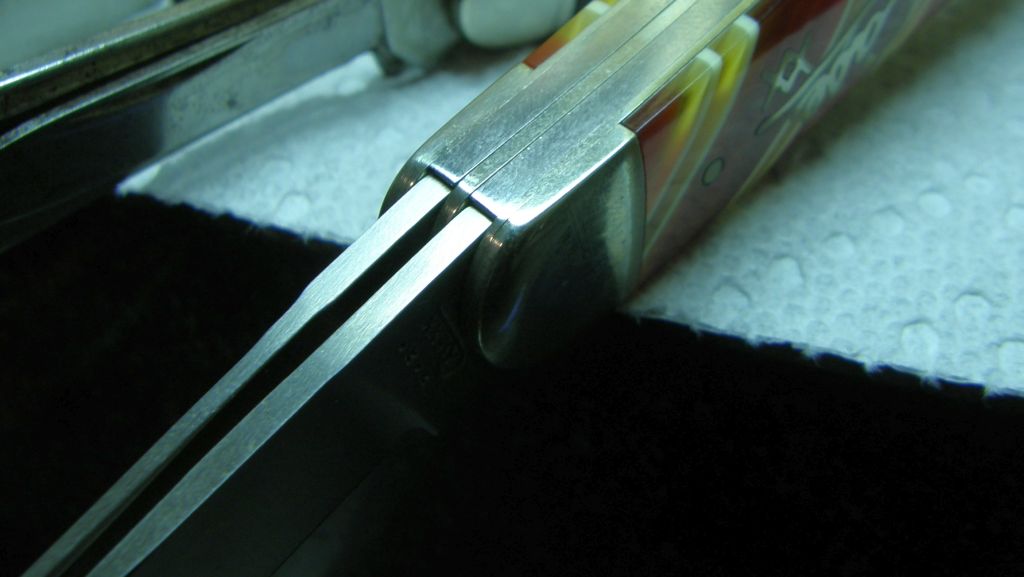
Do you have any pictures of the spring-blade joints with the blades open, Kerry?
 
I can grab a handful of 30+ year old knives that meet up near flush and I can grab a handful of 30+ year old same branded knives that don't.

Why would the same craftsman that lined that blade/backspring up so well, leave gaps between the liner/backspring from end to end? :confused:

Why all the pictures of the spines, why not show the end shot that is the matter of discussion?

I just can't figure out why everyone that wants to prove a point is grabbing knives that speak that point, then taking spine pictures. And the bystanders that look at their collection see that some meet smooth, some don't; but it wasn't something that most noticed or were bothered by until the discussion started here.

Simple question for those that think it is so egregious: Do you at least acknowledge that it has been present in the major branded slipjoints for the last 80 (at least) years? If you were honest with yourself and answered yes, then why is it only now that it is a design flaw?

I send knives back to factories more than most, but by looking at my collection I think I need to send them all back!!

I don't like it; I wish every knife was made such that you couldn't tell where the backspring ended and the blade started; Same for the liners and backsprings as far as that goes. Wish they all snapped hard, but didn't break my thumbnail or have any side/side blade movement. Wish they had perfect mirror finishes and sharpened easily and got a nice patina but never rusted. I demand somebody call the factories and recommend this knife!

You have to love this forum, but sadly even those that are obviously wrong get to post....:D
 
Knifeswapper, Why do you think people are "wrong" on this subject and you are right? Maybe you should send back your collection. There is a reason GEC did this and it wasn't for historical reasons. I agree functionally the underbladedness isn't an issue. I happened to check a few of my slipjoints and here's what I found.
70's era Buck Creek Indian Head Large Stockman - Flush
70's era Boker Large Stockman - Flush
Buck 110 - Flush
70's era Shrade barlow - minor underblading
Buck 701 - Flush

I am of the opinion that if they can do it, and they obviously can, they should make the lockup flush. Show some pride and craftsmanship. Especially if they want to stay in the top 3 production companies lists as most people have them now. One question I have is is this characteristic common across GEC line up?
 
[QUOTE knifeswapper]You have to love this forum, but sadly even those that are obviously wrong get to post....:D[/QUOTE]

You couldn't possibly be talking about ME!!:D

Kidding aside, are the objections to the underblading we are talking about because of function, or because of aesthetics??
Seems the knife will cut regardless. I think it would look better with either less, or no underblading - we probably all agree here to some extent, but it will function.
Would it look better with the EXISTING spring rounded down to meet the open blade tang?? Maybe. That seems to be what some of my older knives have; the spring end rounded down to meet the under-sized blade tang. Seems to be the step that would improve the knife into general acceptance. The square bolstered knives need the flush fit, but a round-bolstered knife like this one can have a rounded spring, and fit the aesthetic of the old time cutlery.
 
Last edited:
Knifeswapper, Why do you think people are "wrong" on this subject and you are right?

Because hes a dealer. He sells GEC knives. More than a bit of bias there.

The Emporer isn't wearing any clothes!
emporer.jpg
 
Gents, let's tread easy here and not presume the intent of our fellow members.
I'd hate to see the thread locked because we couldn't have a civil and rational debate.
Thanks in advance.
 

Man I wish I looked that good in a mirror standing naked....

The :D was an indicator that the sentence was in humor. I don't think there is any wrong or right here as it is obviously a preference issue. It wasn't a defect when Case did it 40 years ago....
Case6347.JPG

and it is my opinion, that it is only aesthetics today. I have been wrong before and it may be me that is wrong now. Perception is reality, and if the new collecting masses decide that all blades have to meet the backsprings perfectly than I will put my clothes back on and admit it.

Regardless, every American / German slipjoint maker has patterns that are made the same. There are just seasons when each get condemned for things that were previously not an issue. This is all fine and good, maybe we will end up getting a perfectly made knife every time.

waynorth, I agree completely with you in that it would look much better if they met perfectly and there were no other issues to contend with. What started down the path that I don't agree with is the opinion (stated as fact) that it was an unintended factory flaw.

jfrye, if it reads as if I thought they did it for historical reasons; my apologies. I think they did it so save money tooling and had no indication that it would be of any significance to the customers, as it is a common setup.

I will simplify my point. All American and German makers have made knives with this "under-bladed" configuration at one point or another. I missed the point in time where it was decided it was a defect; but when you retro-fit such a decision it doesn't hardly seem fair to the craftsmen that made the knives. If it is not acceptable, it should not be acceptable in some consistent fashion; not just those patterns that I am biased to :D (Note: this is humor, as I have previously been labeled bias and ended the paragraph with reference to said biasnessedness; and to infer that said label had some credibility other than simply a jab).

 
Gents, let's tread easy here and not presume the intent of our fellow members.
I'd hate to see the thread locked because we couldn't have a civil and rational debate.
Thanks in advance.

Yeah...what he said. :thumbup::cool: Hey... I learn new things about knives every day and I often times learn something contrary to what I thought was true.

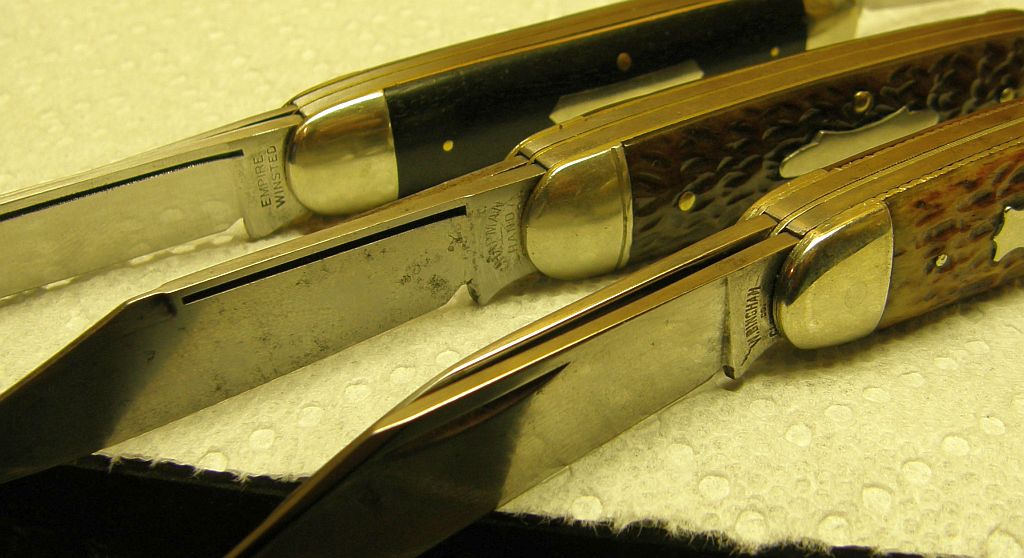
Charlie, the 5-blade cattle knife is now in the Nat. Knife Museum so I won't be able to get any more pix of that...BUT...I have others that I just shot. Clearly the knives with overbite ;) are going to work just fine. They're just not finished in the way the majority of knives were finished back in the day and just look odd to me.
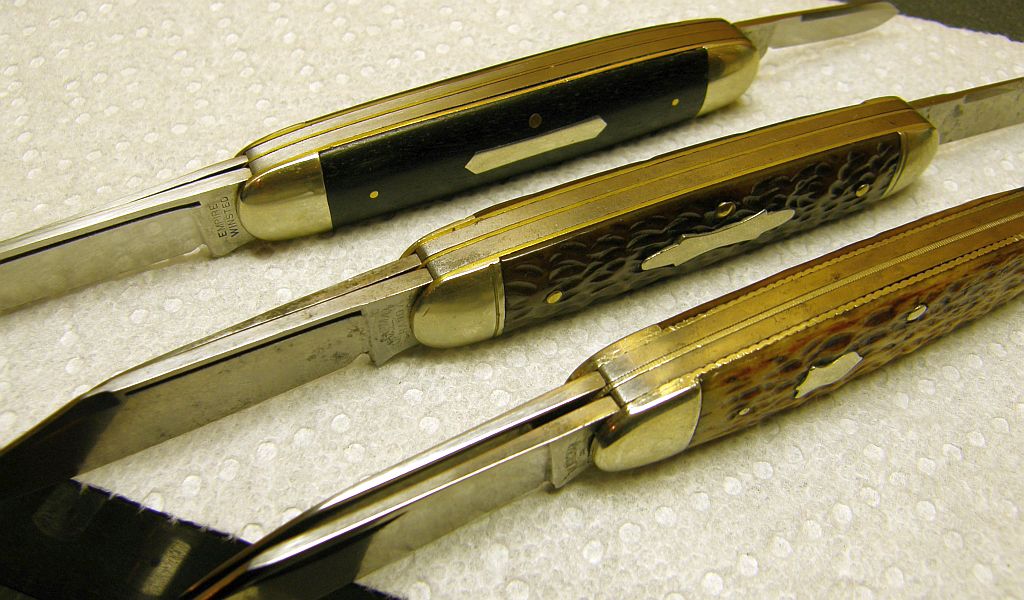
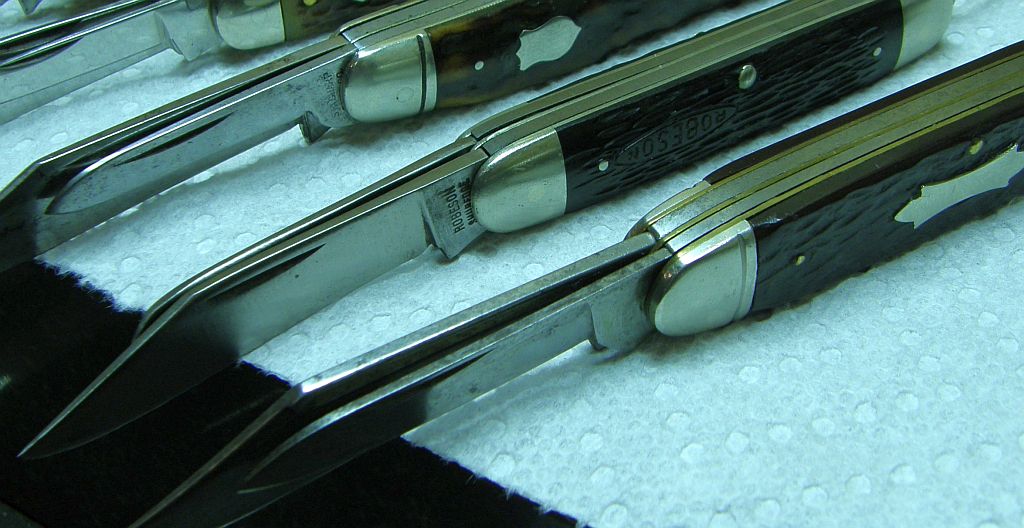
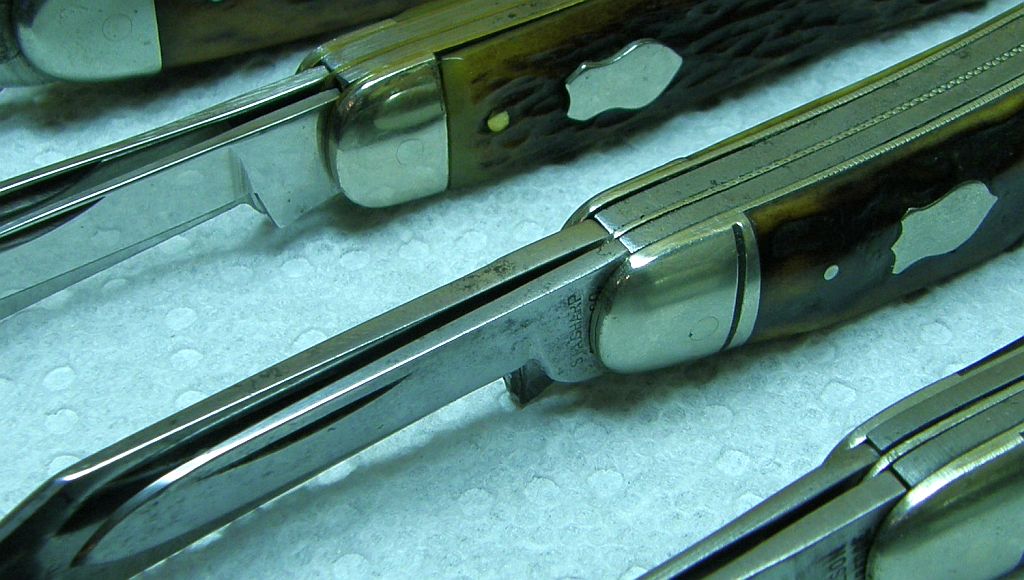
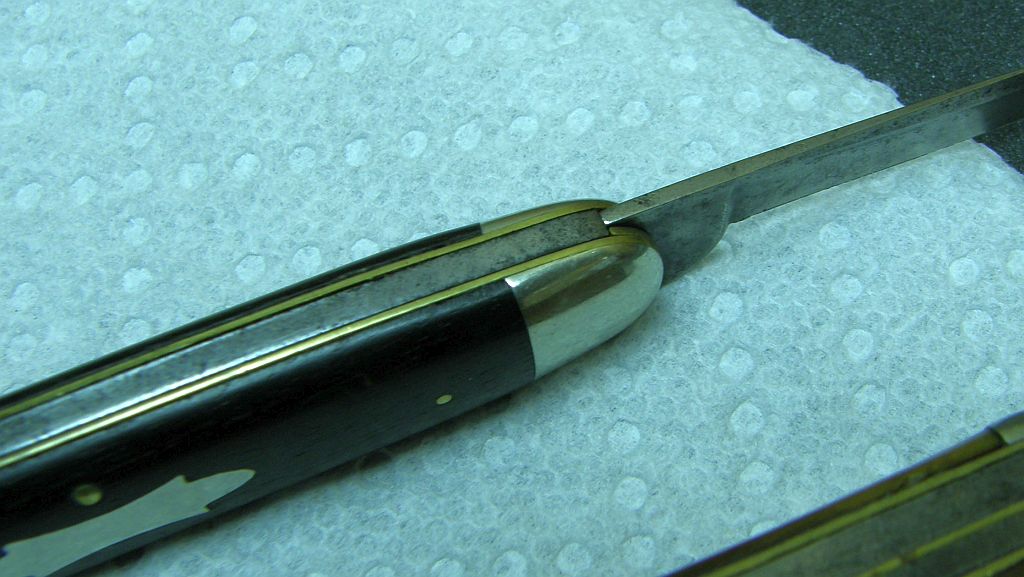
Sorry my other images were too lame to show what I was talking about. Here is a few that I "cherry-picked" from Tony's boxes of goodies. You can see some of the makers marks and figure out that these are old ones. Some are cattle knives and some jacks. Generally speaking, the springs aren't exactly meeting the run up but are usually just a skoshe above the blade.

PB014138.jpg


PB014139.jpg


PB014140.jpg


The dogleg jack has a pen blade that sits lower on the spring. Not all the old knives were perfect, OBVIOUSLY. I saw a few others that were similar but I looked at a lot and this is definitely not the norm.
PB014141.jpg


PB014144.jpg


I threw in the 2001 Case Sowbelly for giggles. :D Tony said that when Case was making this knife, they paid special attention to how much space of the spring was showing above the blade. All three blades/spring levels are the same.
PB014146.jpg


I guess the point is that these show that it is possible to get them closer. I think these show they way a knife should be finished.
 
So Kerry, if the spring ends were "rolled/trimmed" or "rounded" down to meet the blade, it seems a more acceptable appearance could be met. Do you agree? Like that last knife with the Candystripe handles.
 
I think those pictures speak perfectly to my point. Now I have to admit that rounding the backspring to cover up what has now been diagnosed as a design flaw, helps a little with the appearance. But the run-up still sits the same depth below the backspring horizon on these old gems as the new defective models. (Note: humor, I don't think any of these are defective)

Now let's pick on that Robeson in the third picture; look at that backspring sitting proud.... ;)
 
I think those pictures speak perfectly to my point. Now I have to admit that rounding the backspring to cover up what has now been diagnosed as a design flaw, helps a little with the appearance. But the run-up still sits the same depth below the backspring horizon on these old gems as the new defective models. (Note: humor, I don't think any of these are defective)

Now let's pick on that Robeson in the third picture; look at that backspring sitting proud.... ;)

I can't look!! It's . . .it's . . . . .disgraceful!!!:eek:

:D(humor)
 
So Kerry, if the spring ends were "rolled/trimmed" or "rounded" down to meet the blade, it seems a more acceptable appearance could be met. Do you agree? Like that last knife with the Candystripe handles.

If the gap is close enough that it can be closed by rounding over, yes. But the gap on the GEC looks pretty big. The spine of the blade looks very low and I'm not sure it could be rounded that much. If it was mine I would try it but I wouldn't recommend it for a shade tree cutler.
 
If the gap is close enough that it can be closed by rounding over, yes. But the gap on the GEC looks pretty big. The spine of the blade looks very low and I'm not sure it could be rounded that much. If it was mine I would try it but I wouldn't recommend it for a shade tree cutler.

I resemble that remark!!!:grumpy:


:D:D(more humor!)
 
Yes, I can see now how the knife on the right is just as acceptable as the Robeson on the left. :confused:

doh.gif

gec4.jpg


I know which one I'd keep and which one I wouldn't look twice at.

Oh, and the spring ends are rounded down because, well, so are the bolsters. The run-up sits low because you can't center the blade vertically in the frame and have the spine sticking up outside the curve of the bolster to meet the spring. The contour of the spring folllows (or should anyway) the shape of the bolster to meet the blade.
 
Last edited:
Arathol, could you say that another way? I don't quite understand what you described.
 
I take Arathol's last comment to mean the GEC knife needed to start the rounding profile of the bolsters and springs a little sooner to meet the blades, make the blade taller, or a compromise of both.

I like seeing details broken down like this, and especially all the pictures. Thanks for all of the contributions.
 
Charlie, if you're referring to the last part of my post, try looking at it like this-
Heres a 3 1/2" Henry Sears dogleg, same pattern as the GEC. Looking at the knife in profile, the master blade is centered vertically on the bolster, which flows nicely into the blade on top and bottom. If the spring were set back a bit and cut off straight as in the GEC example, and not contoured into the shape of the bolster, in order to be flush with the spring the run-up would have to be higher and longer, extending above the line of the bolster and losing the aesthetics of the knife. So, the spring is made a bit longer and contoured to meet the blade. You can see how its done pretty clearly in the side by side in the above post.

_IGP2481-1.jpg
 
So Kerry,
Let's see if I learned anything here today. You are saying that they should have had a slightly longer spring and back square, so that the spring could be rounded down to better meet the run up?

They definitely should have done that.
 
Last edited:
Status
Not open for further replies.
Back
Top