
-
The BladeForums.com 2024 Traditional Knife is available! Price is $250 ea (shipped within CONUS).
Order here: https://www.bladeforums.com/help/2024-traditional/ -
America has reached 250 years, and I am grateful to be here, in the best country in the world. Thank every one of you who helps make this country a better place, those who have gone before and risked it all, and those who've paid the ultimate price to make the United States what we are today.
Happy Birthday America! Let Freedom Ring for all time!
You are using an out of date browser. It may not display this or other websites correctly.
You should upgrade or use an alternative browser.
You should upgrade or use an alternative browser.
GEC Farm & Field Tools, what can we expect?
- Thread starter rockgolfer
- Start date


- Joined
- May 18, 2008
- Messages
- 1,168
Does anyone know the closed length of the Benjamin L. Hogan, 1865?
4.5 inches
- Joined
- May 18, 2008
- Messages
- 1,168
Thanks. That's going to be a big knife.
Yep, but it should be quite thin, so it should carry fairly well, I might give it a try.
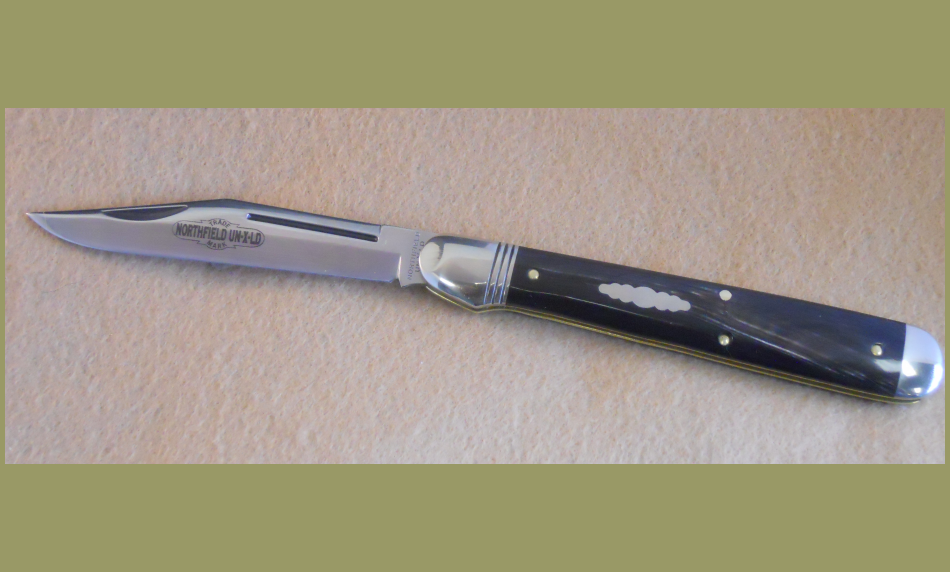


- Joined
- Mar 8, 2008
- Messages
- 26,318
They offered the knife with several other handles, including ebony, stag and many others: http://greateasterncutlery.net/blog/patterns/56-reverse-dog-leg/
Hawkbills have a very specialized use and I just don't see them being a very popular pattern. But the "Weaver Jack" started around $60 shipped so it would be easy for them to make a budget version.
Campbell's Farmer Jack would be a nice pattern to rebirth: http://www.bladeforums.com/forums/showthread.php/984761-Hawk-bills!
The micarta bullet end was another pattern that might be easy to remake as a budget knife.

I can't really say that I'd be excited about those patterns though... a stockman with O1 blades would be more exciting for me.
Take the bullet end pattern and make the secondary a small pruner. That would be one heck of a homesteading knife.

- Joined
- Mar 8, 2008
- Messages
- 26,318
GEC could sell a knife for $5 if they decided that the big picture/long run upside of introducing X new customers to GEC outweighed the loss per piece on that particular product. It's called a loss-leader. Just sayin'.
-- Mark
That's a mighty big "if".


- Joined
- Dec 19, 2006
- Messages
- 8,210
It would be interesting to see stats on GEC's customer base... though it may be a lot like looking the the mirror. I suspect that a lot of GEC's business is from repeat business and collectors. Buck certainly has wider distribution than GEC and GEC only makes a handful of each pattern by comparison. I suspect that any "economy" version of a GEC knife will be targeting different consumers. What appeals to each market? Is it price or fit and finish or performance or tradition or something else? With regards to the Buck 301, it is a very modern interpretation of the classic stockman pattern. The 3-spring Case 47 pattern is also somewhat modernized and the handles aren't rounded off like the oldies... but it more closely resembles an old time stockman. And Case has a very long tradition. The GEC 66 pattern has rounded handles and a 2-spring construction like the oldies. The grinds on the blades, especially the 2012 release Calf Ropers, are pretty good relative to modern knives. I think that these differences are what have allowed them to succeed. Right now they pretty much have their own niche. If Queen ups their game, that may change.
I suspect that a lot of GEC's business is from repeat business and collectors. Buck certainly has wider distribution than GEC and GEC only makes a handful of each pattern by comparison. I suspect that any "economy" version of a GEC knife will be targeting different consumers. What appeals to each market? Is it price or fit and finish or performance or tradition or something else? With regards to the Buck 301, it is a very modern interpretation of the classic stockman pattern. The 3-spring Case 47 pattern is also somewhat modernized and the handles aren't rounded off like the oldies... but it more closely resembles an old time stockman. And Case has a very long tradition. The GEC 66 pattern has rounded handles and a 2-spring construction like the oldies. The grinds on the blades, especially the 2012 release Calf Ropers, are pretty good relative to modern knives. I think that these differences are what have allowed them to succeed. Right now they pretty much have their own niche. If Queen ups their game, that may change.
- Joined
- May 18, 2008
- Messages
- 1,168
It would be interesting to see stats on GEC's customer base... though it may be a lot like looking the the mirror.
Come to think of it, I think the blade grinds are what make GEC so attractive to me, I love their grinds. They're thin without seeming week and they look really good!

- Joined
- May 7, 2011
- Messages
- 3,426
I'm going to bet my dollar (or euro  ) on the #47 being a single blade pruner/hawkbill.
Which could lead me to buy it and make it my gardening knife
Fausto

) on the #47 being a single blade pruner/hawkbill. Which could lead me to buy it and make it my gardening knife
Fausto
- Joined
- Dec 19, 2006
- Messages
- 8,210
Here's a question...
Are these new GECs supposed to be actual farm and field tools or more of an homage to farm and field tools?
I think that's a good point. I think they are somewhere in between. Farm and field tools... for knife aficionados.
We often hear from customers who are disappointed that we do not offer a line of inexpensive knives for day to day, hour to hour use. In particular, they are not looking for the shiny, natural handled work of art, but a tough, durable everyday, throw in the toolbox tool. … It is our attempt to make a strictly user knife at a reduced price that is still GEC quality built. We did so by utilizing innovative processes, less expensive materials, and far fewer labor operations. ..they will be branded Farm & Field Tool. This is a name that we feel exemplifies our intended use of these products. On the farm or out in the field they will be tough durable tools.


- Joined
- Jan 18, 2007
- Messages
- 34,132
That Farmer's Jack would be a very nice pattern, but too costly for this utilitarian line.
A Swell End (Barehead) with a large Sheep/Lambsfoot in the old English style would be a nice rustic knife, kind of Sodbuster hybrid.
A Swell End (Barehead) with a large Sheep/Lambsfoot in the old English style would be a nice rustic knife, kind of Sodbuster hybrid.
My concern with an economy line is that GEC is a small company, with small production capability. If they're making a delrin knife, they're not making a bone or stag knife. They're making one or the other, but not both. My guess is that they want their knives in places like the local Farm and Feed, and want to be seen as an upscale purchase over Case or Queen. I don't know. My guess is that people that buy GEC buy more than one, or at least more than one knife, and maybe they want to reach the guy that buys one knife when or because he needs one. (Weird, but I guess there are people out there like that...)
I'm guessing they'll run into the same issues that Estwing has, for example. You go to the local Home Despot and you can buy any number of Chinese made hammers for a song, and there sits a 40 dollar Estwing in all its glory. Who's going to buy that? Not the construction worker who uses and loses equipment, and probably not the boss buying a dozen for a gang of day laborers. Me, they sell to me, I give them as gifts, and have several myself. But I'm more of an old guy dandy that collects more than uses his tools. And I buy American made stuff because I think it matters and because generally it's made better.
What does all this mean? No idea. I wish GEC well. I love their knives and will continue to buy them because I think they're beautiful. and if more people are exposed to them and decide to buy them as well, bravo, hell yes!
I'm guessing they'll run into the same issues that Estwing has, for example. You go to the local Home Despot and you can buy any number of Chinese made hammers for a song, and there sits a 40 dollar Estwing in all its glory. Who's going to buy that? Not the construction worker who uses and loses equipment, and probably not the boss buying a dozen for a gang of day laborers. Me, they sell to me, I give them as gifts, and have several myself. But I'm more of an old guy dandy that collects more than uses his tools. And I buy American made stuff because I think it matters and because generally it's made better.
What does all this mean? No idea. I wish GEC well. I love their knives and will continue to buy them because I think they're beautiful. and if more people are exposed to them and decide to buy them as well, bravo, hell yes!
It would be interesting to see stats on GEC's customer base... though it may be a lot like looking the the mirror.
I wouldn't panic about Queen
Sam
- Joined
- Jan 12, 2009
- Messages
- 3,198
My guess is that they want their knives in places like the local Farm and Feed, and want to be seen as an upscale purchase over Case or Queen. I don't know. My guess is that people that buy GEC buy more than one, or at least more than one knife, and maybe they want to reach the guy that buys one knife when or because he needs one. (Weird, but I guess there are people out there like that...)
There are indeed! For all the guys that buy several $100+ knives a year because they need them, there are plenty of folks that are on limited budgets. They simply cannot afford a shoe box full of good lookers that are to be admired. And there may be more folks like me than you think, folks that use them as tools. I love some of my knives and actually have a few really nice ones (at least to me!). Regardless of how nice they are, they all must work and earn their keep. There are probably more folks that see knives as utility tools than you might think. That's why Lowe's still carry the CASE sodbuster as well as a Delrin handled (yellow) medium stockman in their stores as a very economical, high value knives. No collecting value at all, just the value of the knife as a tool.
They are primarily for workers, not collectors. If that knife gets left out in the rain while working, falls out of you hand and breaks a scale while you are working on a scaffold, lent to a guy that thinks it is a scraper, stolen, accidentally damaged (hit a hidden nail or staple while cutting), exposed to harsh chemicals that immediately rust the blade (fertilizer, cleaning powders, acidic agents, etc.) and any of the other things that happen to a working knife, you don't have any heartburn. You clean it up, sharpen it, put a dot of oil on the pivot and off you go. Damage to THIS knife isn't actually damage at all; it is "character" or "lovin" on the knife that makes it yours. So stains, chewed up edges, chipped handles, pitted rust spots, etc., are all part what makes that knife yours.
I'm guessing they'll run into the same issues that Estwing has, for example. You go to the local Home Despot and you can buy any number of Chinese made hammers for a song, and there sits a 40 dollar Estwing in all its glory. Who's going to buy that? Not the construction worker who uses and loses equipment, and probably not the boss buying a dozen for a gang of day laborers.
Great example. Now take the Chinese out of the example.
You are a blue collar working man that uses his soddie to sharpen his pencils, scrape off old gaskets, trim wet and filthy wood, clean up equipment, and on an on. All the stuff you do and have done for years with your knife. So now go to the tack store to buy a new knife as you son lost your soddie. (No Chinese, remember.) You see a CASE soddie (iron clad rep as a performer), a Queen Country Cousin (EXCELLENT D2 for superior edge holding and rust resistance) and both are about $25.
Then you see the GEC (who are those guys again?? are they offshore - they don't have a name?) and it is more than double the price. Oh yeah, and it has that same level of rust resistance that the old CASE has... little in a filthy wet pocket. And since it is 1095, it is a bit soft, but no worse than the CASE. But you can buy TWO American made knives that do the same thing as one GEC.
Remember, on the job site, ranch or farm the panache isn't a factor in a tool. So realistically, which one would you buy if you were looking at the utility-to-price factor?
I think these knives will be pretty and probably damn good knives. But the will be for the less committed collectors, knives made for those that want a GEC but can't or won't put $125 to get one. It is like owning an economy Cadillac, you do still have one, but....
I think the "working man's knives" will be big sellers for the weekend warriors, GIFTS (oh, yeah!) and for the that has some Tim Taylor in him.
As far as the working stiffs go, I can't imagine unseating CASE for a simple work knife. Not at the price difference GEC will have. And as far as folders go, I can't see how GEC could hope to compete with BUCK. Excellent blade steel, excellent warranty, and a platinum reputation among my fellow blue collar colleagues, my old military pals, my ranching buddies, etc. BUCK and CASE are what my buddies buy for themselves and have for generations. A more expensive knife that doesn't do anything new or better will have some tough ground to break to get a hold in the blue collar world.
Robert
Last edited:
- Joined
- Jan 18, 2007
- Messages
- 34,132
Very apt points Robert, hard to argue with you on this.
Regards, Will
Regards, Will
- Joined
- Dec 19, 2006
- Messages
- 8,210
I agree that they wouldn't sell in farm and feed stores. Except for people who spend time on knife websites and knife shows, most folks won't even recognize GEC. I can't recall seeing a GEC advertisement anywhere. If they do advertise, I would guess it's probably in specialty knife magazines or websites. I think GEC's Farm & Field tools are targeting us, the same people who spend time on knife websites and knife shows and already buy their knives or are thinking about buying their knives.
I don't expect their distribution channels to change much. GEC's distributer's are all specialty online stores. Most of them are the mom & pop type. Many of them predominantly sell the GEC brand. Only 1 or maybe 2 have brick and mortar stores. GEC doesn't make enough knives to stock all the Lowes stores in a single state. But I don't think the general public is their target audience. It's us.
I don't know if the new Farm and Field brand of knives will be successful. The bullnose was a popular knife... Maybe a third (?) run will be equally successful... or maybe it won't. I think part of the popularity was the pattern. I don't think a hawkbill will be as popular (if that is the new pattern). It has a very specific function and is not a particularly popular pattern... but we'll see. One selling point may be their price... but as has been mentioned, some of the other GEC knives are close in price and they are still more expensive than comparable knives from Case and much more expensive than comparable knives from Rough Rider.... I don't think the Farm & Field brand will prevent a zombie apocalypse...

but the Farm & Field tools are a different category of knife from GEC. The bullnose is not as pretty as some of the other GEC knives but there's also no need to worry about the handle material getting wet or scratched. It's just a rugged, well built and ergonomic tool.
I don't expect their distribution channels to change much. GEC's distributer's are all specialty online stores. Most of them are the mom & pop type. Many of them predominantly sell the GEC brand. Only 1 or maybe 2 have brick and mortar stores. GEC doesn't make enough knives to stock all the Lowes stores in a single state. But I don't think the general public is their target audience. It's us.
I don't know if the new Farm and Field brand of knives will be successful. The bullnose was a popular knife... Maybe a third (?) run will be equally successful... or maybe it won't. I think part of the popularity was the pattern. I don't think a hawkbill will be as popular (if that is the new pattern). It has a very specific function and is not a particularly popular pattern... but we'll see. One selling point may be their price... but as has been mentioned, some of the other GEC knives are close in price and they are still more expensive than comparable knives from Case and much more expensive than comparable knives from Rough Rider.... I don't think the Farm & Field brand will prevent a zombie apocalypse...
but the Farm & Field tools are a different category of knife from GEC. The bullnose is not as pretty as some of the other GEC knives but there's also no need to worry about the handle material getting wet or scratched. It's just a rugged, well built and ergonomic tool.
Last edited: