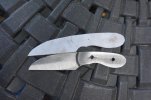
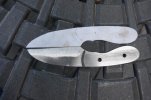
Getting Started on My First Knife

I have the pattern printed out and will cut it this weekend. We can make a tutorial build out of this and it will serve as a learning tool for others. I have no problem with doing the HT, if one of the Long Island makers doesn't offer. Local HT would save two-way shipping ( which is around $5 each way).

Vin - About the handle, what were your plans on materials?


BTW, I am changing the title of this thread to reflect the way it has turned.
 
THANK YOU, STACY!

I will try to document the build.

Handle material- something nice looking (suitable for formal attire/camping) with a good grip in wet (camping, outdoor, kitchen). Any suggestions? I might have access to some handle size scraps of padauk, teak, or maple from a friend. Not sure how well it would grip. I guess I can score it for more traction.

(ps thanks for changing the title. Much better!)
 
".....suitable for formal attire...."

When you say "formal attire", exactly what do you mean? Wet use and camping I understand.
I would usually use Micarta for a knife like this, but any stabilized wood will work.
I'll take a look and see what is sitting in the work room...there is a ton of wood (literally) out there.
 
".....suitable for formal attire...."

When you say "formal attire", exactly what do you mean? Wet use and camping I understand.
I would usually use Micarta for a knife like this, but any stabilized wood will work.
I'll take a look and see what is sitting in the work room...there is a ton of wood (literally) out there.


I'm hoping this blade becomes a true EDC (everything from the campsite to the office). I guess what I mean by formal is something that doesn't look intimidating and can be worn with a button down shirt. I'm not looking for anything blingy and showy.

Micarta sounds like a good material. Maybe a micarta in brownish color would look good?

img_5132.jpg
 
IIRC, I had a couple sheets of that tan/brown Micarta in the cabinet. I'll take a look.
 
And once again, I am left speechless. Thank you for your everything! :D

I was wondering what type of blade grind would be best? Chisel? If so, is the side that is grounded down dependent on the dominant blade position and which hand will be holding the knife?
 
A Full Flat Grind (FFG) is the grind for a Wharnie. A chisel grind is hand dependent, with the bevel on the side that is dominant ( as viewed with the knife held pointing away from you). Another way to show the dominant side is - "set the knife down, bevel up and with the edge toward you. The direction the tip points is the dominant hand."
 
Thanks for the explanation and the tip!

How do you plan on cutting the template on the steel? I would like to minimize any wastage so if there are any pieces of left over steel that could be made into small Kiridashi, please dont throw it out. It would be great to utilize the steel to it fullest capacity.

Thank you!
 
I'll put up a photo later, but this small knife is being cut from a large plate of Hitachi Blue steel. I buy 48" long sheets and keep three or four of them sitting in the shop. The rest will become dozens of kitchen knives.
 
I cut it out yesterday and did the profiling and basic bevels. I will be getting a starter kit of sandpaper and stuff together, and try to get it shipped off mid week.
I still haven't uploaded the photos to the hard drive.
 
I'd just like to say that this thread is several levels of awesome. Stacy, you're the man. :thumbup:
OP - pics please when you git r dun. :D
 
Photos:
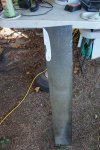
Blade pattern on 48X7" sheet.
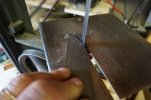
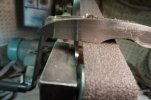
Cutting out blank
Trimmed
Center line scribed
 

Attachments

  • DSC00401 (682x1024).jpg
    DSC00401 (682x1024).jpg
    53.8 KB · Views: 81
  • DSC00405 (1024x682).jpg
    DSC00405 (1024x682).jpg
    44 KB · Views: 82
  • DSC00407 (1024x682).jpg
    DSC00407 (1024x682).jpg
    46.4 KB · Views: 80
  • DSC00408 (1024x682).jpg
    DSC00408 (1024x682).jpg
    53.6 KB · Views: 89
  • DSC00409 (1024x682).jpg
    DSC00409 (1024x682).jpg
    46.8 KB · Views: 89
Photos of blank:
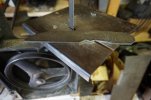
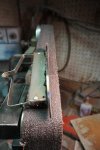
Cutting in distal taper
Distal taper shot
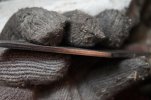
Cutting in basic bevels
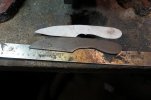
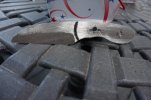
Finished shots
 

Attachments

  • DSC00411 (1024x682).jpg
    DSC00411 (1024x682).jpg
    43.1 KB · Views: 85
  • DSC00412 (682x1024).jpg
    DSC00412 (682x1024).jpg
    29.4 KB · Views: 92
  • DSC00421 (1024x682).jpg
    DSC00421 (1024x682).jpg
    48.3 KB · Views: 84
  • DSC00425 (1024x682).jpg
    DSC00425 (1024x682).jpg
    61.8 KB · Views: 96
  • DSC00426 (1024x682).jpg
    DSC00426 (1024x682).jpg
    60.4 KB · Views: 91
This is just too awesome. I am very excited and can't thank you enough! I hope I can do it justice for the remaining steps. Speaking of were you able to find that brown micarta? If not, no worries I can look into potential handle material.

Can't wait to see this in person!!!! :D
 
I'd just like to say that this thread is several levels of awesome. Stacy, you're the man. :thumbup:
OP - pics please when you git r dun. :D

He IS the man! AntDog, I plan to take pics of the progression. I will most likely be posting questions during the build that I hope people can answer and guide me in the right direction.
 
Photos and asking questions along the build are how to make a first knife come out well. Mistakes avoided are the ones you don't have to fix ( or live with).

I have several handle possibilities that I will be taking photos of in the next day or two. I think you will like the choices.

Read the sticky, "How to Instructions for Making a Knife". It will pretty much walk you through the next steps. Since the profile is done, distal taper added, and the basic bevel is set, you are ready to sand down the bevels to make a Full Flat Grind. That will be done with sandpaper and a hard wooden block. Clamp the blade down on a 2X4 with the knife edge at the board edge. Use a smooth flat stroke, lift the block, and make another stroke. Slowly work the bevel up to the spine and try not to reduce the edge thickness too much. Don't worry if it gets a bit thin, as that can be taken care of by sanding it back a tad before HT. Work both sides to get them even, then switch to the next grit. You will start at 120 grit, 220, the 400. At that point it will be ready for HT. After HT you will start again with 220, 400, 800, and then 1000. At that point it will be ready for the handle work. More on that later.
 
Thank you Stacy,

This is a great write up. I'm copying and pasting this section for reference:
"When sanding, cut the paper into strips, or fold it, and use a six inch long block of hardwood as a backing block.I cut 8X2" strips and use a heavy rubber band to hold the ends on the block. Get a small plastic tub or something that will hold about a quart of water for when you do the wet sanding. You will dip the block and paper in the water. Sand in one direction strokes. Most sanding should start at the ricasso and progress toward the tip. The initial sanding can be perpendicular to the blade ( spine to edge) but the finer sanding should always be parallel to the blade ( ricasso to tip). When changing grits in the coarse to fine range ( 50 to 400 grit) change the angle of each grit so you can tell the old sanding lines from the new ones. Don't move to a finer grit until all the scratch lines from the last one are gone. It is very hard to get them out later. They have a nasty habit of showing up again as you get to the fine grits. If you see a deeper scratch.....stop....and go back at least one grit until the scratch is gone....then proceed back up the sanding steps. Skipping grit sizes is not going to speed things up. Progress from the coarse grit to 400-800 for the pre-HT sanding. In final finish, the finer the grit, the better the blade looks. The rule of thumb is to double the grit size ( more or less) each grit change. That would roughly be 100,200,400,800,1000,1500,2000,4000,8000. When doing the final sanding many people sand dry to 800, then wet sand to 8000. With the 3M polishing papers ( the colored pack) wet sanding is not as necessary, but works very well if you go that route. wet sanding will give you a brighter and shinier final finish. Save the 3M papers for final finishing after the HT. They are super for getting the handle sanded and polished. When wet sanding, clean off the blade, the block, and change the water in the tub at each grit change. BTW, putting a 1/2 teaspoon of dish soap in the quart of water makes it sand better."

Is there a video of this process I can take a look at?

I found this video but I'm sure there must be better ones out there. If so, please let me know.

Here is one I found that I believe demonstrates the process around the 2:30min mark.

[video=youtube;_5LXpgSzKyQ]https://www.youtube.com/watch?v=_5LXpgSzKyQ[/video]

 
Hilarious video on so many levels.That same individual now makes knives with full blown cnc machinery.lol Good luck,Lu
 
Hilarious video on so many levels.That same individual now makes knives with full blown cnc machinery.lol Good luck,Lu

Thanks, Lu.

Not sure what's so funny though. Is it bad that someone makes knives using a CNC? Or are you laughing at the irony?

If anyone has better videos relevant to the next step, please feel free to post. Thank you!
 
Back
Top