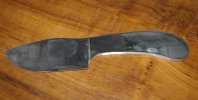
GniCr40Al4 Hunter

Stacy E. Apelt - Bladesmith

ilmarinen - MODERATOR
Moderator
Knifemaker / Craftsman / Service Provider
Joined
Aug 20, 2004
Messages
38,483
This is a hunter/skinner that I am making from hammerfall's Ni-Cr metal. Here are some preliminary observations:

It cuts on a band saw with a Lenox blade slowly, but otherwise no problem. The grit given off is very fine particles.
About like cutting D-2 or S30V.

The profile ground fairly easily with a fresh 60 grit blue Zirconium belt. The Cubitron belt was sluggish, so I switched.

It was slow going on adding the distal taper and main bevels. About like grinding hardened D-2. I was using the Blue Zirconium belts here. It took two belts to get the blade to the stage it is now. I finally discovered that pressing harder and letting the blade get red made it cut faster.Yes, it will glow red, about 1000F, but it gives off no sparks.

From my observations so far, this metal is not beyond the use of any experienced maker with a good and powerful grinder. I will take it to 400 grit and do the HT.

More to follow.
 

Attachments

  • GNiCr40Al4.jpg
    GNiCr40Al4.jpg
    40.6 KB · Views: 418
This is a Ni-Cr alloy and does not "air harden" as an iron and carbon stainless steel would.
The hardening process for this metal is called precipitation hardening or age hardening. It involves holding the metal in a controlled oven at 1200F/650C for six to ten hours.

The short periods of time spent at red during the grinding will not do any hardening.
 
and this thing is pure diet, it has 0 carbon. so we don't need to worry about the surface to decarb during heat treat. also it resistes the oxidation very well too even at 1200 C. the sample sent to the testers are after 1 hour 1200 C solution, very little oxide layer on the surface.
 
This is a Ni-Cr alloy and does not "air harden" as an iron and carbon stainless steel would.
The hardening process for this metal is called precipitation hardening or age hardening. It involves holding the metal in a controlled oven at 1200F/650C for six to ten hours.

The short periods of time spent at red during the grinding will not do any hardening.

the perfered heat treat range is 610~650C. i usually would suggest at 630 C. however if you have a accurate oven, 650C will be no problem either.
 
Sounds like you want to totally finish the blade before HT, then just a little cleanup afterwards. Especially since it gets mondo wear resistant when hardened.

I wondered if you were going to flat grind yours. I think I'll hollow grind mine then to see what that's like. Are you going to destruction test? Are you going to cut test it alongside a constant like S30V or CPM 154?
 
So the pieces went out already solution treated, and all that is left is aging? Is there any cold work in these samples?
 
I am really looking forward to seeing how this turns out! While procrastinating on my dissertation I've made a habit of looking through J-stor for articles about cool new materials; hoping that some of them could make for cool blades. Precipitation hardening nonferrous alloys can have some truly remarkable properties -- but most of them aren't quite right for knife makers. It's great to see that you're meeting with success here! Keep the updates coming!
 
Destruction testing will be of no use, as there is no HT to test. I will do a series of cutting tests, and perhaps have a hunter dress a deer with it.
 
I mean destroy it just to find out what it can take in terms of flex before snapping. I understand it has almost no plasticity to speak of but high elastic strength.
 
So the pieces went out already solution treated, and all that is left is aging? Is there any cold work in these samples?

yes, the pieces we sent were already 1200 C solution treated. and there wasn't any cold work done after the solution.

however additional coldwork can be done by bladesmith if you want to futhur increasing the hardness.
 
So one could cold forge the edge, and achieve a differential hardness. Edge packing for real!
[edit] is there a structure change upon cold work as in many cobalt alloys, or is the increased hardness due only to dislocations
 
Last edited:
Not edge packing at all , just work hardening the edge .Just like they hardened the edges of bronze and iron blades thousands of years ago.
Congratulations -- you've just reinvented the wheel !!
 
I'm interested to know whether you feel cobalt or carbide is warranted to drill with, and what types of finishing belt will cut this stuff. Is it gummy? Does it work harden under a bit easily like TI?

Other questions which are not really practical to figure out all on one knife:
How will it tap?
Mirror polishing?
Electro chemical logo etching?
How will it solder?

It also seems that cold forging along one edge only would set up stresses in the metal. Would the age hardening process relieve these at all?
 
Last edited:
So one could cold forge the edge, and achieve a differential hardness. Edge packing for real!
[edit] is there a structure change upon cold work as in many cobalt alloys, or is the increased hardness due only to dislocations

Mete or hammerfall will correct me if I'm wrong, but I think both statements are correct. Some aluminum alloys gain from cold work before aging treatments. The reason is the cold work creates more dislocations. These act as nucleation sites for the precipitates, promoting finer precipitates more evenly dispursed. So if cold worked, then aged, there is both a structural change and indirect improvement due to dislocations. This alloy sounds like it would have similar properties.

The cold work could contribute to hardness by itself, but it depends on the recrystallization temperature relative to the aging temperature. I have no idea what it is for an alloy like this. I suspect the aging temperature is below the recrystallization temperature, since it would be tricky for the dislocations to act as nucleation sites while the extra ones are being eliminated.
 
I can't help you there .If you can't get information from the manufacturer you'd have to do some experiments.
 
Mete or hammerfall will correct me if I'm wrong, but I think both statements are correct. Some aluminum alloys gain from cold work before aging treatments. The reason is the cold work creates more dislocations. These act as nucleation sites for the precipitates, promoting finer precipitates more evenly dispursed. So if cold worked, then aged, there is both a structural change and indirect improvement due to dislocations. This alloy sounds like it would have similar properties.

The cold work could contribute to hardness by itself, but it depends on the recrystallization temperature relative to the aging temperature. I have no idea what it is for an alloy like this. I suspect the aging temperature is below the recrystallization temperature, since it would be tricky for the dislocations to act as nucleation sites while the extra ones are being eliminated.

me2:
I think you are totally right.during the cold work, significant changes take place for the microstructure of ni-cr alloy. The grain could be elongated,somtimes deformation twins formed,and dislocation density increases greatly along with the work hardening,especially if under the conditions of heavy deformation,the very great concentration of dislocations form sub-grain boundaries.

The microstructure change after cold work mentioned above increase hardeness and leads to the anisotropy.but the alloy should not be used at the time because it is in an unstable state. So applied it to blades we need further aging.

during the aging treatment, occurs recovery then internal stress could be decreased or removed,and at the same time ,the γ'-Ni3Al particles and the cr-rich phase precipitates in the ni-cr alloy,the precipitates are nucleated preferentially at defects, such as dislocations and sub-boundaries.compared with the sample without cold work,the cold work alloy disperses finer distributed precipitated phases and obtain high hardness. also,you had better decrease the aging temperature a little after cold work.
 
Mete or hammerfall will correct me if I'm wrong, but I think both statements are correct. Some aluminum alloys gain from cold work before aging treatments. The reason is the cold work creates more dislocations. These act as nucleation sites for the precipitates, promoting finer precipitates more evenly dispursed. So if cold worked, then aged, there is both a structural change and indirect improvement due to dislocations. This alloy sounds like it would have similar properties.

The cold work could contribute to hardness by itself, but it depends on the recrystallization temperature relative to the aging temperature. I have no idea what it is for an alloy like this. I suspect the aging temperature is below the recrystallization temperature, since it would be tricky for the dislocations to act as nucleation sites while the extra ones are being eliminated.

hi me2.
i think the first thread i posted on bf has a brif explaination on this.

well i was trying to avoid type a wall of text to explain things. from my old forum experience, many people get annoyed by that and just quit reading. but here on bf you guys seems want to know everything lol. so here INCOMING!!! WALL of TEXT!!

The hardening machenism of the alloy is general caused in 3 ways.

First, during the aging the Ni3Al phase separate out from the prime phase, causing the strain which creat a field of stress strengthen and harden the alloy.

Second, if the Ni3Al and other dispersed phase located on the path of the line of dislocation then the Line of Dislocation will be able to cut through the dispersed phase. when this occures, the line of dislocation has to overcome the strain caused by ni3al. also the dispersed phase which cut in two has its surface energy increased. Thus created th energy field in antiphase domain. Which also strengthening the metal. here this mechanism can be caculated as: τ∝f^(1/2~5/6) x r^1/2. f is mass %of percipitation phase. r is radisu of that phase. when f is a constant, greater the r is the greater strengthening potential is. when the size of phase is a constant, then more they are the greater strengthening potential is.

Third, if the dispersed phase is very hard that can not be cut through by the line of dislocation, then the line will twist and circling arround the dispersed phase. Causing a loop on each of the duspersed phase, great increasing the degree of dislocation. Causing the alloy to be hardened futher. this mechanism can be caculated as: τ(twist)=2Gb/L, τ(twist)∝αf^1/2r^-1. α here repersants 2 constant:0.093 and 0.14, it depends on the type of dislocation.

cold work deformation will cause large degree of dislocation accumulated into sub-grain boundary. it lower the recrystalization temperature into the aging range by increasing the strain energy. once recrystalized during the aging process, it will tremendously refine size of dispersion phase. the hardness increasing after coldwork is mostly due to the refinement and higer dispersion of precipitates phrase, also combine with grain refinement. and the recrystalization temperature is not a constant number. it shapes with deformation rate. when we look into the mechanism, everything turns into the very basic. and here is a simple matter of energy conversion. more elastic strain energy granted during cold deformation, less energy is needed for recrystalization to occure. thus lower recrystalization temperature.

for example, this cold roll GNiCr40Al4 alloy from 5 to 3mm lower the recrystalization temperature into aging range 630~650c. greater the elastic strain energy is, the lower the temperature for aging and recrystalization. when hit 90% deformation, age it at 610c.

btw, me2 did you get a test sample from xiachu? if you did, cut it into 10 piece. hammer it into 4.5mm, 4mm, 3.5mm, 3mm...0.5mm. ageing those samples and you will see each of them has a different recrystalization temperature. lol and do not shoot yourself when you see the electricity bills for weeks of controlled aging.

 
Last edited:
me2:
I think you are totally right.during the cold work, significant changes take place for the microstructure of ni-cr alloy. The grain could be elongated,somtimes deformation twins formed,and dislocation density increases greatly along with the work hardening,especially if under the conditions of heavy deformation,the very great concentration of dislocations form sub-grain boundaries.

The microstructure change after cold work mentioned above increase hardeness and leads to the anisotropy.but the alloy should not be used at the time because it is in an unstable state. So applied it to blades we need further aging.

during the aging treatment, occurs recovery then internal stress could be decreased or removed,and at the same time ,the γ'-Ni3Al particles and the cr-rich phase precipitates in the ni-cr alloy,the precipitates are nucleated preferentially at defects, such as dislocations and sub-boundaries.compared with the sample without cold work,the cold work alloy disperses finer distributed precipitated phases and obtain high hardness. also,you had better decrease the aging temperature a little after cold work.

:thumbup::thumbup::thumbup:this had explains everything.
 
Back
Top