Grinding diagnosis/troubleshooting requested

Joined
Sep 16, 2002
Messages
1,577
This is about the 6th blade or so that I've ground on my Craftsman 2x42 grinder. I recently had the opportunity to visit another local maker, and for the first time ever got to watch someone grind a blade and I picked up some helpful tips that really helped me out a lot.

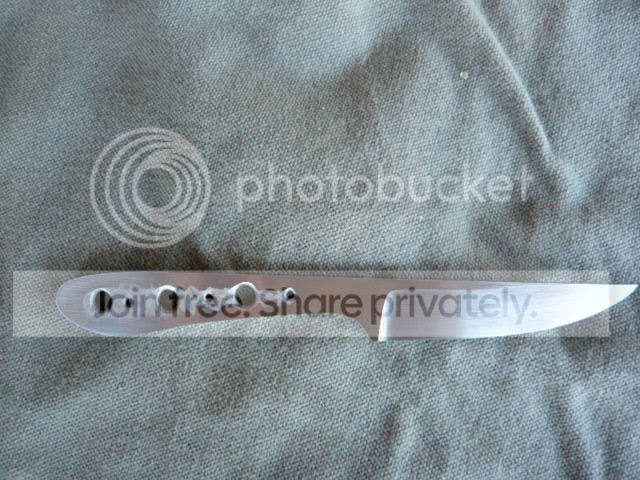
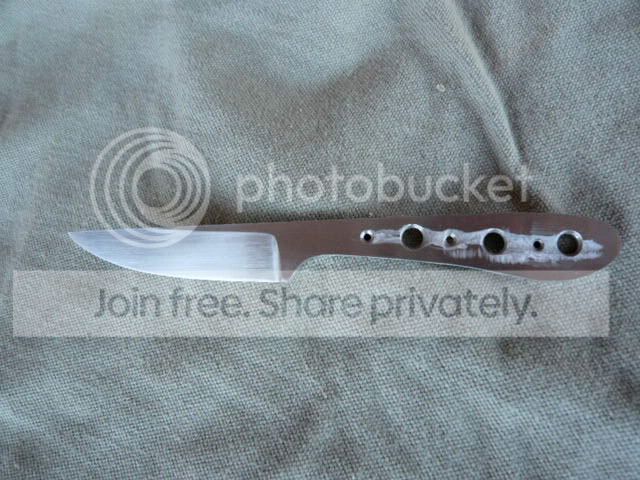
I'm quite pleased overall with how this one turned out with the exception of the right side of the blade, where the grind line sort of jumps up higher out towards the tip. I'm wondering what may have caused this, if anyone can tell from looking at it.

Thanks in advance for any input!
P1000003.jpg

P1000006.jpg
 
Paul, you're right handed? You weren't moving the blade in "exactly" the same manner as you did on the other side. I generally grind the right side before the left because I'm right handed. I can match up the "left handed" grind easier that way. I'm also guessing that you were "dropping" the butt of the knife as you got towards the tip instead of pulling it straight towards you. I dunno if that makes sense. Basically I'm guessing that you were moving the grind more diagonally on the right side at the end of the grind compared to the left side of the blade.

Grinds look very goog though, just match them up and you'll be fine! :thumbup:
 
Looks good to me. Its hard to see what you are talking about in the pictures but if it is what I think, the blade probably wasn't flat on the platen at that point. Ken Coats showed me a helpful tip for keeping both sides even. If you take the blade, tip towards you and edge up, and look at it with a white backing and even light on both sides, you will see any difference in one side or the other. Another one is to get two straight edges, planer blades work well for this, and lay them on the blade lengthwise holding them tight to the ricasso you can see the gap on both sides really well. Assuming your ricasso is even, you can really see any differences. With this method you could also probably measure the difference if you were so inclined. Usually, just by looking, you can tell if one side is heavier than the other.

Blade looks really good though. Looks like your plunges are nice and clean. Great job!
 
PJ,
I have a Craftsman 2X42 also. I think your grinds look pretty good. I do see the difference you are concerned with. Looks to me like the difference is the simple fact of changing from one hand to the other when grinding. I am sure you do not write as well with one hand as the other and for sure not identical. The more blades you grind the more simular the grind lines should get.

Due to the speed of the Craftsman, which can not be altered, it is difficult to control your grinds as you move to higher grit belts. With the Craftsman I never have gone higher than 120 grit because of the speed. After this I do a little draw filing to clean up the grind and then onto the sand paper.
 
After staring a little longer....

Notice that your plunge on the right side is slightly angled more than the other? You were grinding with a different angle from one side to the next, course I think think I've already said that but ah well... err yeah, it's getting late and I have a sheath to finish. :(
 
Will, Garrett, and Paul,

Thanks for your inputs! I'm sorry for the crummy pics, but if you follow the top grind line on the right side (bottom pic, I think that's considered the right side) out towards the tip, it jumps or steps up right at the last 1/4" or so. I don't remember for sure, but I do believe this defect was around for a while and not a one time oops/goof on the belt.

I should have mentioned that I ground the left side (top pic) before visiting the other maker, and the right side after so they were done at different times. The different angle of the plunge may be just the photography, but it may also be explained by grinding at different times and using different techniques.

One possible explanation or theory that I had was that maybe as I approached the tip on the right side, I was pulling the butt out too soon or too abruptly, causing the step. Is that the proper way to get the tip thinned down, by the way?
 
Well ummm I kinda forge in a distal taper :p but yeah, pulling the butt towards you is how I was taught and how I taper towards the tip.
 
Paul- It's looking really good!

There are many things that can throw off your grinds.

One thing to watch, is if your platen it set up so that the belt is running in line with it. Make sure the belt is backed evenly.

Watch belt drift. Lots of guys put a radius on their platen edges. I used to, but ended up finding I have better control with square edges and just drifting the belt off the edge a little. I only drift it over about 1/16" AT MOST.

That's just me. :)

The problem with the bevel is all about pressure. Direct pressure right where you need it... back off where you don't need it.

This is MUCH easier to dial in if you grind off the toolrest like I do and use a push-stick. Come to my shop, and I'll show you how ;) :)

Keep it up Paul.... you're doing awesome! :) :thumbup:
 
Here is a useful tip:

While grinding with your strong hand, pay close attention to how you're holding the blade with your strong hand and supporting it with your weak hand. Study what you're doing. Then when you switch to the other side take note how you're holding the blade. I'll bet it isn't the same. You need to force yourself to hold the blade and support it the exact same way for both sides. And I will bet your problem is coming from the way you support the blade.
 
The other thing is the dreaded "p" word.... practice :p You've got a freaking awesome start there. I don't know if I can grind that well now :( Get a few more blades under (or on) your belt and you'll be teaching us. :thumbup:
 
Looking good! I too use a squared non rounded edge platen. I still have this problem and the advice here is what I try to do as well. Keep it up!!
 
I've never had much luck grinding off of a work rest, I wasn't taught to use one though. I may have to cobble one up for the BK and try again.
 
I've never had much luck grinding off of a work rest, I wasn't taught to use one though. I may have to cobble one up for the BK and try again.
I cant do it either. Trace Rinaldi talked to me about grinding that way and I really goof things up. Grab and Go is all I can get a consitant grind with. Are their tips to using a rest other than practice?
 
Well I'm sure someone will tell me what I tell everyone... practice :p I dunno... maybe there is some technique to it. I'd like to watch someone use a rest to grind so I can better see how they do it.
 
These guys are all just yanking your chain.

The problem is steel mites. They are microscopic psuedo-biotic forms with an incredibly stong spider web like material, and a warped sense of humor. They migrate to whatever area of the lade appears to be the spine and tug pressure toward the belt (kind of like moth to a flame).

They exist everywhere. That is why you see so many "full to the spine" grinds. If you ever see a perfectly straight flat grind, either the maker is using a jig, or you are looking at a Thomas Haslinger blade. :)

Rob!
 
Amen on that, Rob. One thing I've tried to cure myself of is getting the knife off-plane from the platen. Basically, if you dig in more on either side of the platen, your grind line will step up higher on that same side. Keep the knife square with the platen to keep those grind lines straight. Watch your sparks and make them come off of the middle of the belt. I also use a squared edge platen.

--nathan
 
I was tired when I posted last night, so I apologize for leaving out some details. I'm glad to hear the problems aren't caused by me but by steel mites!

I am right handed. The first side (left side, top pic) was ground 'freehand' before my shop visit, the 2nd side (right side, bottom pic) was ground using a push stick off a work table after my visit. I did, however, make some more passes on the first/left side using the table yesterday to try to even things up. This might explain any differences in plunge angles, but curiously that side grind line is quite straight, whereas the other has the issue.

My platen is a ceramic plate from Darren Ellis, with no modification to the edges (except the top and bottom ones.) The belt I used was fairly wobbly, but wouldn't that more affect the side grind line/plunge area than the top grind line?

As for holding the blade itself, I haven't paid much attention. I just read on Egnath's site recently a suggestion to hold the blade with vise grips. I haven't tried that yet, but that might help keep things consistant....I dunno.

Thanks for all the great feedback; I appreciate it!

Edit to add: Aside from the issue I posted about, I feel that using the work table has made a huge difference for me. Not only in the resulting product, but in the ease, speed, control, and confidence in getting there. I used to hold my breath every time I put a blade on my mach-speed Craftsman, hoping that bad things wouldn't happen (and they often did!) Now, I no longer feel that way at all and most passes off the table look and feel good.
 
Until you get better at it make a jig, thats what i did. The jig will take out all human error, I want to heat treat a couple so they will be more durable and slide on the platen better.The knives are really good other than a couplewiggles and wobbles.I have decided to skip hollow grinds for the first portion of my knife making.All these little things like jigs and brackets and braces modified hammers. The jig i use is fool proof and i use every time ginding till i hit the last grit like 320 or 400 what ever i decide hollow grinds are to hard but if you learn them first i guess you wouldnt know any different.
 
Amen on that, Rob. One thing I've tried to cure myself of is getting the knife off-plane from the platen. Basically, if you dig in more on either side of the platen, your grind line will step up higher on that same side. Keep the knife square with the platen to keep those grind lines straight. Watch your sparks and make them come off of the middle of the belt. I also use a squared edge platen.

--nathan

Thanks Nathan, if I understand you correctly this may be along the lines of the theory I posted above, ie. pulling the butt out towards the tip too early/too abruptly.
 
Until you get better at it make a jig, thats what i did. The jig will take out all human error, I want to heat treat a couple so they will be more durable and slide on the platen better.The knives are really good other than a couplewiggles and wobbles.I have decided to skip hollow grinds for the first portion of my knife making.All these little things like jigs and brackets and braces modified hammers. The jig i use is fool proof and i use every time ginding till i hit the last grit like 320 or 400 what ever i decide hollow grinds are to hard but if you learn them first i guess you wouldnt know any different.

I haven't tried hollow grinding yet, only flat grinding. For one reason, I don't have a real grinder that I could hollow grind on. I have strongly resisted making a jig, although I've had the advice several times in the past from others. It's funny, some things (like a grinding jig) I'm very stubborn about, whereas others things I'm very receptive too. I guess I feel that if I use a jig, I will never learn to do it freehand. I almost feel like using a work table is cheating in a way, but after seeing the other maker use it I decided to give it a try.
 
Back
Top