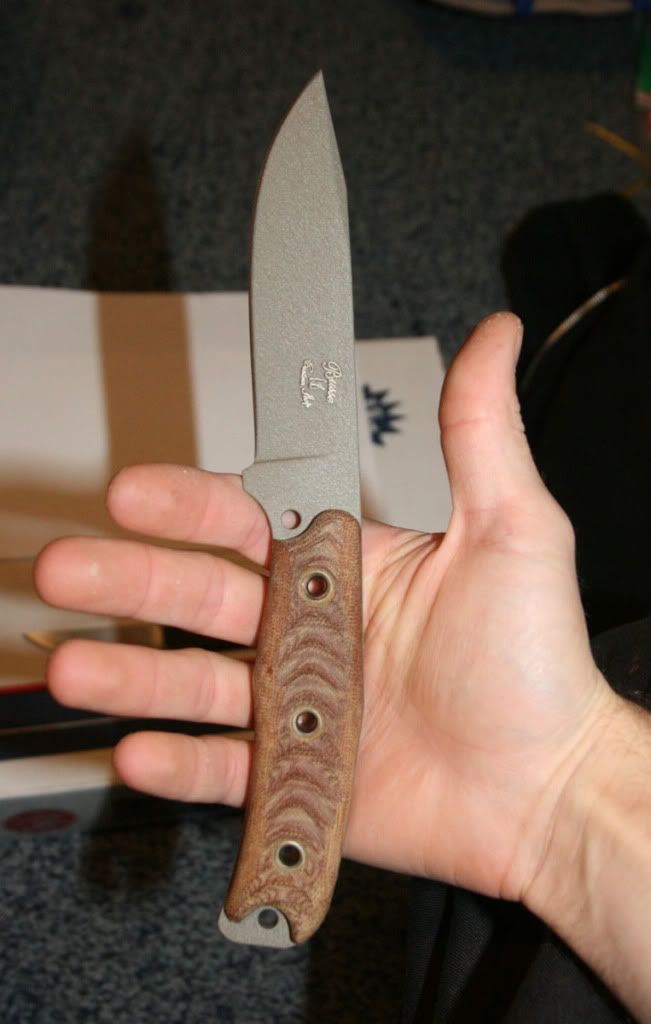
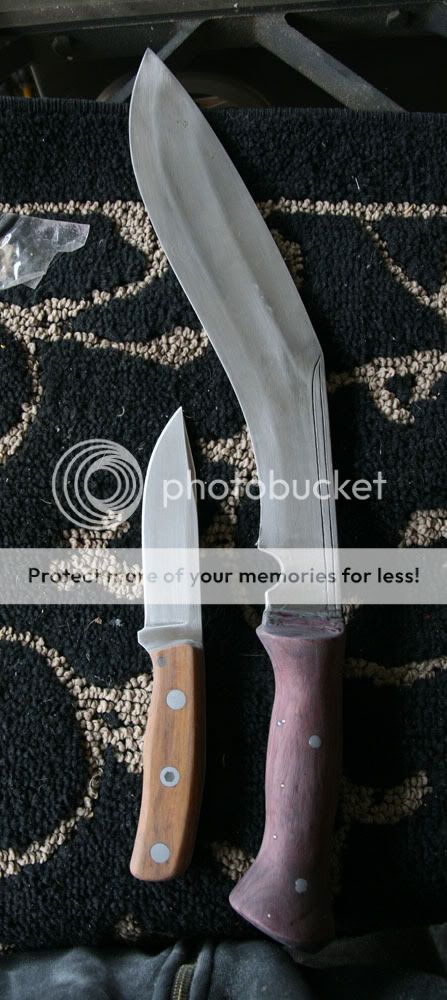
The tip to ricasso grooves of the corrugated bevel seen on the Hell Razor and CG FBM, while perhaps altering the blade's chopping ability, do increase the blade's resistance to lateral forces, making it more difficult to break the blade should you stick it in a tree trunk or stump, or bench vise, and pull sideways on the handle. Prying with a knife is not uncommon.
The edge to spine grooves, found on the M-O/R HG-55, while an interesting, perhaps unique, approach to the main grind for a blade, are another matter entirely. This type of CBT would work very well IF the main ("if the main", HAH! if ANY) expected stress to the knife were of the type encountered by clamping the spine or edge and hitting the exposed edge or spine, respectively, perpendicular to the plane of the blade in an attempt to split the blade lengthwise. Perhaps its me, but I have a difficult time imagining how reinforcing against that type of stress is any advantage as I cannot envision a scenario in which it might occur. I think it a safe bet to assume that not even Noss has tried to destroy a Busse in that particular fashion. Back to a much more commonly encountered stressor, prying.
Here is where the edge to spine grooves offer little other than an unusual appearance. Again, stick the hypothetical blade into a trunk, stump or vise and pull. Perhaps Jerry has alternated the grooves on each side so that the trough of one side coincides with the crest on the other, keeping the blade thickness roughly constant. Coupled with the saber spine, the wavy blade would make the stresses that result from prying interesting. I can visualize the blade failing at the "grind line". I suspect, however, that Jerry has kept the grind mirror image or bilaterally symmetrical so that the peaks and valleys coincide with each other. This makes the blade thick where the peaks match and thin where the valleys do the same. When prying, the blade is most likely to fail at the thinnest part free of restraint. With enough prying force, the blade will fail at the valley of the first groove not stuck in the trunk, stump or vise. Again, perhaps its just me, but I don't see the purpose of making a hard use blade with designed and built-in failure points, those being the trough of each groove.
Dead horse well and truly beaten to pulp.
RANT <OFF>
This one might be worth $0.03. Pete


 Hmm. That's certainly possible. It really depends greatly on the details of the knife's actual morphology -- what the grooves are really like and how they transition into the bulk of the blade itself. Careful design can certainly minimize bending and torsional stresses at those points.


 . . .
. . .