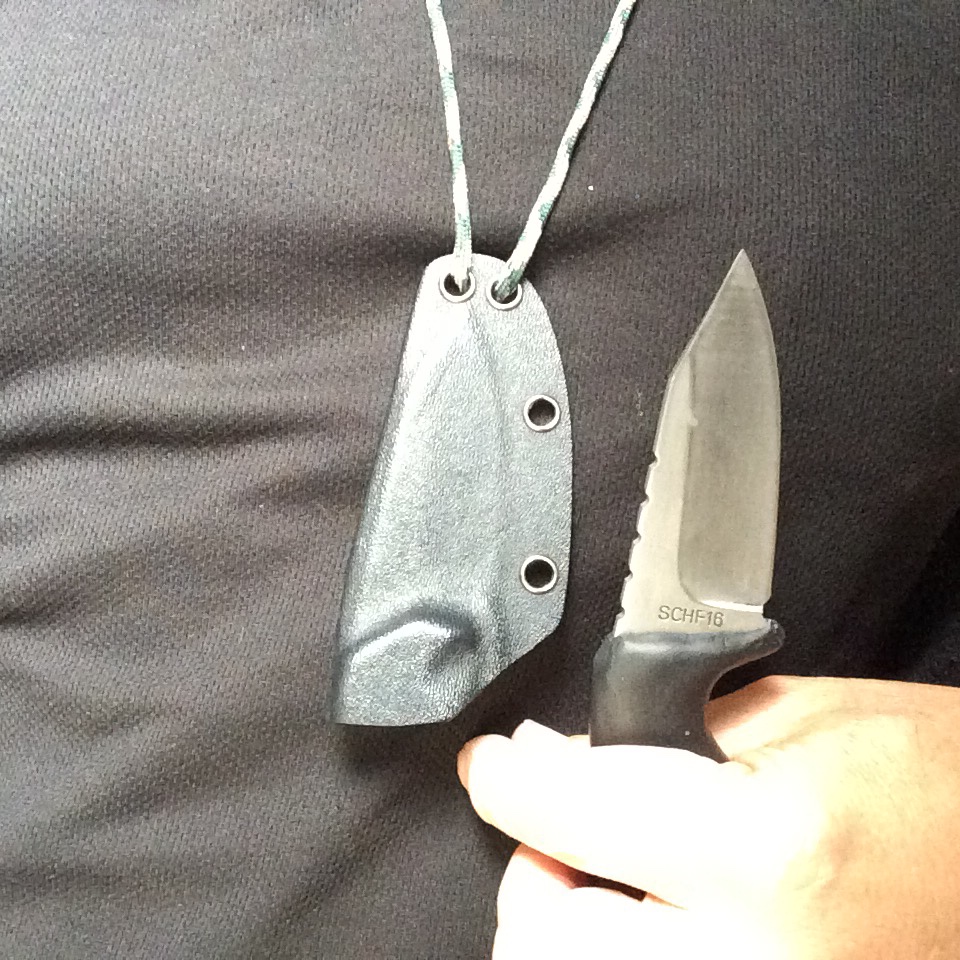
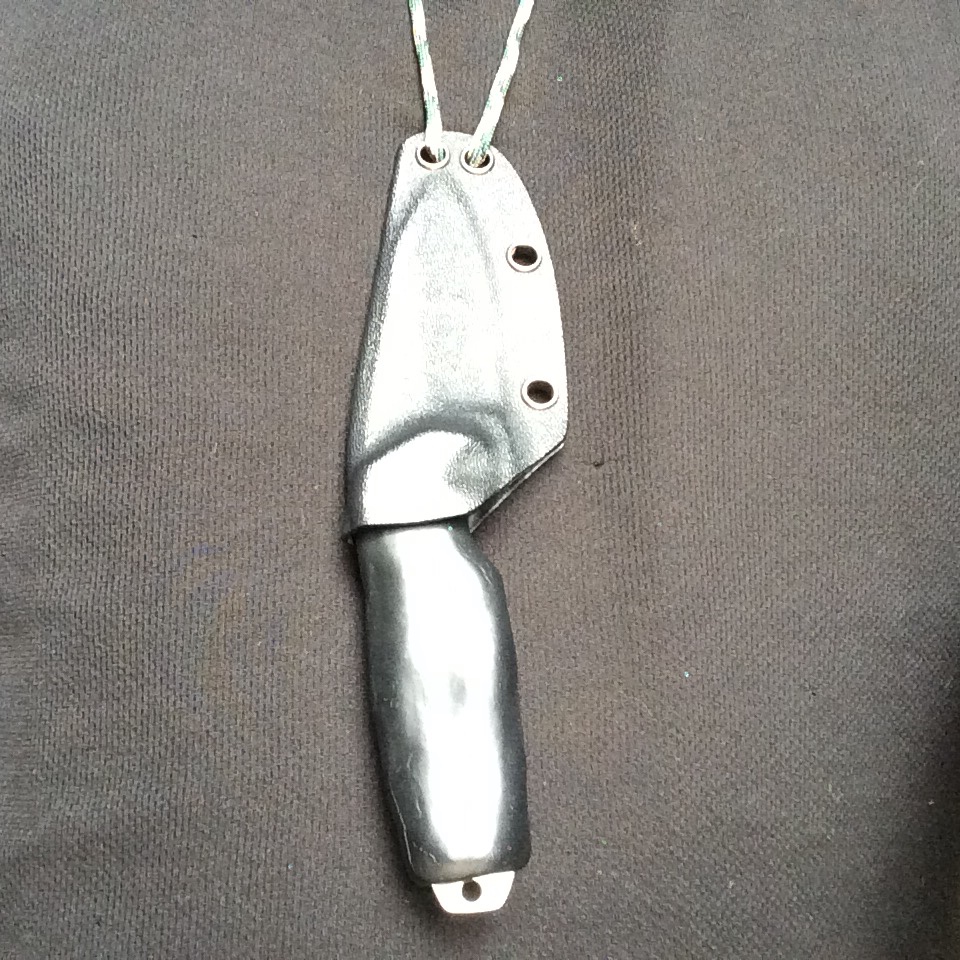
There's basically 3 ways to carry concealed long fixed blades (I don't see the point of carrying concealed short fixed blades):
1-Inside waistband front kidney position. Up to 16" OAL or 10.5" blade. The largest knives can only be carried like this.
2-Inside the waistband accross the lower back in a strong diagonal: Can go up to 14" OAL or 9" with surprising ease and confort, but bulges out the back when bending forward as when cycling. Going smaller than 9" is of no help, because the problem is the length of the handle, and shorter blades may even hurt the stability of the carry(!).
One universal rule to inside the waistband carry is that the thinnest sheaths are not the best, as they allow sliding around or "sinking", and the shortest blades below 7" are of no help, because shorter blades also offer too little contact area to be stable, especially across the small of the back.
3-Final and most tricky method is the opposite-shoulder around the neck elastic shoulder strap, wrapping around the back of the neck and going down the opposite side, usually stabilized with another elastic strap device with a "jaw clip" at the end: The knife is carried upside down: These can nowadays be found offered some with United Cutlery's Karambits, and I buy these low priced knives just for the strap...
This method is very weight sensitive, and blades over 7" draw poorly because, even if you are large, the reach of your arm across your chest limits the motion you can make drawing down and out: At 8" or more, the blade's edges and tip will always rub and dull themselves when curving out of the sheath with your arm motion.
Because this method is so weight sensitive, especially if the 1" wide strap is not widened with an add-on strap, handles should have minimal metal fixtures, and of course never be full-tang(!!!): All-Kraton or plastic handles are by far the best, which excludes most custom knives right off the bat. Even better is to go for a double edged dagger when nearing 7", as these shave a third of the weight to a typical single edge, just from the grinding and tapering tip profile narrowness: Typical synthetic handle daggers are 7-8 ounces to a similar fixed blade of 10-11 ounces, a huge deal after a whole day of hanging on a 1" strap.... Despite its hammer pommel, the most common suitable dagger I know of is the SOG Desert Dagger, or its derivatives, like the Junglee Waterloo. There may be current production knives with similar features or weights, but heavy metal handle fixtures are unfortunately common, and ruin the confort of carry from the shoulder.
Gaston