
HT Techniques and Procedures

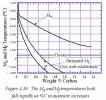
Willie71 - right. If you are not starting out with austenite you won't get anywhere. But going the other direction (into the quench) my understanding is that if you just barely get it below Ms then you get very little martensite and a lot of retained austenite - - - if you get it all the way to Mf (in the required time frame) then you get just about zero retained austenite. In between you get progressively more martensite and less retained austenite as you quench at progressively lower temperatures from Ms toward Mf. Here's a graph (from Verhoeven's public domain Metallurgy of Steel for Bladesmiths http://www.feine-klingen.de/PDFs/verhoeven.pdf) that shows the spread between Ms and Mf for various %C amounts. If I am misunderstanding metallurgy please point me to the appropriate document.
MsMf.jpg
p.s. This graph has temp in C rather than F
 
Good information there on the graph.

I was rereading some of this thread and wanted to get a little clarification from Mr. Burke. Did I understand what you wrote correctly when I read that for your blades, the blind test that determined triple quenching was superior used the HT procedures for a different steel than the steel in the blades?
 
I looked this up in my metallurgy text last night, and all the references there show Mf to be done at 100-200f in carbon steels. Its different in stainless. I'm not sure why this graph shows different temperature ranges. The article you linked suggests that in carbon steels over 0.4%, cooling as we currently are encouraged to will retain in a fair amount of retained austentite. As you noted, sub zero temps are required to get to the highest percentage of martensite, with minimal retained austentite. My question becomes: what is the timeframe that this would need to happen? If we cool traditionally in heated oil, then immediately cool to sub zero, would that be fast enough, or is the transformation "locked in" where we stop our traditional quench? This seems to be more of an issue with 1095, 52100, W1, W2- where carbon is hypereuctoid. Unless the alloys in 5160 change the isothermal transformation to make it more like the hypereuctoid steels, it probably wouldn't benefit much from the sub zero quench. This seems a plausible explanation of the increased hardness in 52100 with freezer cycling. Thank you for this. It shows the folly of blindly accepting ANY viewpoint, regardless of the perceived expertise of the source.
 
Last edited:
Willie71 - right. If you are not starting out with austenite you won't get anywhere. But going the other direction (into the quench) my understanding is that if you just barely get it below Ms then you get very little martensite and a lot of retained austenite - - - if you get it all the way to Mf (in the required time frame) then you get just about zero retained austenite. In between you get progressively more martensite and less retained austenite as you quench at progressively lower temperatures from Ms toward Mf. Here's a graph (from Verhoeven's public domain Metallurgy of Steel for Bladesmiths http://www.feine-klingen.de/PDFs/verhoeven.pdf) that shows the spread between Ms and Mf for various %C amounts. If I am misunderstanding metallurgy please point me to the appropriate document.
View attachment 351102
p.s. This graph has temp in C rather than F

From my reading it becomes more complex. I understand that the rate at which steel is cooled from Ms towards Mf has an impact upon the amount of martensite at any given temperature.
 
I have found this to be quite an interesting thread and I commend those who have read the books and studied all of the data on exactly what will and what won't work when it comes to metallurgy and heat treating blades. I am sure you make fine knives that meet your criteria and I do not mean that in a derogatory way. Everyone has their idea of what they expect of their knives and it's not all the same which is what makes the knife world so interesting.

What I don't understand is why you feel you must publicly denounce what another person has proven to work for them in meeting the objectives or standards they have set out to meet. Don't expect them to show scientific proof of everything. If you don't think it works then spend as much time, effort and money as they did in developing it and then PROVE them wrong. Just because it says in a book that x doesn't equal z doesn't mean that there's not something else in the equation. After all it was strongly believed and probably documented at one time that the world was flat!


Some of you may know me and who I have apprenticed under and continue working with and I am sure that anyone that doesn't will be able to figure it out very shortly.


I personally have a very limited knowledge when it comes to metallurgy so I won't even attempt to debate that subject.

What I would like to bring into this thread is the recent testing of one of my blades.

I was invited to attend a hammer in last month and was asked by the knifemaker hosting it if I would mind doing a forging demonstration and talk about 52100 and how to get the best performance out of it. He also put me on the spot and said he wanted me to test a blade that had been made using the methods that I use (which I learned from the person at the brunt of this thread). I gladly accepted.

Since it was only a 2 1/2 day event there was no way that I could forge and heat treat a blade there and test it so I took one of the blades that I was getting ready to finish up for my table at Blade and decided to test it to destruction.

I hated to lose a knife that I could have on the table but I knew it would be a very worthwhile sacrifice.

I test every one of my blades before I finish them with a guard and handle. I do a complete edge flex the full length of the blade alternating sides and expect them to do a total of 8-10 without chipping out or rolling of the edge. Next I cut test on a 3/4" hemp rope and do 50-100 cuts to make sure it doesn't start to dull. I often see how many I can get before it starts to dull and usually get 700+ cuts.
This knife had already been through those tests and did 8 edge flexes and 100 cuts.

For the demonstration I began by doing 300 cuts on the 3/4" hemp rope and let everyone feel the edge. That made a total of 400 cuts that it had done. There was no dulling. I next set the knife up in the vise and attached a jig so a torque wrench could be used to see how much lateral force it took to flex the blade.
I flexed the blade to 90 degrees and it took 65ft.lbs . I reversed the blade in the vise and flexed the blade completely 180 and it took just under 70ft.lbs

I continued flexing the blade back and forth 180 degrees for a total of 30 times and the torque readings remained constant at 65-70ft.lbs. After 30 flexes I gave up and straightened the blade. There are no cracks or stress risers in the blade. . After I straightened it I did another 100-125 cuts on the rope and it's still sharp.

I can't explain the metallurgical aspects or if the fact that I stand with my left foot forward during forging and heat treating with a toothpick in the right corner of my mouth has any bearing on how my blades will perform but I do know that this is REAL proof that the forging and heat treating methods in question really do work and produce the results that I desire and advertise.

I want to thank everyone for not saying the name of the individual whose methods are in question so as not to hurt his feelings. I am sure he would be crushed that someone is saying that he is full of BS and doesn't know what he's talking about.
 
Last edited by a moderator:
Deveraux - nicely put. I have not seen these blades in person - only in video - but I feel comfortable trusting the honesty of the smiths involved. What is being done does not violate any metallurgical theories I've read, and (trusting the honesty of the smiths involved) it produces repeatable results that are notably different than simpler HT processes. If you want the type of hard-use knife this is designed for, using 52100 with these HT methods certainly seems worth exploring.

If you want the "spring back from 90degrees" that another masterful smith gets with his chef's knives then this would not be the steel and HT method to use. But that would not make a very helpful camp knife.

We don't all have to make the same knife using the same techniques.
 
Last edited:
Michael, I make many chef's knives and most of them from 52100 and I was one of the two people who taught Deveraux this heat treating method. This is the same method I use on all of my knives including the chef's knives and they will bend 90 and spring back to straight. Also if you are talking about Kramer knives then this is the steel he uses for his carbon knives and last I knew he was using a triple quench also.


Deveraux - nicely put. I have not seen these blades in person - only in video - but I feel comfortable trusting the honesty of the smiths involved. What is being done does not violate any metallurgical theories I've read, and (trusting the honesty of the smiths involved) it produces repeatable results that are notably different than simpler HT processes. If you want the type of hard-use knife this is designed for, using 52100 with these HT methods certainly seems worth exploring.

If you want the "spring back from 90degrees" that another masterful smith gets with his chef's knives then this would not be the steel and HT method to use. But that would not make a very helpful camp knife.

We don't all have to make the same knife using the same techniques.
 
Bill Burke - thank you - I stand corrected!

The video I'd seen of the knives made with the method being discussed did not spring back from the bend - they "took a set" and could be bent back and forth dozens of times - but did not spring and did not chip. It is interesting that a triple-quench can produce knives that both take-a-set and knives that spring back from a bend.

Now I definitely have to experiment with multiple thermal cycling and multiple quenching!
 
Bill Burke - thank you - I stand corrected!

The video I'd seen of the knives made with the method being discussed did not spring back from the bend - they "took a set" and could be bent back and forth dozens of times - but did not spring and did not chip. It is interesting that a triple-quench can produce knives that both take-a-set and knives that spring back from a bend.

Now I definitely have to experiment with multiple thermal cycling and multiple quenching!

I am guessing that the knives that spring back from a 90 degree bend are fairly thin while those that are thicker will take a set??
 
Flex and bend are two completely different beasts that many folks seem to lump into the same category. I do not have a problem with the performance of certain smith's knives but rather the explanation they provide as to why they perform the way they do... Or more importantly... the emphasis they place upon knives needing to perform in the same manner. There are many smiths who use the same process to make blades that I have no quarrel with... because they do not speak beyond their understanding of the metallurgical principle. I only get upset in the face of what I feel to be misinformation.
 
Flex and bend are two completely different beasts that many folks seem to lump into the same category. I do not have a problem with the performance of certain smith's knives but rather the explanation they provide as to why they perform the way they do... Or more importantly... the emphasis they place upon knives needing to perform in the same manner. There are many smiths who use the same process to make blades that I have no quarrel with... because they do not speak beyond their understanding of the metallurgical principle. I only get upset in the face of what I feel to be misinformation.

I agree with you there Rick.
 
Rick, "the emphasis they place upon knives needing to perform in the same manner."

Because it's the same emphasis that some people place on making a car that will go over 300 mph or a rifle that will shoot over a 1000 yds, or a knife with expensive exotic materials and designed with no intention of ever being used as a cutting tool.

We do it because that is what we enjoy doing.
 
Nicely put, Butch.
Sometimes, that's all the reason we need.
If a knife and our methods meet our requirements, who is anyone else to judge it?
The "market" will filter out those makers whose knives don't cut the mustard.


We do it because that is what we enjoy doing.
 
Because it's the same emphasis that some people place on making a car that will go over 300 mph or a rifle that will shoot over a 1000 yds, or a knife with expensive exotic materials and designed with no intention of ever being used as a cutting tool.

We do it because that is what we enjoy doing.
Please don't misunderstand me. I am not criticizing how you make or test your knives. I only have a problem with certain bladesmiths who would go as far to tell you there is only one way to skin a cat.... and it so happens to be THEIR way. I think you and I are in agreement, here. Some folks like fast racecars, other prefer off-road jeeps. It would be silly for a Jeeper to criticize a Porsche enthusiast about ground clearance and vice-versa.

I don't want a knife that bends. I don't consider the ABS performance test to be the benchmark of a good knife but rather a test of the maker's ability to control aspects of his/her craft... that is just my opinion. I consider my knives to be hard use blades and did a lot of testing to get them to perform the way I want/need. I find it offensive when a well known bladesmith throws blanket statements that knives, not made his way, will fail at their intended purpose....................... NO.... he means HIS intended purpose.... not mine. I also have a problem when makers use pseudo-metallurgy to explain things. It is obviously forgivable if the person is just doing the best they can with the info they have at the time.... but I have seen/experienced things that lead me to believe otherwise, with regard to the intent of some folks.

Nicely put, Butch.
Sometimes, that's all the reason we need.
If a knife and our methods meet our requirements, who is anyone else to judge it?
The "market" will filter out those makers whose knives don't cut the mustard.
Well said, bud..... what!... no O-Row this year? See you next week!
 
Last edited:
The most amazing thing to me is not the claims being made but rather the lack of other independent testing duplicating the methodology and publishing the results.

A lot of knifemakers have the tools to test 52100 in the same manner and share their results, yet there seems to be only one side putting out their findings on that method.

I am interested in seeing the conclusions others come to when they replicate the method.

The best way to prove something wrong is to actually prove it wrong.
 
When it comes to performance claims like "My knives bend, not break" I need no more proof than a video of a knife bending and not breaking. When someone claims that they get metallurgical benefits, beyond what is expected, I want to see data backing that up. You can't peer review theories/claims that are hovering around in partial posts and magazine articles. Personally, I am not trying to prove anybody wrong. The burden of proof belongs to the one who is making the claim.

IMO, the controversy is not about the performance claims... that is easy to validate.
 
Last edited:
It's not just YOUR opinion, Rick. It's a fact.
It has always been a test of where, how and when the blade is hardened and tempered and the degree of control the maker is able to exhibit over his blade.
The test of that ability can only be determined in the FLEX! test. (It's not a bend test.)
It is such a misunderstood aspect of the "Performance Test".

I know I am the 'Leader' of the "0-Row Dudes", but I had the opportunity to take a 6 row leap to the front of the class, so I took it.
And my buddy, Don Hanson, with whom I shared back-to-back tables the last three years, moved entirely to the Hand Made Section.
So, I'm hanging up my 0-row Dude hat and am going to see what's going on with some new faces.
Carry on, Dude. :thumbup:
I don't consider the ABS performance test to be the benchmark of a good knife but rather a test of the maker's ability to control aspects of his/her craft... that is just my opinion.

Well said, bud..... what!... no O-Row this year? See you next week!
 
Last edited:
Bo-T - yep, the camp knife that bends is thick and the chef knife that flexes is thin - but I expect that has as much to do with differences in the HT of the two spines as with the thickness of the spines (a guess on my part).

AVigil - It's my impression that other smiths have duplicated the camp knife performance using the stated process.

Rick - point well taken on "the best way to make a knife" really being "my best way to make a knife for my intended use".

That and getting independent verification of the grain size achieved seem like the only substantive issues. Other than that I don't see what the big brouhaha is.
 
AVigil - It's my impression that other smiths have duplicated the camp knife performance using the stated process.

.

I have read of those who tried the method and report they are finding similar results.

I am interested in hearing from those who replicate the method and reach other conclusions.
 
I have read of those who tried the method and report they are finding similar results.

I am interested in hearing from those who replicate the method and reach other conclusions.

I have seen one report where forged 52100 was out cut by AEB-L/13C26. Both were HRc 61, with similar microstructures, ie tempered martensite with small carbides. The forging was done by an ABS Master Smith. The AEB-L was taken as supplied from the manufacturer. The grain size of the 52100 was ASTM 13. The AEB-L was not measured. The AEB-L also out cut blades made from 1084 at similar hardness and grain size as the 52100. All the blades were heat treated using salt baths instead of forges or torches.
 
Back
Top