
- Joined
- Dec 13, 2005
- Messages
- 6,105
That's a very simple and good looking field sharpening kit! Kudos for the idea, I'll have to steal it for myself if you don't mind!

The BladeForums.com 2024 Traditional Knife is available! Price is $250 ea (shipped within CONUS).
Order here: https://www.bladeforums.com/help/2024-traditional/
America has reached 250 years, and I am grateful to be here, in the best country in the world. Thank every one of you who helps make this country a better place, those who have gone before and risked it all, and those who've paid the ultimate price to make the United States what we are today.
Happy Birthday America! Let Freedom Ring for all time!
I'd agree that in general it's probably easier to get a really fine edge in a scandi grind than a convex. However to give the other side in general your average convex edge is going to be a bit more resistant to rolling and chipping than your average scandi.
I have a major prejudice against Scandis. I think they are about as crude a knife as one can get. Essentially, a bit of bar stock with an edge dubbed on. Drill a couple of holes to poke pins through and lay on some epoxy and that's it, job done. All the pleasing features of poise, balance and taper are pretty much incidental. They are the kinds of things a prisoner might make. They are very popular here with the reenactment people though. That makes a certain amount of sense to me because the bulk of the reenactment stuff they do calls for using the knife as a chisel, and it's an ideal choice for that. As a field knife rather than a reenactment / bushcraft tool they don't cut it for me though.

Any chance of seeing a pic of said jig? I'm curious.


h,mm lets see some of yours if its that easy.

It doesn't matter in the slightest that you should prefer to avoid an edge type, if you've found what works for you. :thumbup: If you're still interested in 'trying' more convex edges, I think you ought to give David Farmer a try. His edges are fantastic and he can work with you a lot on what you want in a knife. :thumbup::thumbup:
my vote goes to convex...
its easy to put on in the first place, its easy to maintain and you can have a convex that chops like an axe or that slices like a filet knife...
the cutting ability really comes down to how thin the edge is and how flat the sides of the convex are. i understand that the aurora is more of a saber convex grind that is smoothed into the flats nicely, so really its like a convex scandi grind. haven't held one, so can't comment directly, but that's what i've read.
i love the way scandis cut but i can't stand sharpening them. its so much easier to do a quick stropping on some sandpaper and then a strop with compound than take out the benchstone and lay up the angle and take strokes. maybe i'm just spoiled since i got my belt sander, but it just seems like it takes forever to sharpen a scandi. i think its because you have to take off so much metal.
gazaati, for convex field sharpening, try one of these. they are easy to make and you can carry a ton of different grit sandpapers inside. you can even glue a strop to the back if you want.
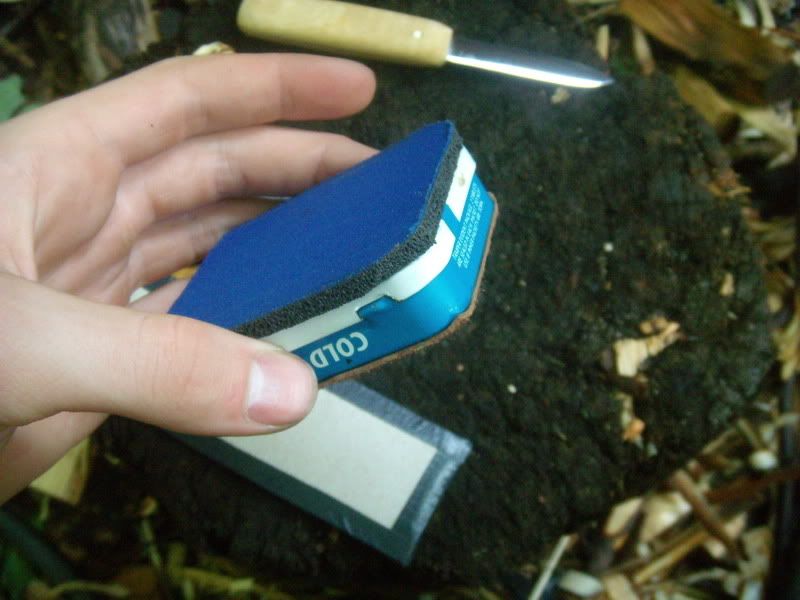


as for how it performs in wood...i find that every knife performs slightly differently in terms of the angle that you have to cut with in wood. my first several cuts are often lousy and uncontrolled with a new knife...it takes a minute to figure out the angle. if you tilted the aurora up a few degrees, you might do better cutting the wood.
if none of this works for you or you are past trying again...then enjoy the scandis! they are great cutters and they are stout too.
I think he has a picture in his forum, but since I can't use "search" here, here's a jig pic from British Blades
http://www.britishblades.com/forums/showthread.php?t=35912&highlight=scandi+grinding+jig

Lets forget sharpening.
I found that my aurora keeps slipping off the wood and its still shaving sharp it could slice paper. The edge was too fat to properly sink inside hard wood.


I have a major prejudice against Scandis. I think they are about as crude a knife as one can get. Essentially, a bit of bar stock with an edge dubbed on. Drill a couple of holes to poke pins through and lay on some epoxy and that's it, job done. All the pleasing features of poise, balance and taper are pretty much incidental. They are the kinds of things a prisoner might make. They are very popular here with the reenactment people though. That makes a certain amount of sense to me because the bulk of the reenactment stuff they do calls for using the knife as a chisel, and it's an ideal choice for that. As a field knife rather than a reenactment / bushcraft tool they don't cut it for me though.
