
-
The BladeForums.com 2024 Traditional Knife is available! Price is $250 ea (shipped within CONUS).
Order here: https://www.bladeforums.com/help/2024-traditional/
You are using an out of date browser. It may not display this or other websites correctly.
You should upgrade or use an alternative browser.
You should upgrade or use an alternative browser.
I Want A New Grinder
- Thread starter colu41
- Start date

Why are most of the grinder builds I see using 3 phase motors and VFD instead of a DC motor (like a treadmill motor) and a speed controller? Seems like the latter is cheaper. I see a lot of people convert small hobby mills to use treadmill motors, why not grinders?

- Joined
- Dec 24, 2014
- Messages
- 1,598
Why are most of the grinder builds I see using 3 phase motors and VFD instead of a DC motor (like a treadmill motor) and a speed controller? Seems like the latter is cheaper. I see a lot of people convert small hobby mills to use treadmill motors, why not grinders?
When I talked to my brother about wanting to build a grinder, he was saying something along the same line.
- Joined
- Jul 13, 2009
- Messages
- 21,855
Why are most of the grinder builds I see using 3 phase motors and VFD instead of a DC motor (like a treadmill motor) and a speed controller? Seems like the latter is cheaper. I see a lot of people convert small hobby mills to use treadmill motors, why not grinders?
When I talked to my brother about wanting to build a grinder, he was saying something along the same line.
All those motors are odd frame sized taht are weird to mount, they are all open frame motors.
TEFC motors with standard 56 nema frames are sealed against metal dust and will mount up in a standard repeatable way.
DC controllers are dirt cheap, motors are rare and expensive
vfd's are common and reasonable, 3 phase motors are common and cheap
- Joined
- Dec 24, 2014
- Messages
- 1,598
All those motors are odd frame sized taht are weird to mount, they are all open frame motors.
TEFC motors with standard 56 nema frames are sealed against metal dust and will mount up in a standard repeatable way.
DC controllers are dirt cheap, motors are rare and expensive
vfd's are common and reasonable, 3 phase motors are common and cheap
Thanks for this. I'm going with the links that Ken gave me. $260 shipped for a 2hp motor and 3hp vfd. Can't beat that. Now I need to find metal.
And I've been looking on ebay, whats a good price for wheels? I found a 4 inch aluminum drive wheel for $40 something shipped. What about tracking wheel?
And also, for platen wheels I've heard of people using wide skateboard wheels. Is this acceptable? Or just do it right with an all aluminum set?

- Joined
- Oct 17, 2007
- Messages
- 4,288
Do a search on eBay from "Grinder Wheel Set" and you'll see a hand full of options. You should be able to get 2 idlers for a flat/slack belt platen, a tracking wheel, and a drive wheel for about $105 to $135 or so.
The 3" diameter "longboard" type skateboard wheels work GREAT for platen wheels and I've used them for tracking wheels also. I MUCH prefer the skateboard wheels to all aluminum platen wheels.
Note, the 2hp 3ph motor I linked to is a 3450 RPM motor, the 1725 RPM is about $40 adder. Much discussion on which is best, 1725 vs 3450 RPM motors. I "think" (not sure) I might prefer the 3450RPM - it allows me to use a 4" diameter drive wheel, overspeed motor about 10% and have 4,000 SFPM belt speed. The 1725 RPM requires a 100% over speed with 4" drive wheel, but this should not be a problem. I "think" the biggest reason I use 3450RPM motor is saving $40 on motor cost.
Ken H>
Note, the 2hp 3ph motor I linked to is a 3450 RPM motor, the 1725 RPM is about $40 adder. Much discussion on which is best, 1725 vs 3450 RPM motors. I "think" (not sure) I might prefer the 3450RPM - it allows me to use a 4" diameter drive wheel, overspeed motor about 10% and have 4,000 SFPM belt speed. The 1725 RPM requires a 100% over speed with 4" drive wheel, but this should not be a problem. I "think" the biggest reason I use 3450RPM motor is saving $40 on motor cost.
Ken H>
- Joined
- Dec 24, 2014
- Messages
- 1,598
The 3" diameter "longboard" type skateboard wheels work GREAT for platen wheels and I've used them for tracking wheels also. I MUCH prefer the skateboard wheels to all aluminum platen wheels.
Note, the 2hp 3ph motor I linked to is a 3450 RPM motor, the 1725 RPM is about $40 adder. Much discussion on which is best, 1725 vs 3450 RPM motors. I "think" (not sure) I might prefer the 3450RPM - it allows me to use a 4" diameter drive wheel, overspeed motor about 10% and have 4,000 SFPM belt speed. The 1725 RPM requires a 100% over speed with 4" drive wheel, but this should not be a problem. I "think" the biggest reason I use 3450RPM motor is saving $40 on motor cost.
Ken H>
I think I'll stick to what your setup is. I don't know anything about the technical details about a grinder so, I would really rather "copy" for say, someone elses design, so I know it works. lol.
- Joined
- Mar 25, 2015
- Messages
- 38
I know there are cheaper wheels than using Beaumonts, but just a suggestion... I ordered their complete platen assembly which came with an aluminum swivel plate, wheels and platen and brackets, because I couldn't build it for the price they were selling it for. Don't remember the exact price, but IMHO it was extremely good value!
KMG's platen assembly looks like everything is listed on website at $132 plus shipping and the best I saw on ebay was around $123 shipped.... Not a bad price at all, especially if you need to purchase the wheels also.
Good luck - and if you'll do a google search on "KMG grinder clone plans", then about 3 or 4 down is a straightrazorplace" that has a PDF file to a set of plans that are posted by permission of author. They are what I used as a "go by" - of course I did a few changes, used a direct drive motor on my last grinder. The plate to mount the 56C motor mount will need a lathe to make it.
Ken H.
Good luck - and if you'll do a google search on "KMG grinder clone plans", then about 3 or 4 down is a straightrazorplace" that has a PDF file to a set of plans that are posted by permission of author. They are what I used as a "go by" - of course I did a few changes, used a direct drive motor on my last grinder. The plate to mount the 56C motor mount will need a lathe to make it.
Ken H.
- Joined
- Dec 24, 2014
- Messages
- 1,598
KMG's platen assembly looks like everything is listed on website at $132 plus shipping and the best I saw on ebay was around $123 shipped.... Not a bad price at all, especially if you need to purchase the wheels also.
Good luck - and if you'll do a google search on "KMG grinder clone plans", then about 3 or 4 down is a straightrazorplace" that has a PDF file to a set of plans that are posted by permission of author. They are what I used as a "go by" - of course I did a few changes, used a direct drive motor on my last grinder. The plate to mount the 56C motor mount will need a lathe to make it.
Ken H.
I dont remember where I saw it but another guys design didn't have that second arm on the top. Made it look extremely simplistic compared to most designs, but still very sturdy and durable.. Know anything about that?
This may have been it
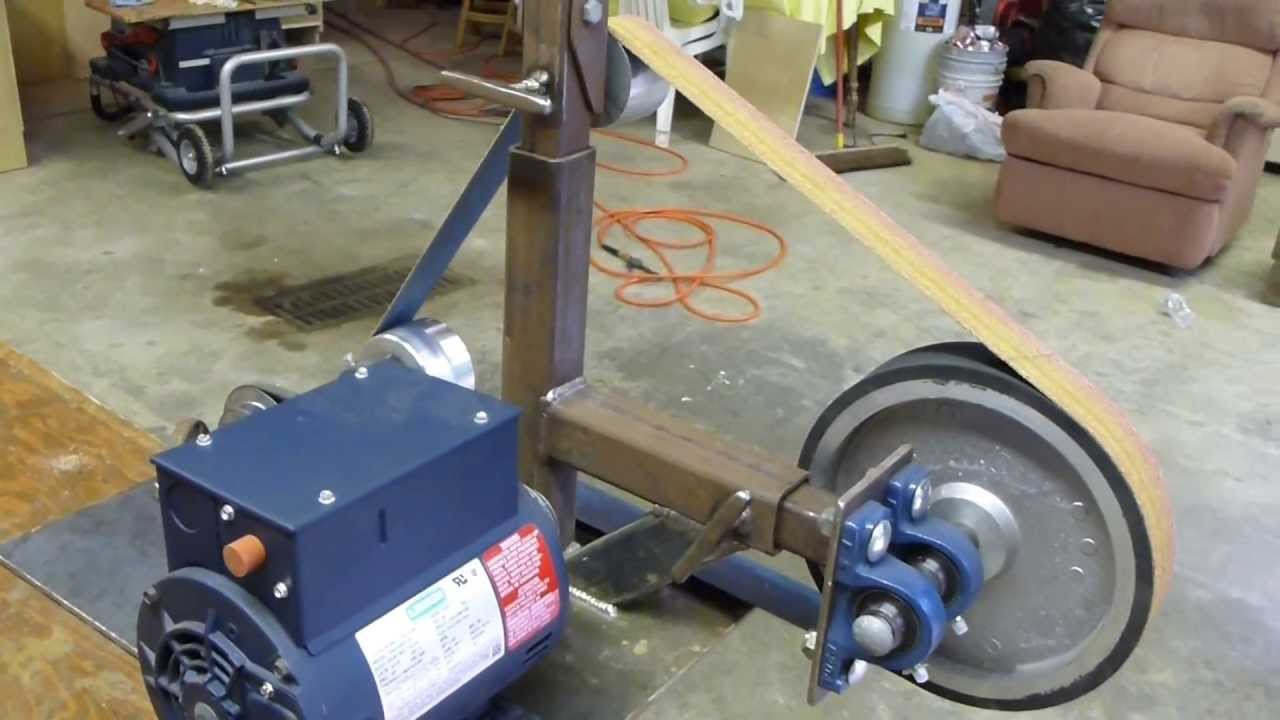
I also have a question on how the wheels are attached? Especially the drive wheel?
The drive wheel is just a solid aluminum rod with a 5/8" (or 3/4") diameter hole for the shaft to slide thru. There are set screws that allow the wheel to be tighten to shaft to prevent slipping. Most drive wheels also have a keyway to match keyway in shaft.
That grinder shown is using a Grizzly 10" contact wheel, and a solid shaft bolted solid to wheel and using pillow bearings to support. From the position of motor, it looks like it's using a belt assembly driving a shaft to pillow bearings also. That's how I did my first grinder, but I MUCH prefer the 56C motor mount for direct mounting with drive wheel mounted to motor shaft. google 56C motor mounting and you'll see a lot of info there.
Ken H>
That grinder shown is using a Grizzly 10" contact wheel, and a solid shaft bolted solid to wheel and using pillow bearings to support. From the position of motor, it looks like it's using a belt assembly driving a shaft to pillow bearings also. That's how I did my first grinder, but I MUCH prefer the 56C motor mount for direct mounting with drive wheel mounted to motor shaft. google 56C motor mounting and you'll see a lot of info there.
Ken H>
- Joined
- Dec 24, 2014
- Messages
- 1,598
The drive wheel is just a solid aluminum rod with a 5/8" (or 3/4") diameter hole for the shaft to slide thru. There are set screws that allow the wheel to be tighten to shaft to prevent slipping. Most drive wheels also have a keyway to match keyway in shaft.
That grinder shown is using a Grizzly 10" contact wheel, and a solid shaft bolted solid to wheel and using pillow bearings to support. From the position of motor, it looks like it's using a belt assembly driving a shaft to pillow bearings also. That's how I did my first grinder, but I MUCH prefer the 56C motor mount for direct mounting with drive wheel mounted to motor shaft. google 56C motor mounting and you'll see a lot of info there.
Ken H>
Thanks yes I will be going with a direct drive also. But this frame design is what I'm going for. I hope to be purchasing the motor and vfd within the next week or so.
Take a plate something like this one on ebay: http://www.ebay.com/itm/331288525277 and weld it to the frame for direct drive. I think he's a bit expensive on this plate, but it's a decent example.
- Joined
- Oct 17, 2007
- Messages
- 4,288
I dont remember where I saw it but another guys design didn't have that second arm on the top. Made it look extremely simplistic compared to most designs, but still very sturdy and durable.. Know anything about that?
This may have been it
I also have a question on how the wheels are attached? Especially the drive wheel?
I believe the maker of that particular grinder put a heavy compression spring in the bottom of that socket so that it pushes the tracking arm straight up and gives the required tension. As for the drive wheel, it appears that he used a set up similar to the KMG: a short shaft with the drive wheel on one end, some pillow block bearings, and then a step pulley. If you're going with a VFD, then just mount your drive wheel directly to the motor shaft.
The tracking wheel is probably just bolted to that pivoting flange (or he may have welded some all thread to the flange).
The contact wheel is a grizzly knife grinder wheel, so it doesn't have bearings, just a through hole. Because of that, it appears he used an appropriately sized bolt and just ran it through some pillow blocks. Another option would have been to bore it out for some sealed bearings.
However you mount your wheels, make sure you use some bushings and not just flat washers so that when you tighten your nuts your not compressing the sides of the bearings and their seals. The bushings will put the force on the inner races instead.
- Joined
- Dec 24, 2014
- Messages
- 1,598
I believe the maker of that particular grinder put a heavy compression spring in the bottom of that socket so that it pushes the tracking arm straight up and gives the required tension. As for the drive wheel, it appears that he used a set up similar to the KMG: a short shaft with the drive wheel on one end, some pillow block bearings, and then a step pulley. If you're going with a VFD, then just mount your drive wheel directly to the motor shaft.
The tracking wheel is probably just bolted to that pivoting flange (or he may have welded some all thread to the flange).
The contact wheel is a grizzly knife grinder wheel, so it doesn't have bearings, just a through hole. Because of that, it appears he used an appropriately sized bolt and just ran it through some pillow blocks. Another option would have been to bore it out for some sealed bearings.
However you mount your wheels, make sure you use some bushings and not just flat washers so that when you tighten your nuts your not compressing the sides of the bearings and their seals. The bushings will put the force on the inner races instead.
A lot of great info guys. But just curious. What would that mount plate be used for? I don't understand why it needs to be mounted with that. Doesnt the 56c motor have a mount on the bbottom?
You could certainly use mounting feed to mount a motor direct drive and it wouldn't need to be a 56C frame. The use of a 56C frame is to allow the use of a mounting plate such as the one linked. This mounting plate would be welded to the grinder frame to provide a very rigid mount for the motor, BUT that does required the plate to be lined up with no room for error. Using a motor with mounting feet (would not need to be 56C frame) would allow bolting motor base direct to the grinder frame mounting plate. Then if motor wasn't aligned exact, the motor could be tweaked a bit to allow correct alignment. I think a motor with mounting feet/base would work just fine - and maybe even better than a 56C motor because it would allow adjusting the motor alignment after installation. The motor base would require bolting so it wouldn't slip any during use - perhaps with a stop screw?
Ken H>
Ken H>
- Joined
- Dec 24, 2014
- Messages
- 1,598
You could certainly use mounting feed to mount a motor direct drive and it wouldn't need to be a 56C frame. The use of a 56C frame is to allow the use of a mounting plate such as the one linked. This mounting plate would be welded to the grinder frame to provide a very rigid mount for the motor, BUT that does required the plate to be lined up with no room for error. Using a motor with mounting feet (would not need to be 56C frame) would allow bolting motor base direct to the grinder frame mounting plate. Then if motor wasn't aligned exact, the motor could be tweaked a bit to allow correct alignment. I think a motor with mounting feet/base would work just fine - and maybe even better than a 56C motor because it would allow adjusting the motor alignment after installation. The motor base would require bolting so it wouldn't slip any during use - perhaps with a stop screw?
Ken H>
Interesting. So would it cheaper to get one that is not a 56C?